
Aisling Larkin, Varanasi, India
Unexpected Companionship in Varanasi

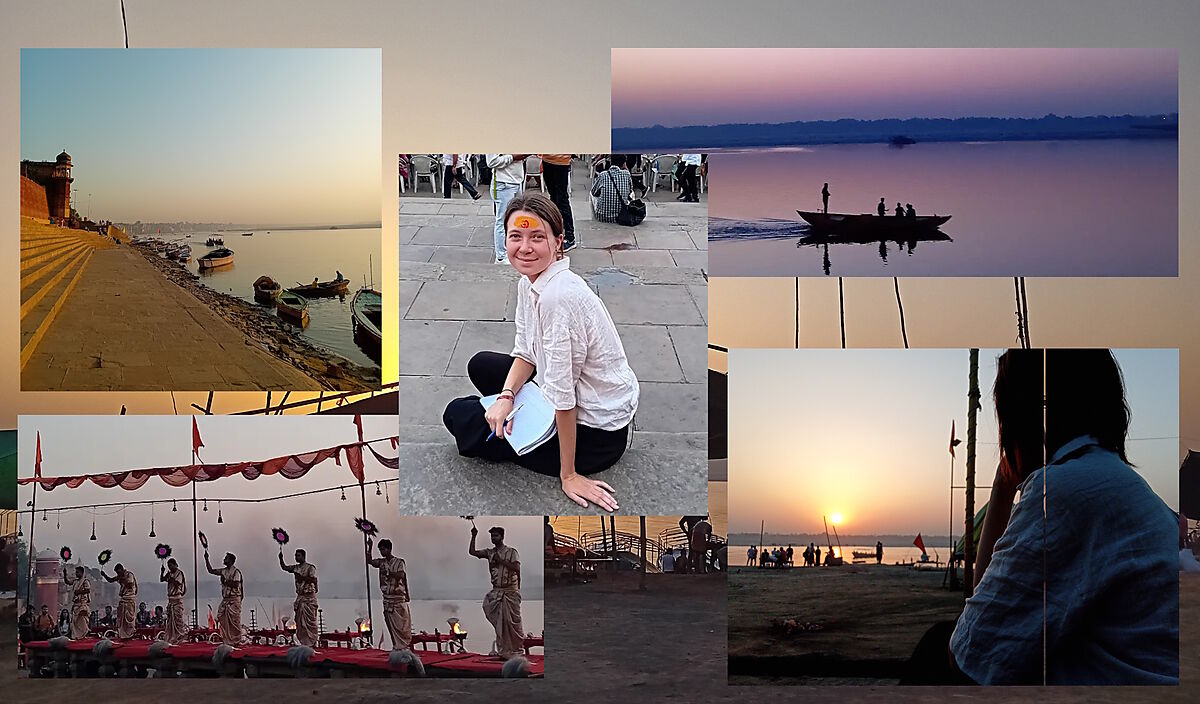
Early morning in Varanasi, I emerge from the shadowed labyrinthine streets of the old city onto the wide expanse of the ghats, ancient riverfront steps that cascade gracefully to the Ganges. Pale pink stone worn smooth by pilgrims, now muted grey under the vast canvas of an inky blue pre-dawn sky, and I feel as if I have escaped from the tight embrace of claustrophobic streets, of tangled webs of electrical wire and sleeping dogs, to finally draw breath.
In India, things are never as quiet as they may first appear. If the old city is the constantly beating heart of Varanasi, then the River Ganges is its indefatigable artery. Mussy haired boat builders brush their teeth whilst surveying the skeletal hulks of their handiwork; devotees in vibrant saris and dhotis bathe at the water's edge. The river shimmers like a sheet of beaten silver, stirring with the occasional silent ripple of a longboat, heaving fishermen casting black silhouettes on the water.
I reach Assi Ghat for the morning Aarti, a prayerful ceremony of light and music to worship the goddess Ganga, just as the sun appears ruby red on the eastern sky, a burnt orange fading into a spectrum of watery yellows and pinks, casting luminous streaks of colour across the river, washing over the city roofs.
Arriving in Varanasi completed months of solo travel, and although I am well used to my own company, amidst the sea of joyful faces I am struck by a sudden chord of loneliness. As I sit on a wall feeling rather removed, I hear a friendly greeting and look into the earnest face of a man in his early twenties. He says he is from a neighbouring village who wants to meet new people and rapidly asks whether I would like to walk and talk with him. Inexplicably I find myself accepting.
He tells me about his grandfather, the original storyteller, who taught him stories of Lord Shiva and Brahma; I tell him about my grandfather in turn, a musical orator in his own right, and there is a connection through our shared humanity. We talk about everything and nothing, from religion and our contrasting upbringing to the most embarrassing love-life stories. We spend the stifling afternoon hours idling in Blue Lassi, a one-roomed shop nestled in an overcrowded street where cool velvety lassi (yoghurt) is served fresh in earthenware pots.
As night draws in, we head back to the ghats for the sunset Aarti, an ancient fire ritual bringing light to darkness. The crowd slowly swells with locals, tourists, and shouting hawkers, the atmosphere chaotic yet intimate. As the deep rhythm of the Sanskrit shlokas picks up, my earlier melancholic voice is all but forgotten as I too transition from darkness to light, basking in the warm glow of unexpected companionship. Later, as we merge with a turbulent departing crowd, surging back through the streets in search of a sharing plate of steaming late-night tamatar chaat, I feel profoundly content.