
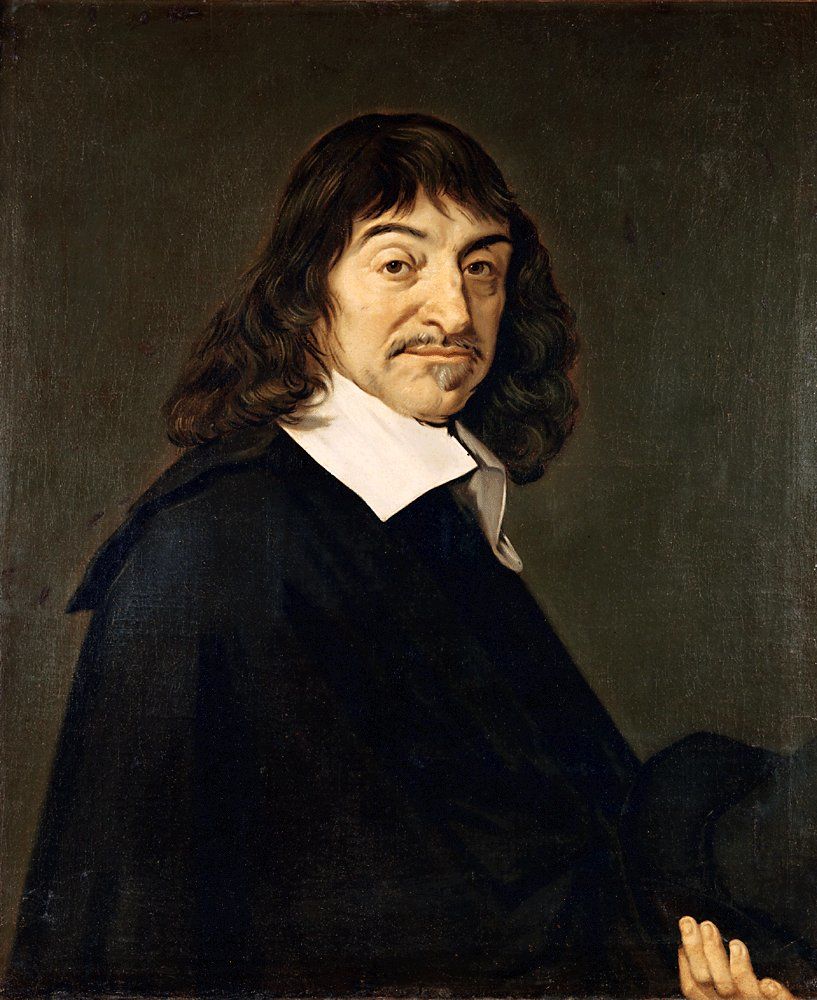
Portrait of René Descartes
René Descartes(1596-1650)

René Descartes (1596–1650) was a French philosopher and scientist, generally regarded as the father of modern Western philosophy. He was born in central France to Joachim Descartes, a lawyer; and Jeanne Brochard, who died one year after his birth. From age 11 to 18 he studied mathematics and philosophy, amongst other subjects, at the prestigious Jesuit College Henri IV at La Flèche. Later on, he reflected in Discourse on the Method (1637) (a philosophical and autobiographical treatise on how humans acquire knowledge) that his schooling left him with more doubts than certainties.
After receiving a law degree from the University of Poitiers in 1618, he joined the army of Prince Maurice of Nassau in Holland, designing structures and machines of war. There he met the influential philosopher Isaac Beeckman, who sparked his interest in mathematics and physics, and composed a short treatise on music, the Compendium Musicae (1618). His most important works, however, are his writings on philosophy and science: Meditations on First Philosophy (1641), Principles of Philosophy (1644) and The Passions of the Soul (1649). The scientists Isaac Newton and Gottfried Leibniz were both influenced by his ideas: the former in his analysis of motion; the latter in his work on metaphysics and almost every other detail.
Descartes also produced influential work in mathematics, most notably the Cartesian coordinate system, which appeared in the appendices of Discourse.
In 1649, Descartes moved to Sweden to privately tutor the 23-year-old Queen Christina but died of pneumonia the following year at the age of 53. His birthplace, La Haye en Touraine, was renamed to Descartes in his honour in 1802.
After receiving a law degree from the University of Poitiers in 1618, he joined the army of Prince Maurice of Nassau in Holland, designing structures and machines of war. There he met the influential philosopher Isaac Beeckman, who sparked his interest in mathematics and physics, and composed a short treatise on music, the Compendium Musicae (1618). His most important works, however, are his writings on philosophy and science: Meditations on First Philosophy (1641), Principles of Philosophy (1644) and The Passions of the Soul (1649). The scientists Isaac Newton and Gottfried Leibniz were both influenced by his ideas: the former in his analysis of motion; the latter in his work on metaphysics and almost every other detail.
Descartes also produced influential work in mathematics, most notably the Cartesian coordinate system, which appeared in the appendices of Discourse.
In 1649, Descartes moved to Sweden to privately tutor the 23-year-old Queen Christina but died of pneumonia the following year at the age of 53. His birthplace, La Haye en Touraine, was renamed to Descartes in his honour in 1802.