
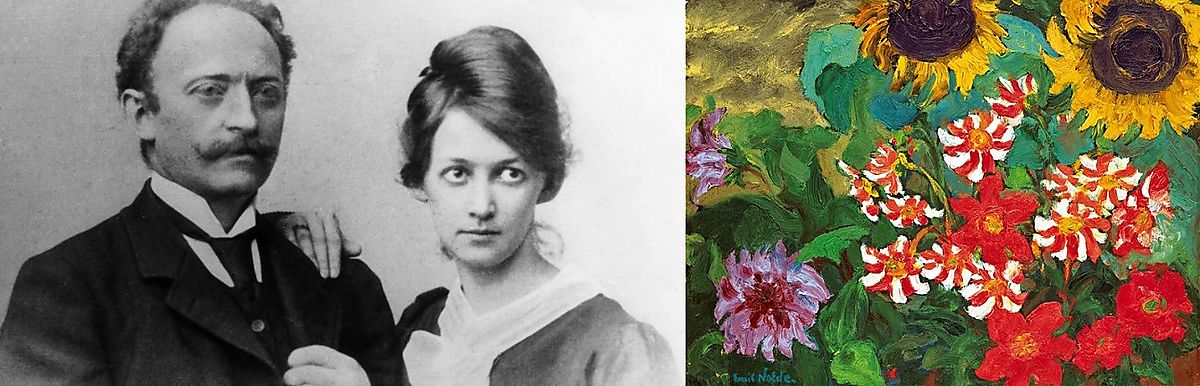
Emil Nolde, Ada Vilstrup and Dahlien und Sonnenblumen
Emil Nolde(1867-1956)
On 7 August 1867, Emil Hansen was born in Nolde, a village near the German-Danish border. He later adopted the name of his birthplace. After working as an apprentice woodcarver and painter, Nolde moved to Munich in 1898, at the age of 31, to pursue his artistic ambitions. When his application to the Munich Academy of Arts was rejected, he started studying with well-known artists Friedrich Fehr and later Adolf Hölzel. A year later, he moved to Paris to attend the private art school Académie Julian.1
In 1902, Nolde married Danish actress Ada Vilstrup and the couple moved to Berlin, where they live in poverty as success eluded Nolde. Between 1906 and 1909, colour gains importance in his oil paintings.2 In 1908, Nolde became a member of the prestigious artists group Berliner Sezession from which he was excluded two years later after a disagreement with its president. The years thereafter are marked with considerable success, with exhibitions in various cities.
In 1927, the couple built a studio in Seebüll; they moved there permanently after Nolde’s studio in Berlin was bombed in 1944. They planted a flower garden—represented in paintings such as Dahlien und Sonnenblumen (1928).
Despite being an early Nazi-party member, he fell out of favour in 1937, labelled a ‘degenerate’ artist. After his wife’s death in 1946, Nolde married Jolanthe Erdmann, who at 26 was 54 years his junior.
Nolde received many awards in the postwar years, including the Grand Prize at the 26th Venice Biennale (1952).
Emil Nolde died in Seebüll on 13 April 1956. The Nolde Foundation was founded in the city to safeguard his estate.3
In 1902, Nolde married Danish actress Ada Vilstrup and the couple moved to Berlin, where they live in poverty as success eluded Nolde. Between 1906 and 1909, colour gains importance in his oil paintings.2 In 1908, Nolde became a member of the prestigious artists group Berliner Sezession from which he was excluded two years later after a disagreement with its president. The years thereafter are marked with considerable success, with exhibitions in various cities.
In 1927, the couple built a studio in Seebüll; they moved there permanently after Nolde’s studio in Berlin was bombed in 1944. They planted a flower garden—represented in paintings such as Dahlien und Sonnenblumen (1928).
Despite being an early Nazi-party member, he fell out of favour in 1937, labelled a ‘degenerate’ artist. After his wife’s death in 1946, Nolde married Jolanthe Erdmann, who at 26 was 54 years his junior.
Nolde received many awards in the postwar years, including the Grand Prize at the 26th Venice Biennale (1952).
Emil Nolde died in Seebüll on 13 April 1956. The Nolde Foundation was founded in the city to safeguard his estate.3
References
- Serge Sabarsky. Emil Nolde. Watercolors and Graphic. Tutte Druckerei Salzweg bei Passau. 1998. 19-23
- Magdalena M. Moeller. Nolde. Der Maler. Hirmer Verlag. 2016. 206-212
- Serge Sabarsky. Emil Nolde. Watercolors and Graphic. Tutte Druckerei Salzweg bei Passau. 1998. 19-23