
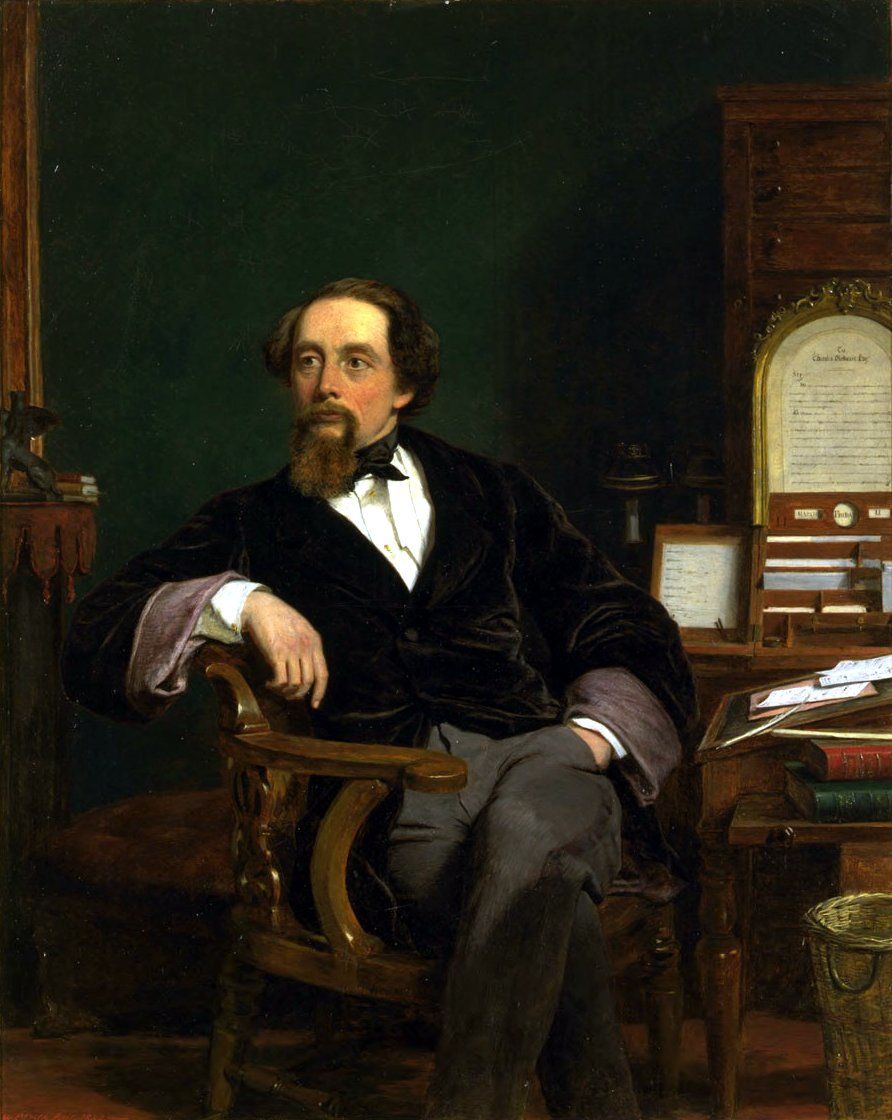
Charles Dickens in his Study
Charles Dickens(1812-1870)
Charles Dickens was an English writer. He created some of the world's best-known fictional characters and is regarded by many as the greatest novelist of the Victorian era.
Born in Portsmouth, Dickens left school to work in a factory when his father was incarcerated in a debtors' prison. Despite his lack of formal education, he wrote 15 novels, five novellas and hundreds of short stories and non-fiction articles. Dickens also campaigned vigorously for social reforms.
Dickens's literary success began with the serial publication of The Pickwick Papers (1836) and is now regarded as the literary colossus of his age. His novella, A Christmas Carol (1843), continues to inspire adaptations in every artistic genre. Oliver Twist and Great Expectations are also frequently adapted, and, like many of his novels, evoke images of early Victorian London. His plots were carefully constructed, and he often wove elements from topical events into his narratives.
Dickens has been praised by fellow writers, including Leo Tolstoy and George Orwell, for his unique characterisations and social criticism. Others, such as Oscar Wilde and Virginia Woolf, complained of a lack of psychological depth and a vein of sentimentalism.
The term Dickensian is used to describe something that is reminiscent of Dickens and his writings, such as poor social conditions or comically repulsive characters.
Born in Portsmouth, Dickens left school to work in a factory when his father was incarcerated in a debtors' prison. Despite his lack of formal education, he wrote 15 novels, five novellas and hundreds of short stories and non-fiction articles. Dickens also campaigned vigorously for social reforms.
Dickens's literary success began with the serial publication of The Pickwick Papers (1836) and is now regarded as the literary colossus of his age. His novella, A Christmas Carol (1843), continues to inspire adaptations in every artistic genre. Oliver Twist and Great Expectations are also frequently adapted, and, like many of his novels, evoke images of early Victorian London. His plots were carefully constructed, and he often wove elements from topical events into his narratives.
Dickens has been praised by fellow writers, including Leo Tolstoy and George Orwell, for his unique characterisations and social criticism. Others, such as Oscar Wilde and Virginia Woolf, complained of a lack of psychological depth and a vein of sentimentalism.
The term Dickensian is used to describe something that is reminiscent of Dickens and his writings, such as poor social conditions or comically repulsive characters.
Charles Dickens adapted from Wikipedia and licensed by The Cultural Me under CC BY SA 3.0