
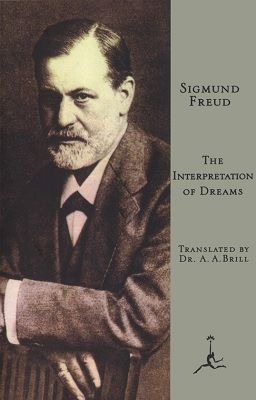
Book cover: The Interpretation of Dreams
The Interpretation of Dreams
Artists
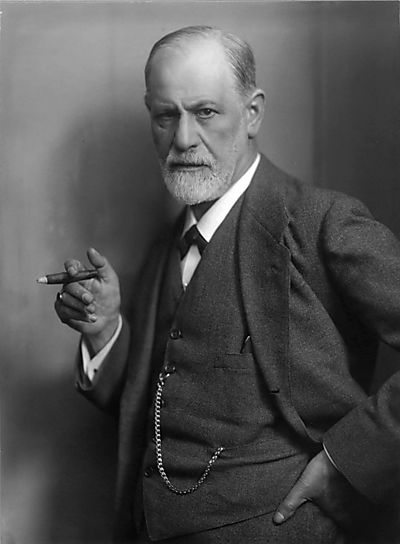
The Interpretation of Dreams was one of Sigmund Freud’s best known published works. It set the stage for his psychoanalytic work.
Freud began to analyze dreams after finding, during therapy, that many of his patients mentioned experiences that related to dreams. Freud believed that dreams were messages from the unconscious masked as wishes and provided access to one’s deepest thoughts.
In order to remain in a state of sleep, the unconscious mind filtered negative thoughts, representing them in an edited form in an effort to deal with conflict.
Freud defined four stages in the conversion of dreams from unconscious thoughts to that which can be remembered.
Ideas first go through a process of condensation that takes thoughts and turns them into a single image. Then, the true emotional meaning of the dream loses its significance in an element of displacement. This is followed by symbolism, representing our latent thoughts in a visual format.
Freud emphasised the importance of symbolism in the interpretation of dreams. The objects of dreams were thought to be highly symbolic with underlying meaning, with many of the objects having sexual connotations. For example, poles and monuments represent the penis, while caves and bottles represent the vagina. Freud believed all human behavior originated from sexual drives and desires.
In the last stage of secondary revision, dreams are made sensible suitable for narration. This is what the subject remembers when they awake.
Freud began to analyze dreams after finding, during therapy, that many of his patients mentioned experiences that related to dreams. Freud believed that dreams were messages from the unconscious masked as wishes and provided access to one’s deepest thoughts.
In order to remain in a state of sleep, the unconscious mind filtered negative thoughts, representing them in an edited form in an effort to deal with conflict.
Freud defined four stages in the conversion of dreams from unconscious thoughts to that which can be remembered.
Ideas first go through a process of condensation that takes thoughts and turns them into a single image. Then, the true emotional meaning of the dream loses its significance in an element of displacement. This is followed by symbolism, representing our latent thoughts in a visual format.
Freud emphasised the importance of symbolism in the interpretation of dreams. The objects of dreams were thought to be highly symbolic with underlying meaning, with many of the objects having sexual connotations. For example, poles and monuments represent the penis, while caves and bottles represent the vagina. Freud believed all human behavior originated from sexual drives and desires.
In the last stage of secondary revision, dreams are made sensible suitable for narration. This is what the subject remembers when they awake.
The Interpretation of Dreams adapted from Wikipedia and licensed by The Cultural Me under CC BY SA 3.0