
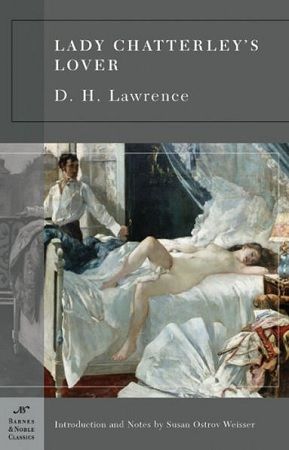
Front cover of Lady Chatterley's Lover
Lady Chatterley’s Lover
Artists
Lady Chatterley's Lover (1928) is a novel by D. H. Lawrence. The book gained notoriety for its story of the physical (and emotional) relationship between a working class man and an upper class woman, its explicit descriptions of sex, and its use of then-unprintable words.
An unexpurgated edition was not published openly in the United Kingdom until 1960, when it was the subject of a watershed obscenity trial against the publisher Penguin Books. Penguin won the case, and quickly sold 3 million copies. The book was also banned for obscenity in the United States, Canada, Australia, India and Japan.
The story is said to have originated from events in Lawrence's own unhappy domestic life, and the setting of Nottinghamshire, where he grew up. According to some critics, the fling of Lady Ottoline Morrell with "Tiger", a young stonemason who came to carve plinths for her garden statues, also influenced the story.
The novel has been published in three versions.
An unexpurgated edition was not published openly in the United Kingdom until 1960, when it was the subject of a watershed obscenity trial against the publisher Penguin Books. Penguin won the case, and quickly sold 3 million copies. The book was also banned for obscenity in the United States, Canada, Australia, India and Japan.
The story is said to have originated from events in Lawrence's own unhappy domestic life, and the setting of Nottinghamshire, where he grew up. According to some critics, the fling of Lady Ottoline Morrell with "Tiger", a young stonemason who came to carve plinths for her garden statues, also influenced the story.
The novel has been published in three versions.
Lady Chatterley’s Lover adapted from Wikipedia and licensed by The Cultural Me under CC BY SA 3.0