
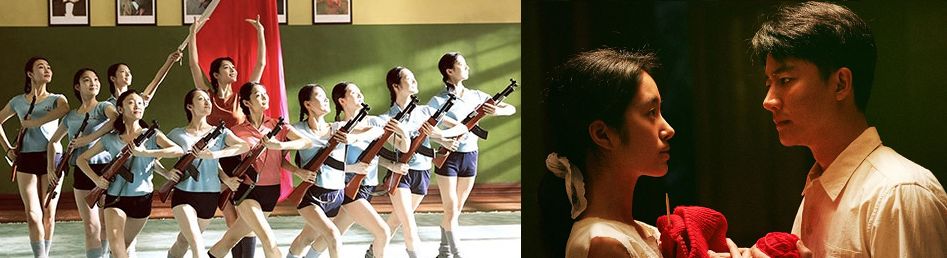
Stills from Youth (2017)
Xiaogang Feng’s Youth (2017)

Youth is well named. It captures the joy of adolescence whilst confronting the difficult transition to adulthood. It sounds like every other coming-of-age drama; it is not. The path it takes is much more rich and unconventional.
Set in China in the 1970s, the semi-autobiographical film tells the story of director Xiaogang Feng and writer Gelin Yan’s time as adolescent soldiers in a military art-troupe in the People’s Liberation Army. They are not shy when it comes to depicting life during the Cultural Revolution. With a distinctly anti-war tone and, occasionally, an anti-Maoist murmuring, it is remarkable this film made it through Chinese censorship. This leniency is a testament to Feng’s clever filmmaking, not the censors’ generosity. Though the historical setting makes it easy to identify the controversial Sino-Vietnamese War of 1979, Feng provides no explicit grounds for censorship. No opinions on the war are directly expressed, and the enemy are never named or shown onscreen, despite there being a seven minute, single-take battle scene. Feng subverts the censors with simple, emotional storytelling, allowing his protagonists’ pain to communicate the suffering of war, and the danger of confronting totalitarianism.
Youth feels urgent. It is a remarkable piece of art, each shot beautifully composed yet effortless, but its most important aspect is the perfectly balanced political boldness. Youth shows us that art in China is changing. While still subject to the censor, more and more filmmakers are daring to push the boundaries and the results are breathtaking.
Set in China in the 1970s, the semi-autobiographical film tells the story of director Xiaogang Feng and writer Gelin Yan’s time as adolescent soldiers in a military art-troupe in the People’s Liberation Army. They are not shy when it comes to depicting life during the Cultural Revolution. With a distinctly anti-war tone and, occasionally, an anti-Maoist murmuring, it is remarkable this film made it through Chinese censorship. This leniency is a testament to Feng’s clever filmmaking, not the censors’ generosity. Though the historical setting makes it easy to identify the controversial Sino-Vietnamese War of 1979, Feng provides no explicit grounds for censorship. No opinions on the war are directly expressed, and the enemy are never named or shown onscreen, despite there being a seven minute, single-take battle scene. Feng subverts the censors with simple, emotional storytelling, allowing his protagonists’ pain to communicate the suffering of war, and the danger of confronting totalitarianism.
Youth feels urgent. It is a remarkable piece of art, each shot beautifully composed yet effortless, but its most important aspect is the perfectly balanced political boldness. Youth shows us that art in China is changing. While still subject to the censor, more and more filmmakers are daring to push the boundaries and the results are breathtaking.