
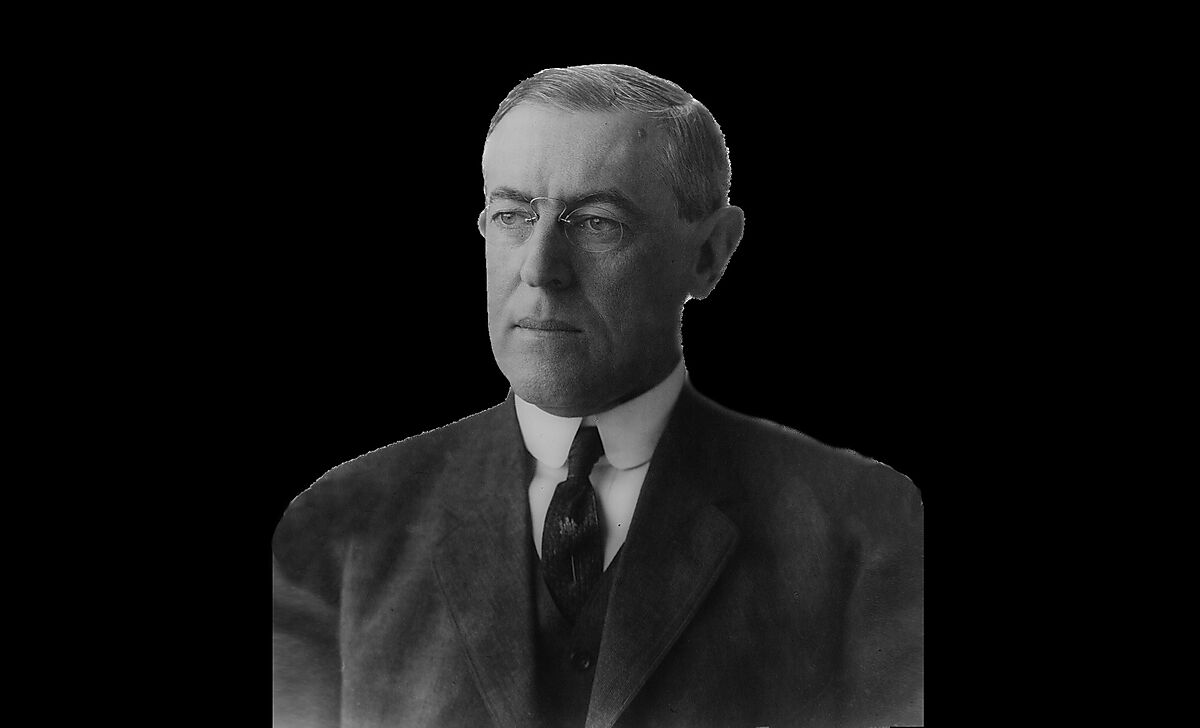
Woodrow Wilson
Woodrow Wilson’s European Legacy versus the Erosion of Goodwill Domestically
In December 1931 Poland’s wartime prime minister, Ignacy Padereci, unveiled a statue of US President Woodrow Wilson in a botanical garden in Poznań, Poland. The statue was erected in the presence of Wilson’s widow, Edith, and stood for a decade before being toppled by the Nazis. (A newer sculpture of Wilson was erected in its place in 1994.1) Padereci, in what was a personal mission, wanted to commemorate Wilson’s championing of an Independent Poland at the Paris Peace Conference of 1918. The veneration of Wilson in Poland (and many other European cities, which includes a Wetherspoons pub named after him in Carlisle, England) has continued with the unveiling of a plaque on 15 May 2018 on Wilson Square in Warsaw’s northern district of Żoliborz.2 In the United States, in 1948 Princeton University named the School for Public and International Affairs in Wilson’s honour; he had graduated from and been the 13th president of the university.
Woodrow Wilson was the 28th president of the United States, serving from 1913 to 1921. Domestically he is best known for the Federal Reserve Act (1913), which created the Central Bank of America; the Federal Trade Commission Act (1914), which established a regulator of unfair trade; and the Adamson Act (1916), which established an eight-hour workday for railroad workers — all of which are in place to the present day.
In Europe during his tenure war was brewing. On 2 April 1917, Wilson asked a joint session of Congress for a declaration of war against Germany.3 Although initially favouring neutrality Wilson was persuaded, amongst other factors, by the sinking of the British liner Lusitania with the loss of 128 American lives. The Allied victory would come on 11 November 1918, but earlier that year, on 18 January 1918, Wilson had delivered his Fourteen Points Speech to Congress outlining preventive measures to avoid another world war. Wilson called for a reduction in armaments, an end to secret treaties between nations, and for colonial powers to reconsider their claims to certain lands. Very few of these points were adopted in the punitive Versailles Treaty of 1919 — which demanded Germany bear responsibility for the war, alongside harsh reparations (compensation for the costs of the war).
However, Wilson’s vision of an organisation to resolve international conflicts was achieved with the formation of the League of Nations (to be headquartered in Geneva, Switzerland) on 10 January 1920. Yet, despite Wilson’s vigorous advocacy until his death in 1924, the US Senate remained opposed to US involvement in the league and it never became a member. Two decades and a half later, after the world had witnessed the horrors of WW2, on 24 October 1945 a new organisation with a broader mandate, the United Nations (UN), was established. The UN sought to address the shortcomings of Wilson’s League of Nations, but nevertheless owes its very existence to its precursor. In 2000, Wilson’s momentous time in office earned him a ranking of 6 (out of 46 presidents) by prominent historians.
However, this had plummeted to 13 by 2021.4 A year earlier, at Princeton University his name had been removed from the school of Politics and International Relations. The reconsideration of Wilson’s legacy coincides with the renewed focus on race relations in the United States. In Gallup polling to determine the most important issues for Americans, race rarely showed any ‘significant percentages’ across much of the 21st Century. 5 By 2020 that percentage had shot up to double figures.
What do we know about Wilson’s attitude towards race? Wilson was born in 1856 in the southern state of Virginia. His father was a Presbyterian minister who served as chaplain to the Confederate army during the American Civil War (1861–65). Wilson would have been a young boy in the Reconstruction Period that followed (1865–77), during which attempts were made to redress the injustices suffered by the black population during slavery; this push towards egalitarianism was largely led by radicals of the Republican party. Wilson’s election to the Presidency was significant in that he was the first Democratic candidate to win the black vote6; the black community had previously mainly voted Republican after gaining voting rights in 1869.
It is popularly known that in 1915, Wilson screened the film The Birth of a Nation (1915) at the White House. The film used racist stereotypes to portray blacks and was supportive of the Ku Klux Klan (KKK), a violent white supremacist organisation. Wilson is said to have expressed admiration for the film, saying that it was ‘history written with lightning’.7 However, this could well have been admiration for the technical innovations of the film, of which there were many. With regard to the KKK, Wilson says in his book A History of the American People (1902) that the whites ‘were roused by a mere instinct of self-preservation [...] until at last there had sprung into existence a great Ku Klux Klan, a veritable empire of the South, to protect the southern country’.8 There was no shortage of criticism for the Klan either, as Wilson described how they brought ‘a reign of terror’ through their ‘brutal crimes’ in which ‘the innocent suffered with the guilty’.9 He is also often quoted on his disparaging remark, ‘in the villages the negroes were the office holders, men who knew none of the uses of authority, except its insolences’10 Wilson’s views here are on the mismanagement of the railways during the Reconstruction period of which he was extremely critical.
Despite the possibility that Wilson’s views on race are often taken out of context, some of his legislative actions as President caused undeniable, lasting damage to African-Americans.
During his presidency, Wilson oversaw the resegregation of the Federal workforce, effected on 11 April 1913. This was one of the few public sectors in which blacks had enjoyed equality following the Civil Rights Act of 186611, with both the Post Office and the Treasury employing sizable numbers of black workers. The ramifications of this policy are still felt today, with the Quarterly Journal of Economics finding that Wilson's segregation of the civil service widened the black-white earnings gap by 3.4–6.9 percentage points.12 In short, Wilson’s racially motivated policies caused economic inequality still felt in contemporary America.
This betrayal is at the root of the erosion in historical goodwill toward Wilson in his own country. In the United States 58% of the population now state that diversity makes their country a better place compared to other European nations who are more neutral on the issue13. The United States, therefore, finds itself unable to look beyond Wilson’s racism.
Across the Atlantic, the years of 1918–19 were described as a ‘Wilsonian Wave’ across Europe when he enjoyed a hero’s welcome in Italy and a royal dinner in Great Britain.14 Much of Europe still remains enamoured with the figure who came to be known as Europe’s man of peace.
Historical figures are often defined not by their actual decisions or the nuance of their beliefs, but rather summarised in broad strokes, with their busts and images attached to whichever movement deems them most useful. Wilson was a man of extraordinary contradiction; tirelessly advocating the vulnerable on a global scale, yet marred by a deep prejudice towards a large contingent of his own people. The relative weights placed on these two factors domestically and internationally explains why opinion on him differs so markedly.
References
- In Your Pocket. "Woodrow Wilson". In Your Pocket Essential City Guides. 2023
- US Mission Poland. "Ambassador Mosbacher and Mayor Unveil Plaque of President Woodrow Wilson". U.S Embassy & Consulate in Poland. 2019
- Office of the Historian. "U.S Entry into World War I, 1917". Foreign Service Institute
- C-SPAN. "‘2021 Presidential Historians Survey". National Cable Satellite Corporation. 2021
- Frank Newport. "Race Relations as the Nation’s Most Important Problem". Gallup. 2020
- Edgar. E Robinson. "The Presidential Vote 1896-1932". The American Academy of Political and Social Science. 177, no. 1. 1935. pp. ix–403. ix–403
- Mark E. Benbow. "Birth of a Quotation: Woodrow Wilson and “Like Writing History with Lightning”". The Journal of the Gilded Age and Progressive Era. 9, no. 4. 2010. pp.509–533. 509
- Woodrow Wilson. A History of the American People. New York: Harper and Brothers. 1901. p.57
- Woodrow Wilson. A History of the American People. New York: Harper and Brothers. 1901. p.64
- Woodrow Wilson. A History of the American People. New York: Harper and Brothers. 1901. p.49
- Library of Congress. "The African American Odyssey: A Quest for Full Citizenship. Reconstruction and Its Aftermath". Library of Congress
- Abhay Aneja, Quo Xu. "The Costs of Employment Segregation: Evidence From The Federal Government Under Woodrow Wilson". UC Berkeley. 2021
- Bruce Drake, Jacob Poushter. "In views of diversity, many Europeans are less positive than Americans". Pew Research Center. 2016
- Carl Bouchard. "The Wilsonian Moment". Digital Encyclopedia of European History. 2023

The figures of world leaders are erected in our streets and their names adorn our textbooks, but I wanted to take a different look at them. I’ve seen leaders of my own country and of others turn from revered to reviled within my own lifetime. Woodrow Wilson is a fascinating case-study of this phenomenon. I’ve always had a fascination with American Presidents — often ordinary, self-made men who can go on to be treated like royalty — and Woodrow Wilson is a key example of one who is loved in some places but hated elsewhere.— Paul Tomlinson