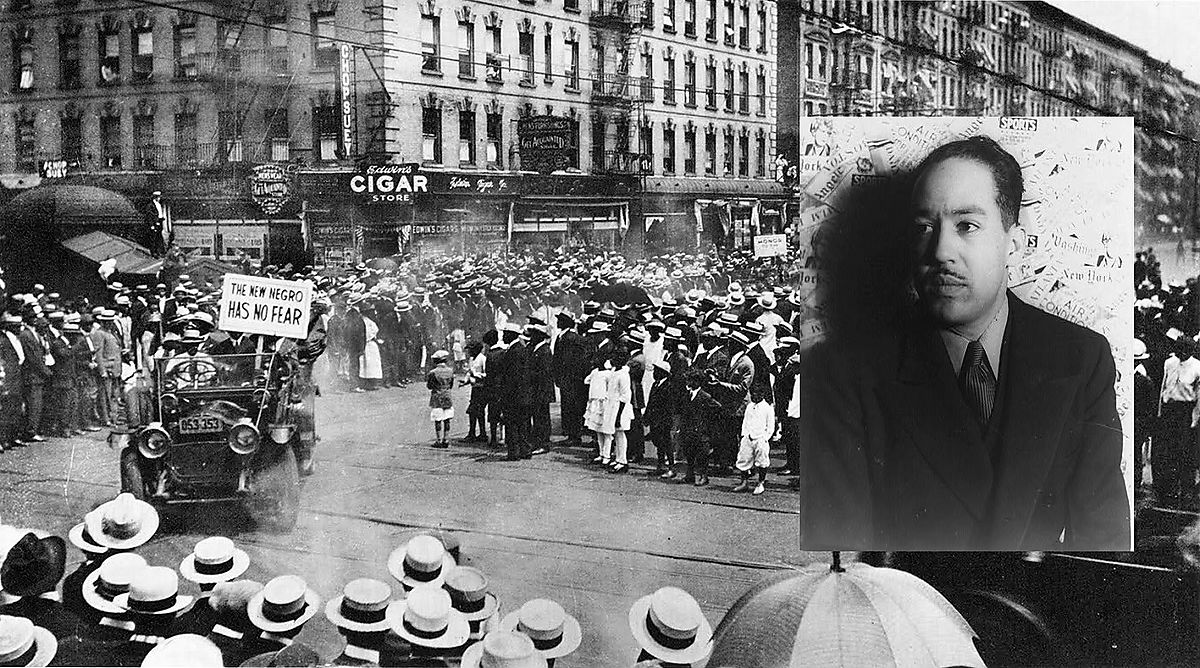
On 4 September 1921, 19-year-old Langston Hughes, overwhelmed by his desire to see Harlem, watched as New York rose out of the bay.
Having never been in a subway and conscious of his position of being ‘black in a white world’1, Hughes’ arrival into Harlem was unsurprisingly significant: ‘When I saw [135th street], I held my breath … Hundreds of colored people! I wanted to shake hands with them, speak to them … I went up the steps and out into the September sunlight. Harlem! I stood there, dropped my bags, took a deep breath and felt happy again.’2
He called 1920s Harlem ‘the period when the Negro was in vogue’3, describing the infiltration of African art, music, and literature into mainstream outlets. Some Harlemites claimed the race problem had been solved through art, as monied whites flocked to Harlem to be amongst the black artists in their stamping ground.
But this was a time when segregation was rife: unless a job was marked for black workers, he writes, ‘there was no use applying’4. Hughes felt the vogue of Harlem was making a spectacle of the black community. Whist card game parties, with their ‘awful bootleg whiskey and good fried fish’5, took place in crowded apartments, away from the prying eyes of white visitors. There, Hughes made literary connections with the ‘Negro intellectual’6 who was also drawn to Harlem. His poetry that followed, however, led to the label of ‘poet lowrate’ by black critics, as he failed to solely reflect the ‘beautiful’ of his race7.
Hughes, though, maintained his independence: ‘I was not Africa. I was Chicago and Kansas City and Broadway and Harlem.’8
Langston Hughes. The Big Sea: An Autobiography, in Collected Works Langston Hughes, Volume 13. University of Missouri Press. 1940. 94
Langston Hughes. The Big Sea: An Autobiography, in Collected Works Langston Hughes, Volume 13. University of Missouri Press. 1940. 83
Langston Hughes. The Big Sea: An Autobiography, in Collected Works Langston Hughes, Volume 13. University of Missouri Press. 1940. 178
Langston Hughes. The Big Sea: An Autobiography, in Collected Works Langston Hughes, Volume 13. University of Missouri Press. 1940. 86
Langston Hughes. The Big Sea: An Autobiography, in Collected Works Langston Hughes, Volume 13. University of Missouri Press. 1940. 179
Langston Hughes. The Big Sea: An Autobiography, in Collected Works Langston Hughes, Volume 13. University of Missouri Press. 1940. 186
Langston Hughes. The Big Sea: An Autobiography, in Collected Works Langston Hughes, Volume 13. University of Missouri Press. 1940. 203-204
Langston Hughes. The Big Sea: An Autobiography, in Collected Works Langston Hughes, Volume 13. University of Missouri Press. 1940. 243
Claire Woods
Birmingham
I developed an interest in the likes of Hughes and McKay whilst studying the Harlem Renaissance during my degree. I was inspired by how writers in the throes of segregation broke free of their moulds and incorporated colourful, cultural elements into poetry. A rich melting pot of the English written word was thereby formed, providing inspiration for future black artists.