
Weimar Republic
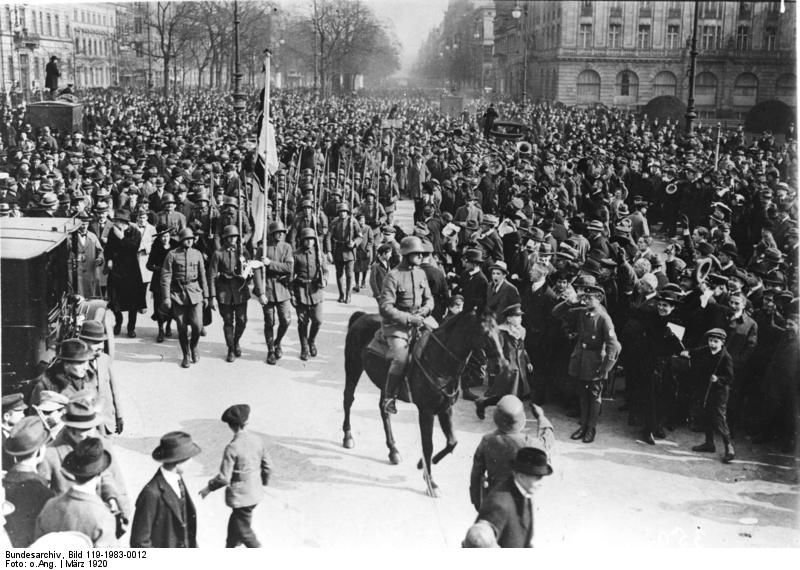
Entry of the naval brigade in Berlin, March 1920
The Weimar Republic is an unofficial historical designation for the German state from 1918 to 1933. The official name of the republic remained Deutsches Reich unchanged from 1871.
Germany became a republic in February 1919, following the earlier abdication of Kaiser Wilhelm II, when the position of President of Germany was created. A national assembly was convened in Weimar, where a new constitution for Germany was written and adopted on 11 August 1919, the city providing the unofficial name for the republic.
In its fourteen years, the Weimar Republic faced numerous problems, including hyperinflation, political extremism (with paramilitaries—both left- and right-wing) as well as contentious relationships with the victors of the First World War.
In 1933, Hindenburg appointed Adolf Hitler as Chancellor with the Nazi Party being part of a coalition government. Within months, Hitler's seizure of power brought the republic to an end – as democracy collapsed, the founding of a single-party state began the dictatorship of the Nazi era.
Germany became a republic in February 1919, following the earlier abdication of Kaiser Wilhelm II, when the position of President of Germany was created. A national assembly was convened in Weimar, where a new constitution for Germany was written and adopted on 11 August 1919, the city providing the unofficial name for the republic.
In its fourteen years, the Weimar Republic faced numerous problems, including hyperinflation, political extremism (with paramilitaries—both left- and right-wing) as well as contentious relationships with the victors of the First World War.
In 1933, Hindenburg appointed Adolf Hitler as Chancellor with the Nazi Party being part of a coalition government. Within months, Hitler's seizure of power brought the republic to an end – as democracy collapsed, the founding of a single-party state began the dictatorship of the Nazi era.
Weimar Republic adapted from Wikipedia and licensed by The Cultural Me under CC BY SA 3.0