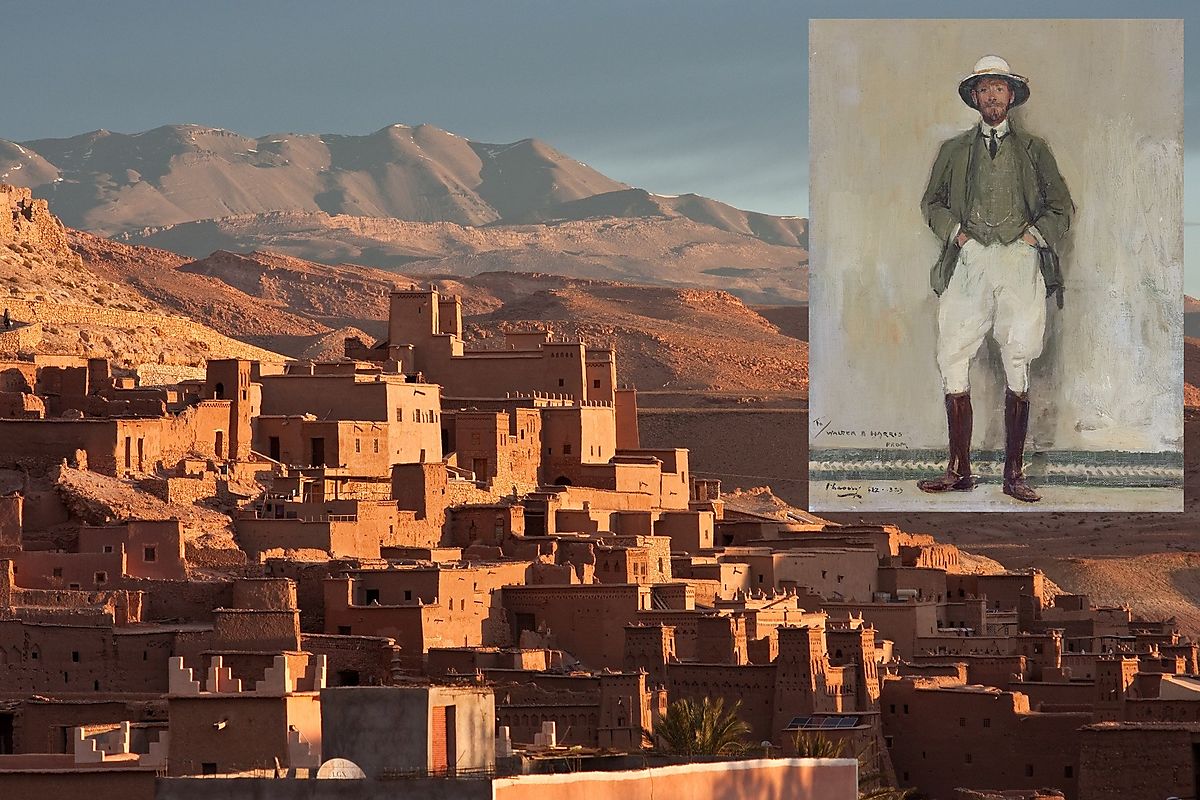
This work, ‘Walter Burton Harris and Morocco’, is a derivative of ‘Morocco Village’, ‘Walter Burton Harris’ used under CC BY. ‘Walter Burton Harris and Morocco’ is licensed under CC BY SA 4.0 by The Cultural Me
Walter Harris and the Amazigh: A Nineteenth Century Insight into Morocco
In September 1893, Walter Burton Harris, an English journalist and travel writer, left England for an audacious journey to North Africa. His lengthy description of the Berbers of Morocco in his travel narrative Tafilet (1895) is foundational in its ethnography of this indigenous people of North Africa.
Harris arrived in the port city of Safi in mid- October. After gathering a crew and necessities, he headed into the interior, towards the Atlas Mountains, with a layover in the former capital of Morocco—Marrakesh. Upon departing Marrakesh, Harris noticed a sharp distinction in the way the people dressed. To the best of his knowledge, he had now set foot in the land of the mountaineers, the land of the Berbers. Harris was astonished at how distinctive they were in relation to the Arabs: ‘While the [Arabs] wear the jelab, a hooded garment closed down the front, it is never found amongst the Berbers, whose one desire as to clothing seems to be absolute freedom of limb.’
Harris thought the Berbers were a subgroup of the Hamites1 (a defunct, Eurocentric classification). However, it is now known that these subgroups are independent branches of the broader Afro-Asiatic language family.
During his travels, Harris identified four Berber dialects, spoken in different parts of Morocco: Shelha, Riffia, Susia, and Drauia2. Harris observed that his servant, a Riffia speaker, could make himself comprehensible to speakers of the other dialects.
As for ‘Berber’, unable to trace its origins, Harris suggested it was a Roman term for those who did not speak Latin or Greek.3 However, the people that Harris called ‘Berber’ have always referred to themselves as the ‘Amazigh’—‘free’ or ‘noble man’.
Walter Harris. Tafilet: The Narrative of a Journey of Exploration in the Atlas Mountains and the Oases of the North-West Sahara. Edinbrugh and London: William Blackwood and Sons. 1895. 94
Walter Harris. Tafilet: The Narrative of a Journey of Exploration in the Atlas Mountains and the Oases of the North-West Sahara. Edinbrugh and London: William Blackwood and Sons. 1895. 100
Walter Harris. Tafilet: The Narrative of a Journey of Exploration in the Atlas Mountains and the Oases of the North-West Sahara. Edinbrugh and London: William Blackwood and Sons. 1895. 93-94
Nawfal Khmirau
Berlin, Germany
Living in Morocco’s capital, little did I know about the authenticity of the Amazigh culture aside from the stereotypical representations of urbanites. Being half Amazigh, and after travelling to remote Amazigh villages, I had the opportunity to gain a clearer insight, which contradicted every stereotype and prejudice I had known. The Amazigh people are still marginalised within Moroccan society.