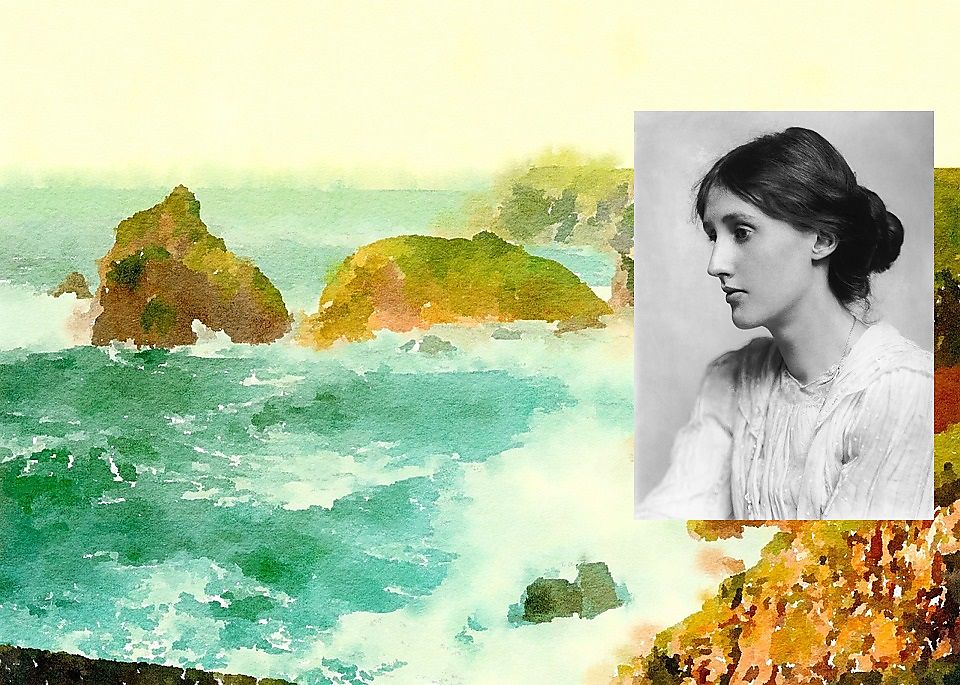
This work, ‘Virginia Woolf-Cornwall Sea Watercolour’, is a derivative of ‘Virginia Woolf in 1902’, ‘Watercolour’ used under CC BY. ‘Virginia Woolf-Cornwall Sea Watercolour’ is licensed under CC BY SA 4.0 by The Cultural Me
Virginia Woolf and the Novel as the Unconscious and Intrinsic Experience of Life
Virginia Woolf marvelled at the beauty and fluidity of an ordinary day, describing the mind as receiving
a myriad of impressions — trivial, fantastic, evanescent, or engraved with the sharpness of steel.1
Similarly, she believed in the artistic freedom to base the literary novel on emotion over convention.
In her essay Modern Fiction she deals with this contradiction, the problematic concept of the novel, proposing that the writer is constrained by a tyrant who enforces a plethora of rules. Woolf explains that this metaphorical tyrant requires plot, love interest, tragedy, comedy and unfaltering probability. “Is life like this?”2 she ponders and then asks, “must novels be like this?”3
Woolf went on to breathe life into these theories when she wrote The Waves (1931). Of this work she famously told composer Ethel Smyth, “I am writing to a rhythm and not to a plot.”4 Comparing its structure to a piece of music, she sought to reimagine the definition of the novel itself.
Upon the original manuscript she scrawled notes to allude to this redefinition; claiming she would be glad if this piece was in fact not read as though it were a novel. Elsewhere, she rather charmingly pronounced it as a “playpoem”.5
The Waves follows the lives of six characters from childhood to adult life in a series of what she terms as “dramatic soliloquies”.6 Woolf speaks directly from inside each of the characters’ minds, narrating their thoughts and insights to the rhythm of the sea by which they live.
McNeille, Andrew, Ed. The Essays of Virginia Woolf. Volume 4. The Hogarth Press. 1984. 160
McNeille, Andrew, Ed. The Essays of Virginia Woolf. Volume 4. The Hogarth Press. 1984. 160
McNeille, Andrew, Ed. The Essays of Virginia Woolf. Volume 4. The Hogarth Press. 1984. 160
Woolf, Virginia. A Reflection of the other person: letters to Virginia Woolf, Vol 4. The Hogarth Press. 1974. 204
Anne Olivier Bell, Ed.. The Diary of Virginia Woolf Vol 3. Penguin. 1982. 203
Anne Olivier Bell, Ed.. The Diary of Virginia Woolf Vol 3. Penguin. 1982. 312
Gemma Campbell
London
I wanted to highlight the way in which Woolf often found the novel rigid by definition; she both praised and imagined novels that were less defined by rules. In Woolf’s most poetic piece The Waves, she sought to challenge and reinvent the concept of what a novel could be. In this work she aimed to conjure more authentically the unconscious and intrinsic experience of life and of being.