
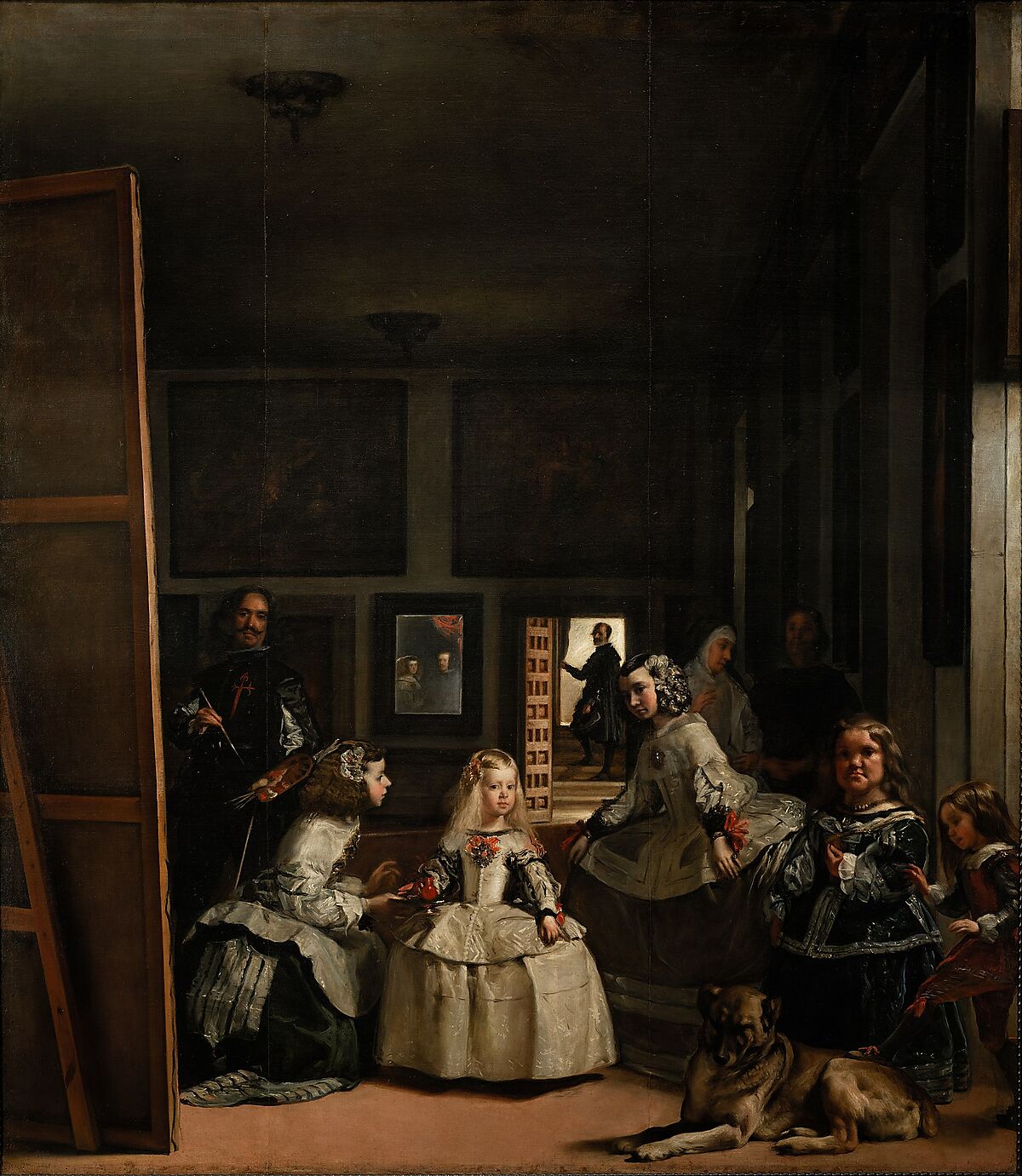
Las Meninas
Velázquez’s ‘Las Meninas’ (1656): An Insight into the Societal Status of the Early Modern Court Artist
Diego Velázquez’s painting Las Meninas (1656; ‘The Ladies in-Waiting’) depicts an intimate scene of life at the royal court of Philip IV of Spain. In the earliest inventories it was initially referred to as La Familia (‘The Family’).1
Velázquez himself is featured at his easel to the left of the composition. On his chest is the insignia of the Order of Santiago, a Spanish order of knights. Curiously, however, Velázquez was not admitted to the order until three years later, and it is speculated that Philip IV personally added the red cross of the insignia as a show of admiration for his court artist.2
Velázquez arrived at the royal court in Madrid in 1622 to take up his appointment as court painter to Philip IV. At the time that he painted Las Meninas, Velázquez had been serving Philip IV for thirty years. During this time, Velázquez had constructed an image of Philip in the dynastic tradition of his ancestors Charles V and Philip II, depicted Philip IV in the same austere black cloth that signalled his membership of the Hapsburg dynasty.
Charles V (1500–58) was the great-great-grandfather of Phillip IV and under his reign Hapsburg imperial power had reached its height. Charles had employed the great Italian Renaissance artist Titian (1488/90–1576) as court painter. Thus Velazaquez belonged to the distinguished tradition of court painters whose profession diverged from that of lowly artisan craftsmen working outside court circles in cities and towns, painting for commercial gain.
Velázquez’s role as court painter earned him not only artistic recognition but also granted him direct access to Philip IV. This privilege set him apart from other courtiers who vied for access and influence in the highly stratified atmosphere of the royal court.
In Las Meninas, Velázquez depicts himself with the keys of the Chamberlain of the Palace around his waist, a position which he was awarded in 1652. In this role Velázquez was responsible for overseeing the daily operations of the palace, including organising Philip IV’s personal travel and special court ceremonies involving the monarch.3 The notable detail of the keys in the painting draw attention to Velázquez’s privileged access to Philip IV and the monarch’s trust in him.
In the painting Velázquez is shown staring directly at the viewer; however, we quickly realise that he is in fact appraising the subject of his painting. This subject is none other than Philip IV, whom we see reflected in the mirror opposite. The portrayal of this direct eye contact with the monarch serves to underline Velázquez’s intimate relationship with Philip IV.
In the background of Las Meninas are two paintings, copies of works by the influential Flemish painter Peter Paul Rubens, Pallas and Arachne (1636–37) and Apollo and Pan (1636–38).4 These works, depicting scenes from the Roman poet Ovid’s Metamorphoses (8 CE), reflect the elevated themes from classical antiquity that often inspired Baroque art. The copies were executed by Juan Bautista del Mazo, Velázquez’s son-in-law. Rubens, like Velázquez, benefitted from Philip IV’s patronage, but he also worked at the court of the English monarch Charles I and for Marie de’ Medici, regent for the young Louis XIII of France.
Through careful symbolism in Las Meninas, Velezquez presents himself as a courtier whose craft commands respect. We observe his intimate relationship with Philip IV and his position of responsibility within the court. We are able to discern how Velázquez situates himself within the elite tradition of European court artists — those who trace their intellectual credentials to classical antiquity, thereby elevating their craft to the respectable pursuit of ideals.
In investigating the court environment around the time of the painting, we find that, before he could be knighted, Velázquez was required to prove to the Chapter of the Order that he had never performed a menial task, as an artisan craftsman, instead had painted only for the King or for his own pleasure — never for commercial gain.5 This reticence among members of the court to accept Velázquez’s knighthood may have been politically motivated, with courtiers fearing that Velázquez’s close access to the monarch could challenge the existing court hierarchy. It also suggests the lingering association of painting with manual labour.
Therefore, Velázquez’s self-promotion, the inclusion of his persona in the painting and the associated symbolism aimed at elevating his craft, arguably had deeper motives — whether as a work in anticipation of, or in response to, such disquiet. His eventual knighthood in 1659 stands as a testament to the success of Las Meninas. The painting emerges as both a declaration of his craft’s elevation to a liberal art and a clear indicator of the evolving status of the artist as an intellectual and courtly figure.
References
- Suzanne L. Stratton-Pruitt (ed.). Velázquez’s Las Meninas. Cambridge: Cambridge University Press. 2003. pp. 2-3
- José Lopez Rey and Odile Delenda. Velázquez: The Complete Works. Köln: Taschen. 2018. p.300
- Antonio Dominguez Ortiz, Alfonso E. Perez Sanche and Julian Gallego. Velázquez. New York: Metropolitan Museum of Art & Harry N. Abrams, Inc. 1989. p. 58
- José Lopez Rey and Odile Delenda. Velázquez: The Complete Works. Köln: Taschen. 2018. p.300
- Joseph-Émile Muller. Velázquez. London: Thames & Hudson Ltd. 1976. p. 232

This article stems from my interest in Diego Velázquez’s painting Las Meninas, a painting which blurs the boundaries between reality and illusion with its layered perspectives. It is also an interesting painting because, while it is an example of Velázquez’s technical mastery, it also provides a window into the environment of the Early Modern court more broadly.— Sally Holden