
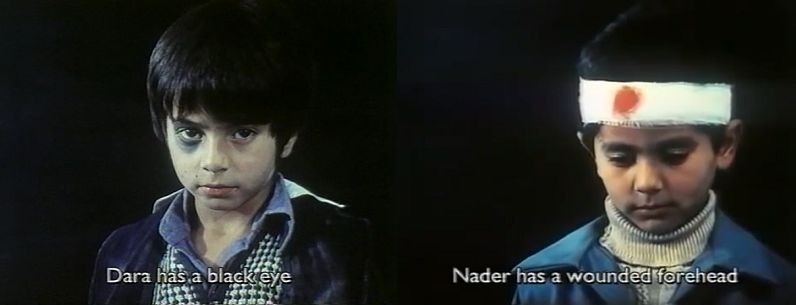
Stills from Two Solutions for One Problem
Two Solutions for One Problem – Abbas Kiarostami's Modern-Day Parable

While newcomers to Abbas Kiarostami’s films can be mystified by some of his more experimental works, his 4min 25s Two Solutions for One Problem (1975) is a testament to the Iranian director’s simple but idiosyncratic style. Kiarostami was commissioned to create the film by his employer, the Institute for the Intellectual Development of Children and Young Adults in Tehran, back when he did not consider himself a filmmaker. In what has been called a “deadpan, Bressonian restaging of one of Laurel and Hardy's epic grudge matches”1, Kiarostami offers the viewer two distinct outcomes for the same original predicament.
Kiarostami uses a minimalist classroom setting to show two friends, schoolboys Dara and Nader, caught up in an escalating war of retribution. After Dara returns a borrowed book to Nader with its cover torn, a physical tit for tat follows, culminating in a blackened eye and a wounded forehead. The resulting material damage is tabulated on a blackboard by an invisible hand while their enmity is tacitly expressed. We then witness an alternate reality: on receiving the book, Nader immediately repairs it. There is no violence and the boys remain friends.
Two Solutions for One Problem serves its didactic purpose exquisitely by adopting a formulaic yet relatable exploration of schoolboy behaviour. In addition, Kiarostami’s modest fable delivers a quietly profound message for larger conflicts. One is led to question whether there is any practicality or justice in “an eye for an eye”, or whether it would indeed leave the whole world blind.
Kiarostami uses a minimalist classroom setting to show two friends, schoolboys Dara and Nader, caught up in an escalating war of retribution. After Dara returns a borrowed book to Nader with its cover torn, a physical tit for tat follows, culminating in a blackened eye and a wounded forehead. The resulting material damage is tabulated on a blackboard by an invisible hand while their enmity is tacitly expressed. We then witness an alternate reality: on receiving the book, Nader immediately repairs it. There is no violence and the boys remain friends.
Two Solutions for One Problem serves its didactic purpose exquisitely by adopting a formulaic yet relatable exploration of schoolboy behaviour. In addition, Kiarostami’s modest fable delivers a quietly profound message for larger conflicts. One is led to question whether there is any practicality or justice in “an eye for an eye”, or whether it would indeed leave the whole world blind.