
Three-Decker Novel
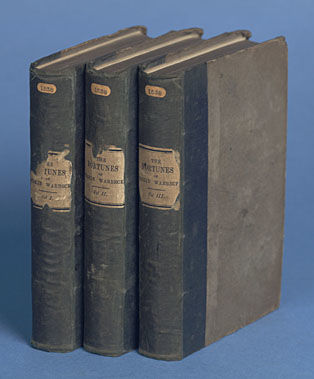
Mary Shelley The Fortunes of Perkin Warbeck
The Three-Decker or Triple Decker was a standard form of publishing for British fiction during the 19th century. It was a significant stage in the development of the modern novel as a form of popular literature in Western culture.
Three volume novels began to be produced by the Edinburgh-based publisher Archibald Constable in the early 19th century. Constable was one of the most significant publishers of the 1820s and made a success of publishing expensive, three-volume editions of the works of Walter Scott. This continued until Constable's company collapsed in 1826 with large debts, bankrupting both him and Scott.
As Constable's company collapsed, the publisher Henry Colburn quickly adopted the format. The number of three-volume novels he issued annually rose from six in 1825 to 30 in 1828 and 39 in 1829. Under Colburn's influence, the published novels adopted a standard format of three volumes in octavo, priced at 31 shillings and sixpence. The price and format remained unaltered for nearly 70 years, until 1894.
Three-volume novels quickly disappeared after 1894, when both Mudie's and W. H. Smith stopped purchasing them.
Three volume novels began to be produced by the Edinburgh-based publisher Archibald Constable in the early 19th century. Constable was one of the most significant publishers of the 1820s and made a success of publishing expensive, three-volume editions of the works of Walter Scott. This continued until Constable's company collapsed in 1826 with large debts, bankrupting both him and Scott.
As Constable's company collapsed, the publisher Henry Colburn quickly adopted the format. The number of three-volume novels he issued annually rose from six in 1825 to 30 in 1828 and 39 in 1829. Under Colburn's influence, the published novels adopted a standard format of three volumes in octavo, priced at 31 shillings and sixpence. The price and format remained unaltered for nearly 70 years, until 1894.
Three-volume novels quickly disappeared after 1894, when both Mudie's and W. H. Smith stopped purchasing them.
Three-volume novel adapted from Wikipedia and licensed by The Cultural Me under CC BY SA 3.0