
Visiting Italy; Deepa Srivastava
The Unspoken Lives of Italian Piazzas

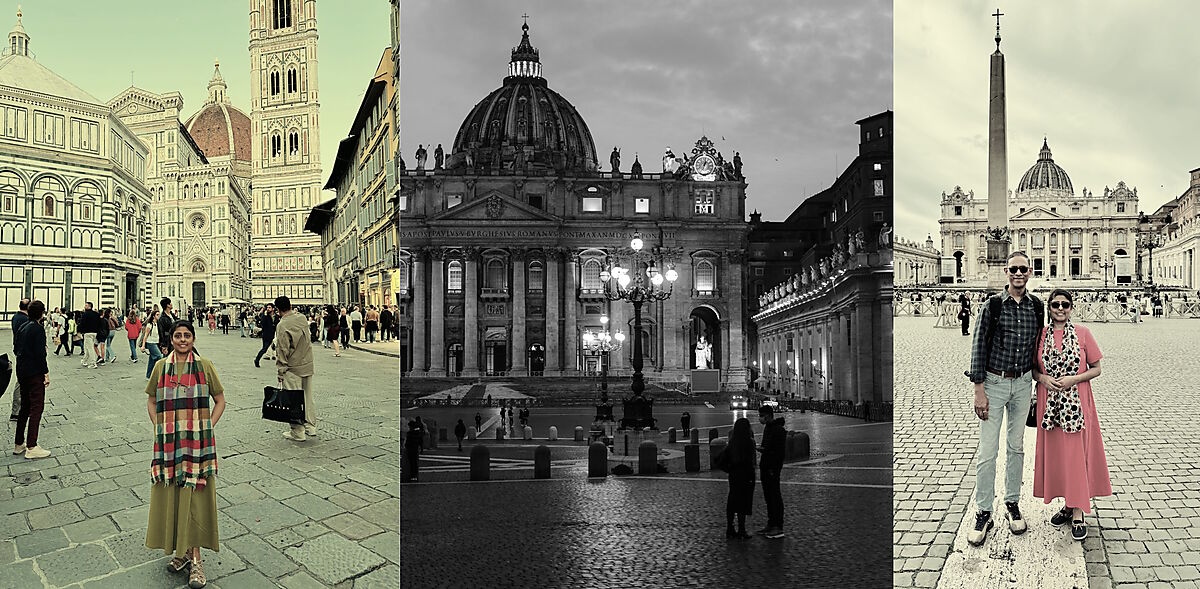
‘Stand in the centre,’ he said, as I handed over my camera. He expertly aligned the basilica and the tall obelisk. ‘This square,’ he continued, his gaze wandering over Piazza San Pietro, his eyes lingering on St Peter’s Basilica, upon which the morning light lay draped like silk, ‘has been a gathering place for many centuries. You’ll see places like this everywhere in Italy.’
On Tuesday, walking through the ruins of the Roman Forum, I imagined the world that once existed there, citizens debating the politics of the time, merchants calling out their wares, processions passing through the archways. Around me, life went on — tourists clutching guidebooks, couples strolling hand in hand, children playing tag among the fluted Corinthian columns. I heard laughter, the clicking of cameras, the hum of many languages. A man stood nearby, he turned as if responding to my unspoken thoughts, ‘Even now,’ he said, ‘Rome still gathers here.’
As I climbed the steps at Piazza di Spagna, a street musician’s saxophone merged naturally with bursts of laughter and fragments of conversation. The rhythmic click of cameras, distant chatter of vendors, and the quiet vigilance of local police blended unobtrusively into the square’s liveliness.
Strangers came and went, yet for a brief moment, we all belonged to the same space. Was this what the traveller at St Peter’s Square meant? That piazzas weren’t just places to admire from a distance, but spaces you stepped into, something you lived without even realising?
Another day, another city, another piazza. In Florence, locals and tourists alike sipped coffee in cafés by Piazza del Duomo, their voices merging into a familiar, unhurried rhythm — of life unfolding — beneath the towering Gothic façade of Florence Cathedral. I traced the intricate details of the Baptistery in wonder. Soon the sound of bells tolling from Giotto’s Campanile came floating down like a blessing.
I realised then that these public spaces exist not merely in architecture frozen in time, but also in the way people gather there, just as they have for centuries — it’s woven into daily life.
And then, in Venice, I found that familiar melody again, where Piazza San Marco stretches toward the shimmering lagoon, its edges blurring into the water, gondolas swaying gently nearby. The square felt like the city’s soul — timeless, elegant, alive. Pigeons fluttered between the footsteps of passing visitors by the clock tower, darting away as children chased them laughing. A bride posed for photographs, her veil catching the breeze. Families gathered in conversation and laughter.
Nearby, an elderly woman sat with her eyes closed, listening — to the jazz from a street musician’s trumpet drifting in the sultry air? Or to something deeper? Then she opened her eyes and smiled suddenly. ‘I come here every year,’ she said, her voice carrying the weight of familiarity, as if speaking of an old friend.
And as I walked away, immersed in the moment — the past, the present, the in-between — I wondered if perhaps I, too, would return.