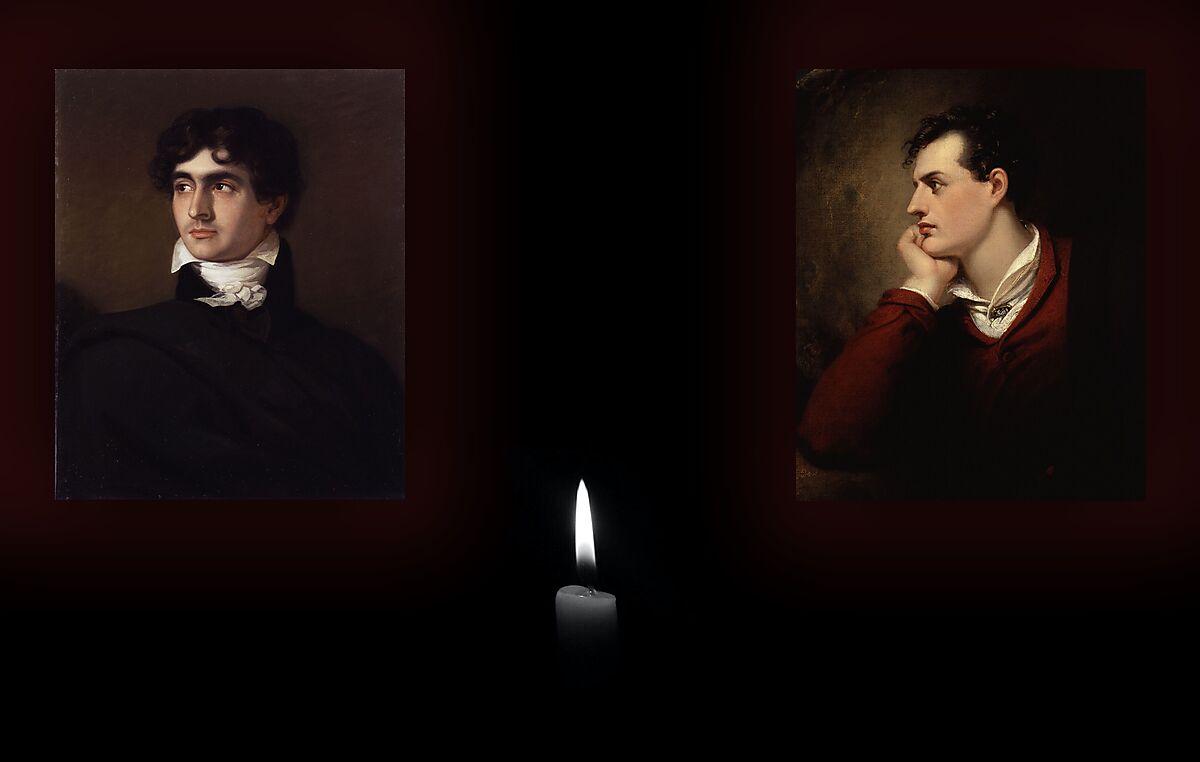
In the spring of 1816, John Polidori, a young and ambitious physician, was engaged by the poet Lord Byron to accompany him to continental Europe. Polidori was just twenty at the time and Byron eight years his senior. Their tumultuous relationship would become immortalised in Polidori’s novel The Vampyre (1819).
Aubrey, the novel’s youthful protagonist, is about to embark on the Grand Tour. Lord Ruthven, a mysterious and wealthy gentleman, asks to accompany him. On his journey, Aubrey meets various townspeople who warn him of the dangers of vampires.
Polidori had clearly intended Ruthven to be a stand-in for Byron as his very name is taken from a parody of Byron, written by his former lover Lady Caroline Lamb1. Aubrey in turn is modelled on Polidori’s youthfulness and naiveté, but, perhaps reflecting his admiration for the older man, Polidori also bestows on him Byron’s adventurous spirit and heroic nature.
They were accompanied on their travels by the writers Percy and Mary Shelley, and Polidori was quickly replaced by Percy as Byron’s primary companion2. Polidori also notes in his diary that he tried to impress Byron by sharing his attempts at playwriting, which were brushed off3.
Polidori reflects his dissatisfaction through Lord Ruthven by making him cold and selfish. Yet Ruthven also tends to a sickly Aubrey, acting as his ‘constant attendant’4. The desire to be admired by Byron remained.
The theme of love and hate is so integral to the novel that it has become a staple of vampire fiction itself. The seductive vampire, who loathes humanity yet is drawn to it, has appeared in vampire fiction from Dracula (1897) to the contemporary Twilight (2005).
Richard Switzer. Lord Ruthwen and the Vampires. The French Review, Vol. 29, No. 2. Dec 1955. 107
John William Polidori. The Vampyre’ and other Writings, ed. By Franklin Charles Bishop. Manchester: Alliance House. 2005. xv
John William Polidori. The Diary of Dr. John William Polidori 1816: Relating to Byron Shelley, Etc’, ed. By William Michael Rossetti. London, Forgotten Books. 2015. 123
John William Polidori. The Vampyre’ and other Writings, ed. By Franklin Charles Bishop. Manchester: Alliance House. 2005. 12
Gemma Unyereno
London, UK
I visited the Wellcome Library in London last year, and came upon the biography of John Polidori, a book that is very difficult to get a hold of. I was immediately struck not by the similarities between his life and ‘The Vampyre’ but the subtle differences. I could certainly identify with how much of my own feelings are exposed in trying to change my past through writing.