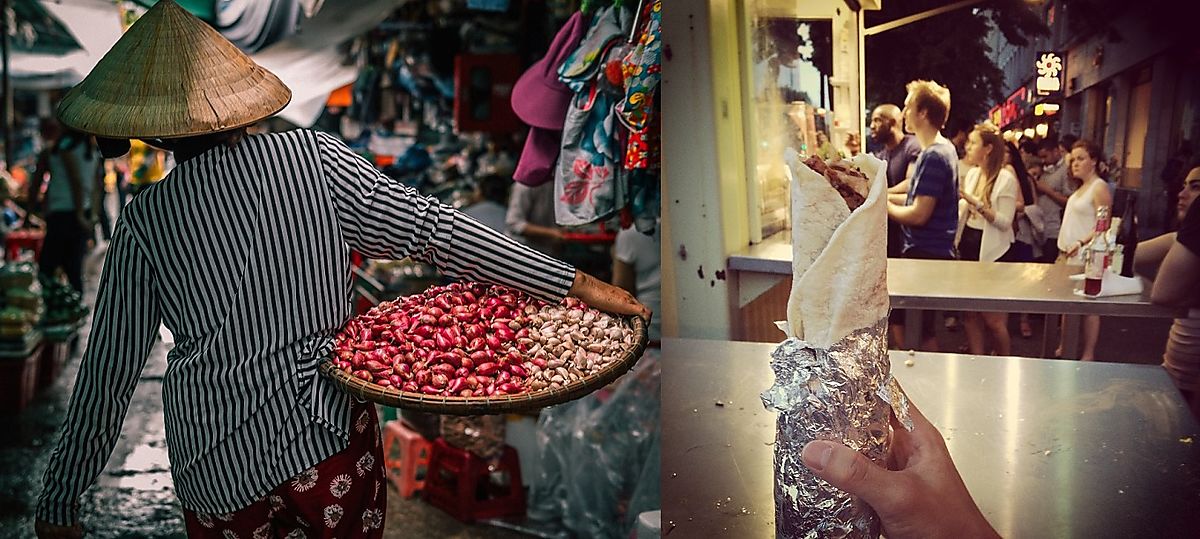
This work, ‘Vietnamese and Turkish Communities, Berlin’, is a derivative of ‘Asian Food Vendor’, ‘Berlin Kebab’ used under CC BY. ‘Vietnamese and Turkish Communities, Berlin’ is licensed under CC BY SA 4.0 by The Cultural Me
The Story of the Turkish and Vietnamese Communities Behind the Berlin Wall
A favourite street snack in Berlin, Germany is the Döner kebab — sliced meat from a vertical rotisserie, served in bread with salad and sauce — found on street corners and around bustling U-Bahn stations. Now a staple of the German diet, it was introduced to West Berlin in the early 1970s by Turkish Gastarbeiter (guest workers), a multinational migrant workforce recruited to offset labour shortages during West Germany’s post-war economic miracle. The Gastarbeiter were meant to be temporary residents, but after the economic crisis of 1973 and subsequent recruitment ban, many Gastarbeiter chose not to leave Germany for fear of not being able to return.
Equally prominent in Berlin are Vietnamese restaurants and East Asian supermarkets. Although some of Berlin’s Vietnamese community arrived in West Berlin after fleeing the Vietnam War (1955-75), even prior to that, in the 1950s, the East German government had begun inviting Vietnamese students to receive their education in Germany.1 Then, from the 1980s onwards, East Germany included Vietnam in its own migrant worker programme, which was similar to the West German Gastarbeiter scheme; Vertragsarbeiter (contract workers) were recruited from the communist Vietnamese state — in a move aimed not only at aiding its own economic growth, but also to support a fellow Eastern Bloc country.
Both communities experienced violence in the aftermath of reunification, including arson attacks on Turkish and Vietnamese homes carried out by neo-Nazis.2 But, as an integral part of the city’s culinary landscape, Vietnamese and Turkish restaurants are a reminder of how the city’s political history has contributed to its contemporary cultural diversity.
Simon Burnett. Ghost Strasse. Montréal: Black Rose Books. 2007. 95, 97
Isabella Barber
Manchester
I lived in Berlin for a year, and although I was familiar with the reasons behind the extensive Turkish cuisine in the city, I had no idea why there were so many Vietnamese restaurants. I want the reader to appreciate how the city’s history has had a lasting impact on its diversity: its extensive Turkish and Vietnamese restaurants — something that tourists often remark upon, but do not always understand.