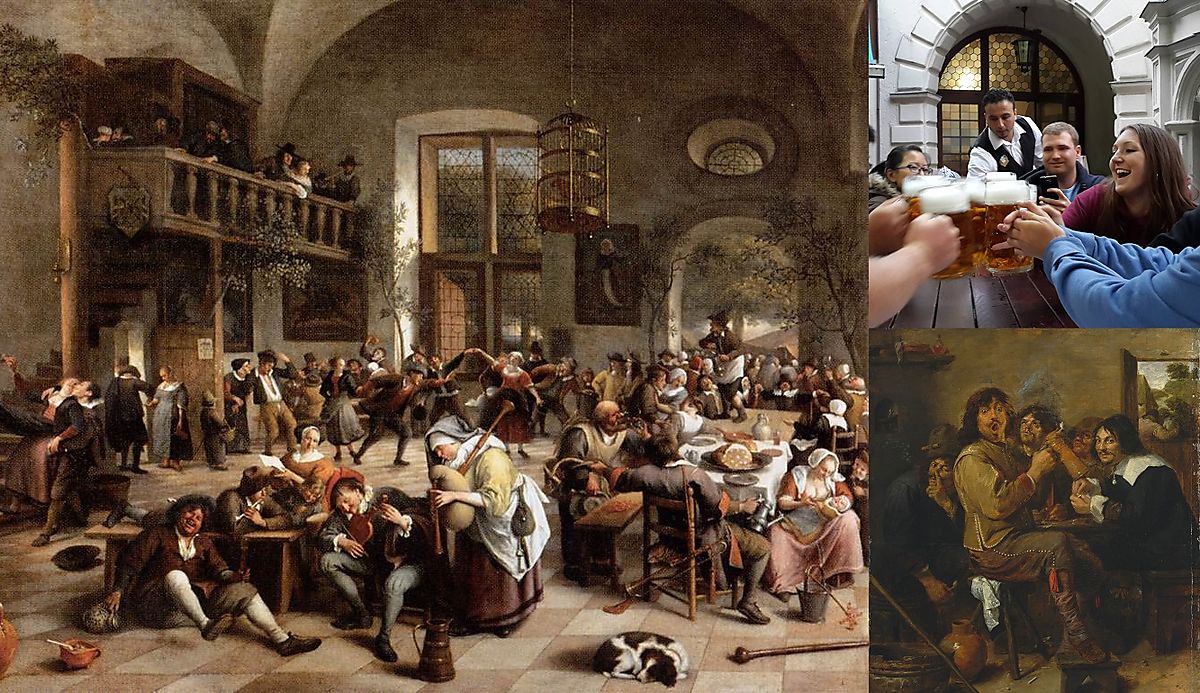
It was not uncommon to find a sleeping drunkard in a field on the way to church in Early Modern England. The years 1550-1700 saw the rise of the alehouse as a communal hub where people gathered to socialise and drink beer — much like pubs in contemporary Britain.1
Ale-selling began as a cottage industry, predominantly carried out by women, but by the 1500s had evolved into a brewery, offering food and lodging.2 Increases in poverty, urbanisation and the growing popularity of beer saw alehouse numbers rising from 19,000 in 1577 to over 40,000 by 1680.3
Soon commonplace activities within the alehouse began to attract the attention of authorities fearful of moral corruption and political dissension: violent brawls between intoxicated men, dalliances with the house harlot for 6d a go, and the singing of satirical ballads mocking those in power.4 In a bid to curb excessive drinking, Puritans rid the religious calendar of many drunken festivities, culminating with the banning of Christmas celebrations during the Interregnum, whilst James I’s “tippling” Acts of 1603 reinforced licensing laws to curb alehouse numbers.5
However, within English society, in addition to church attendance, the alehouse also served the recreational needs of the parish. Generally a respite for the poor, it was not uncommon for wealthier members of society, like Samuel Pepys, to be found there.6 A drink could represent a range of social exchanges: from a token of friendship to the sealing of a business deal. Additionally, a visit to the alehouse accompanied harvest downtimes as well as important rites of passage such as weddings and christenings — very much a precursor to modern British life.7
Peter Clark, ed. Donald Pennington and Keith Thomas. The Alehouse and Alternative Society, in Puritans and Revolutionaries: Essays in Honour of Christopher Hill. Oxford University Press. 1982. 51-53
Peter Clark. The English Alehouse: A Social History 1200-1800. London: Longman Higher Education. 1983. 199
Peter Clark, ed. Donald Pennington and Keith Thomas. The Alehouse and Alternative Society, in Puritans and Revolutionaries: Essays in Honour of Christopher Hill. Oxford University Press. 1982. 51-52
Ian Mortimer. The Time Traveler’s Guide to Elizabethan England. Bodley Head. 2003. 323
C M Iles. Early Stage of English Public House Regulation. Wiley: The Economic Journal 13, 50. 1903. 254-7
Peter Clark, ed. Donald Pennington and Keith Thomas. The Alehouse and Alternative Society, in Puritans and Revolutionaries: Essays in Honour of Christopher Hill. Oxford University Press. 1982. 51-52
Alexandra Shepherd. ‘Swil-bols and Tos-pots’: Drink Culture and Male Bonding in England, c.1560-1640; in eds. L Gowing, N I Hunter and M Rubin, Love, Friendship and Faith in Europe 1300-1800. Basingstoke. 2005. 112-113
Amy Bensley
London
I wanted to write this article on the alehouse in Early Modern England, because it provides parallels in the attempt to suppress subversive activities within a popular subculture. Clerical and governmental authorities saw the potential for political dissent and moral corruption in pub culture in Early Modern England — just as they do today.