
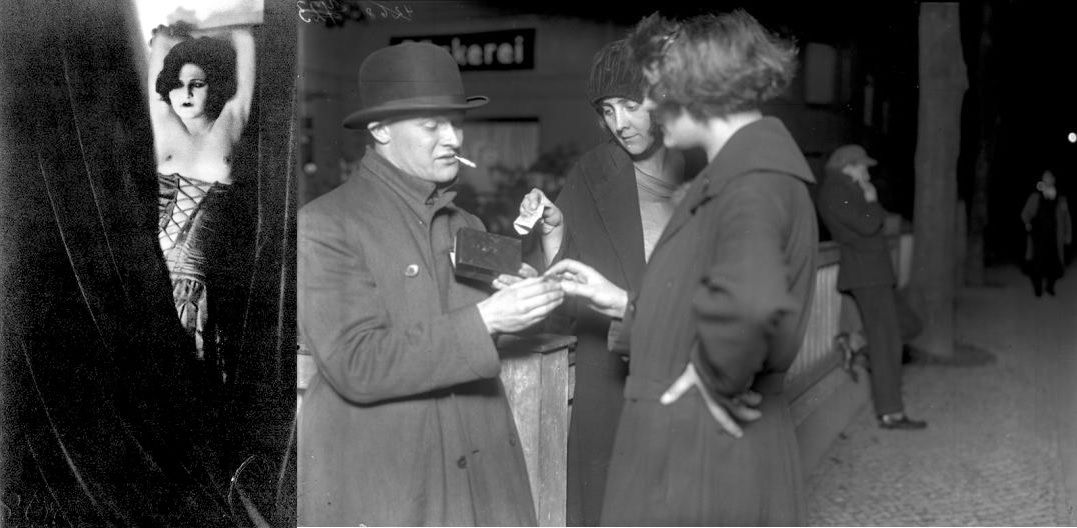
Anita Berber in Kokain / Cocain Seller, 1920s Berlin
The Social Conscience of Anita Berber, Weimar’s ‘Priestess of Debauchery’

The icon of the age … Anita Berber, dipped white rose petals in a cocktail of chloroform and ether at breakfast, before sucking them clean.”1The actress and dancer Anita Berber (1899–1928) is remembered as Weimar Germany’s “Priestess of Debauchery”. During the intoxicating and turbulent Golden Twenties, Berber was a symbol of Berlin’s excesses: an openly bisexual drug addict, who reportedly spat brandy at disorderly spectators during performances.2
Yet there was more to Berber than her provocative nature. Kokain (Cocaine), one of her well-known dances, tells the story of addiction. Whilst it was indeed titillating — at times it was performed nude3 — it was also distressing. Berber threw her body “into a monstrous cascade”,4 and the dance ended in the death of the addict.5 These performances were not a celebration of cocaine, but rather a portrayal of its devastating effects.
Although Berber was undoubtedly a transgressive figure, this dance demonstrates the complexity of her work, containing as it does an element of social commentary. In Kokain, Berber chose to portray not the decadence of the era, but her own struggles, to which others might relate.
According to Berber herself, such themes were not uncommon in her performances. Much like today, in her time she was both misrepresented and misunderstood; speaking to journalist Fred Hildenbrandt in 1922 she said, “we dance death, illness, pregnancy, syphilis, madness, dying, infirmity, suicide, and nobody takes us seriously.”6 To remember her only as an icon of debauchery is to ignore these socially critical elements.
Do you want to learn to write like this?
References
- Norman Ohler, trans. Shaun Whiteside. Blitzed: Drugs in the Third Reich (ch. The Chemical Twenties). London:Penguin. 2016
- Mel Gordon. Voluptuous Panic. Los Angeles: Feral House. 2006. 270
- Karl Toepfer. Empire of Ecstasy. Berkeley: University of California Press. 1997. 90
- Joe Jenčik. Dance and Snobbery (quoted in Erika Hughes, Art and Illegality on the Weimar Stage). 1931. 328
- Erika Hughes. Art and Illegality on the Weimar Stage. Journal of European Studies 39, no. 3. September 2009. 33
- Anita Berber in Fred Hildenbrandt, “... ich soll dich grüssen von Berlin. 1922-1932. Berliner Erinnerungen 6 ganz und gar unpolitisch”. Quoted in Alexandra Kolb, “Performing Femininity” (2009). Cultural History and Literary Imagination 12, Bern: Peter Lang. 209