
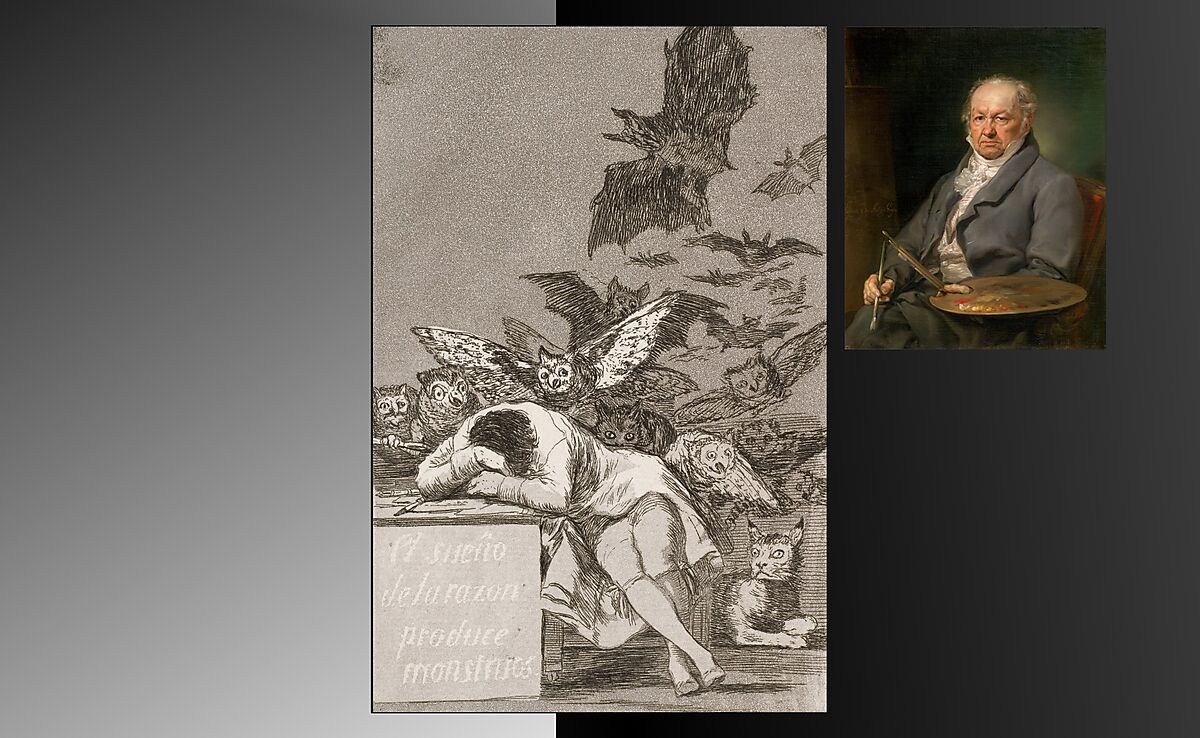
The Sleep of Reason Produces Monsters & Francisco Goya (inset)
The Sleep of Reason Produces Monsters: The Enlightened Romanticism of Francisco Goya
In 1799, Spanish artist Francisco Goya published a series of 80 etchings known as Los Caprichos (The Follies). Already struggling with deafness and unrequited love (for the Duchess of Alba), Goya had become deeply troubled by Spain’s cultural regression: The economy had collapsed, the Inquisition was resurrected, and a Napoleonic invasion seemed likely.1
Across much of the Caprichos, Goya satirises the ‘common prejudices and deceitful practices’2 of his society — a corrupt clergy, prostitution, and superstition.
However, Plate 43, The Sleep of Reason Produces Monsters, provides an insight into Goya’s philosophy. It shows a personification of the Enlightenment, collapsed in sleep while monsters prey upon it, a metaphor for Spain’s cultural backwardness. For the monsters, he may have borrowed animals from Spanish folklore to highlight the self-destructive nature of the country’s traditions and superstitions.
In a note to the Prado Museum catalogue, Goya wrote an extended caption to his work: ‘Imagination abandoned by reason produces impossible monsters: united with her, she is the mother of the arts and the source of their wonders.’3
Goya’s choice of words here, ‘imagination’ rather than ‘mankind’ abandoned by reason, is unusual. It shows his sympathy for the emerging ideas of Romanticism, a movement gaining prominence at the time through the writings of Swiss philosopher Jean-Jacques Rousseau. Rousseau challenged Enlightenment society by championing nature and artistic expression through emotion and imagination rather than reason alone (an Enlightenment ideal). Goya urges his fellow citizens to draw upon Enlightenment rationality, yet tantalisingly points to the Romantic future.
The Caprichos were intended to be popular art,4 but never became such during Goya’s lifetime. Fearing punishment from the Inquisition, Goya suspended sales in 1803. Spain’s monarch, King Charles IV, who liked Goya personally, protected him from persecution by claiming that he had ‘expressly ordered Goya to make’ them,5 and bought them in exchange for a scholarship and pension for the artist’s son.6
References
- William Vaughan. Romanticism and Art. London: Thames and Hudson. 1994. p. 85
- Robert MacLean. "Los Caprichos". Glasgow University. 2006
- Tomás Harris, Philip Hofer (ed.). Francisco Goya: Los Caprichos. New York: Dover Publications. 1969. p. 54
- Robert Hughes. Goya. London: Vintage. 2004. p. 216
- Tomás Harris, Philip Hofer (ed.). Francisco Goya: Los Caprichos. New York: Dover Publications. 1969. p. 3-4
- Robert MacLean. "Los Caprichos". Glasgow University. 2006

When I wrote a university essay on Goya’s Caprichos, I was captivated by their bone-chilling darkness. I soon learned that they are imbued with desperation for rationality, which is remarkable considering the artist’s psychological depravity. The philosophy of ‘The Sleep of Reason Produces Monsters’ steers us towards inward and public harmony. It can make all walks of life easier, from academic pursuits to human interactions.— Tom MacKinnon