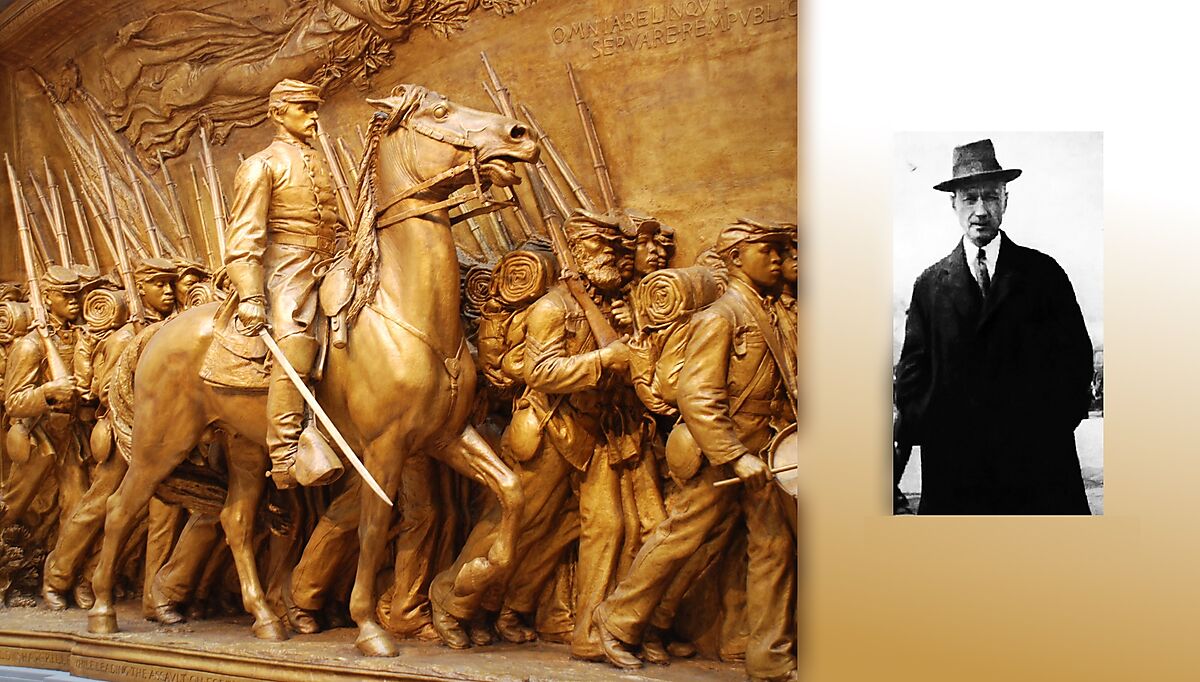
This work, ‘Robert Gould Shaw Memorial & Charles Ives (1913)’, is a derivative of ‘Robert Gould Shaw Memorial’, ‘Charles Ives’ used under CC BY. ‘Robert Gould Shaw Memorial & Charles Ives (1913)’ is licensed under CC BY SA 4.0 by The Cultural Me
‘The Saint-Gaudens on Boston Common’ — Charles Ives’s use of Musical Quotation
On the edge of Boston Common stands The Robert Gould Shaw and Massachusetts 54th Regiment Memorial (1884), a sculpture by Augustus Saint-Gaudens. The memorial commemorates the death of Colonel Shaw at the battle of Fort Wagner 1863 as he led the first-ever all-black regiment in the American Civil War.
Charles Ives (1874–1954) composed Three Places in New England between 1911 and 1914. The first movement ‘The Saint-Gaudens on Boston Common’ pays tribute to Shaw and the 54th regiment.
Ives’s is known for his use of musical quotation — borrowed melodic phrases ranging from just a few notes to a whole theme, a kaleidoscope of tunes from hymns to parlour songs. In deciding which quotations to include, Ives had a guiding principle. Music to him had both an exterior ‘manner’ and an interior ‘substance’, the true passion behind the notes. His borrowed material, therefore, was often sourced from community settings, occasions where people made expressive music, to celebrate, worship, entertain.
The ‘Saint-Gaudens’ opens with two melodic quotations from Stephen Foster’s ‘Old Black Joe’, a song in the style of the Negro spiritual. The quotations are stretched in a ghostly quality, gently played by the violins, as cello and bass accompany with a trudging march. As the march picks up pace, eerie echoes of Civil War songs ‘Marching through Georgia’ and ‘Battle Cry of Freedom’ emerge from the unsettled dissonance.1 Ives would have considered these borrowed songs to be rich in substance: the passion with which they were originally sung.
The intertwining of these two racially disparate quotations is a metaphor, illustrating the black soldiers of the 54th regiment entering a civil war dominated by white men.
Henderson, Clayton W.. Ives’ Use of Quotation. Music Educators Journal 61, no. 2. 1974. 23-28
Sophie Adams
London, UK
I was introduced to the music of Charles Ives whilst studying at university. Ives's distinctive use of musical quotation immediately caught my curiosity as on my first hearing I imagined a radio tuning in and out between different channels. I want to give readers an introduction to Ives musical ear, a world where anything from ‘brass bands with wings’ to ‘orchestras on mountains’ is perceivable.