
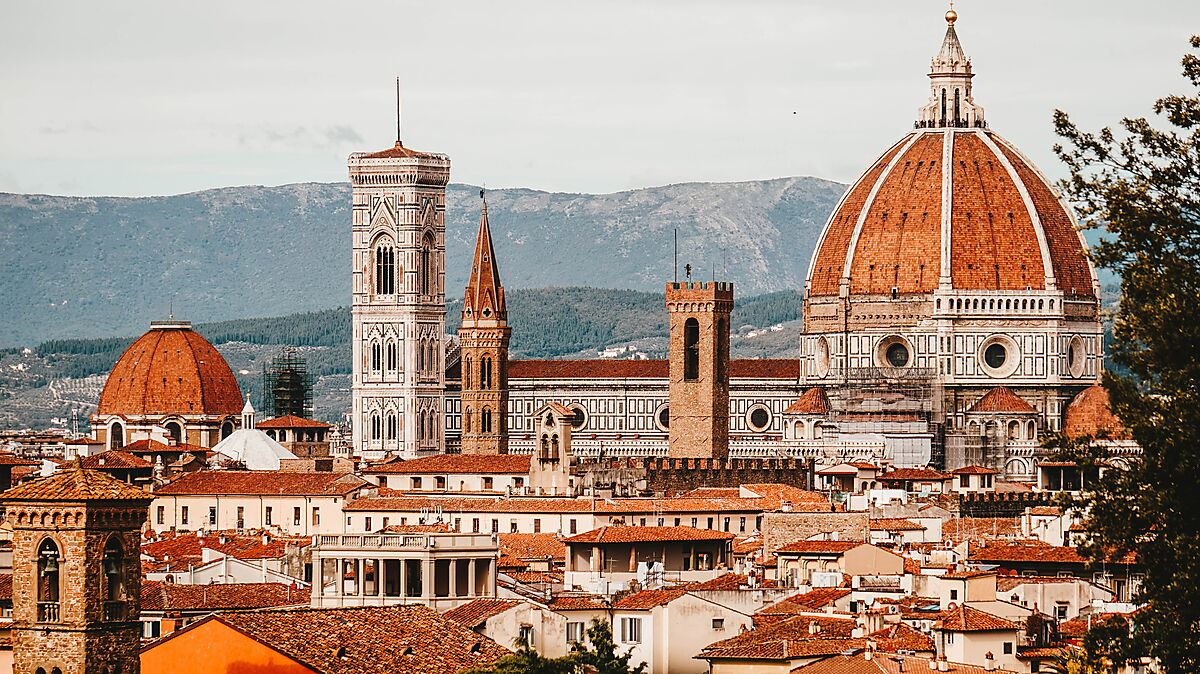
Cathedral of Florence from Piazza Michelangelo
The Renaissance Bottega and Intergenerational Skill Transfer through the Hand of the Master
In 1488, at the age of 13, Michelangelo Buonarroti was apprenticed to the artist’s workshop or bottega of Domenico Ghirlandaio in Florence. Ghirlandaio was a successful artist of the Florentine Renaissance, and according to art historian ante litteram Giorgio Vasari, he ran a workshop whose ‘production was prolific’ where ‘no job was ever refused’1.
At the time a bottega, although founded by a master such as Ghirlandaio, was a cooperative venture for producing and delivering the commissions of wealthy patrons or institutional clients, such as the Ospedale degli Innocenti orphanage (which paid Ghirlandaio 115 florins to paint an altarpiece in 1485).2 Structurally the bottega resembled a typical artisan’s workshop, but it was also a functioning shop: a salesroom opened out onto the street in which finished works were displayed and where the master would welcome customers.
In Ghirlandaio’s bottega both his brothers and brother-in-law worked alongside him3. In addition there were apprentices or garzoni, such as Michelangelo, who worked from a few months to several years. Although some were as young as seven years, most were ten years or older. They were entrusted to the care of the master where the boys would become part of the household, lodging and taking meals with the master’s family.4 The Florentine artists’ profession was regulated by a guild, which required the master to provide apprentices with a contract or accartati and salary.5 Michelangelo assisted Ghirlandaio on a three-year contract on a salary of eight gold florins per year (a skilled labourer would receive thirty-eight florins a year)6. The garzoni were initially set menial tasks (such as the grinding of pigments and the preparation of canvases), progressing to copying the master’s drawings, before finally being allowed to paint minor or tedious decorative parts and peripheral figures in the master’s own works.7
At the end of the apprenticeship, the artist-craftsman would achieve a journeyman qualification, which would allow them to provide their services as independent artists, but not run their own workshops. Membership of the guild and acknowledgement as a master (maestro dell’arte) is finally achieved when the artist presents their masterpiece (from which the word originates), a work displaying their mastery of painting, giving them the right to open their own bottega.
The Renaissance bottega provided the means by which artistic skill, the ‘hand of the master’, was transferred from one generation to the next. Raphael, a contemporary of Michelangelo, was greatly influenced by his master Perugino, a renowned painter of the Umbrian school.8 Perugino’s hand can be seen in Raphael’s The Marriage of the Virgin (1504), which pays homage to a work of the same name by his master. Raphael creates an almost mirror image by retaining the composition structure and iconography of Perugino’s altarpiece, but with subtle differences to create his own masterpiece.
As for Michelangelo, his authorised biographer, Ascanio Condivi, would claim that he was entirely self-taught rather than a product of the workshop system.9 However, Ghirlandaio’s style and technique appear in the early drawings of his student, especially in the pose of figures and drapery, and the unique cross-hatch shading which was a hallmark of Ghirlandaio’s bottega. Michelangelo also learnt the fundamentals of fresco paintings from Ghirlandaio, which he used to good effect in his work on the Sistine Chapel — masterpieces that can be admired to this day.
References
- Luciano Bellosi and Aldo Rossi. Giorgio</em> <em>Vasari, Le vite de' più eccellenti pittori, scultori, ed architetti. Torino: Einaudi. 1986. p. 476
- NA. "Five Contracts For Italian Renaissance Painting Commissions". Northeastern Illinois University
- Gerald S. Davies. Ghirlandaio. London: Methuen and co.. 1909. p. 96
- NA. "The making of an artist". Italian Renaissance Learning Resources
- Ettore Camesasca. Artisti in bottega. Milano: Feltrinelli Editore. 1996. p. 188
- Alessia Meneghin. "The livery of a Florentine employee in the fifteenth century: the rewards of a lifetime of service". History of Retailing and Consumption. 1, no. 1. 2015. 47-62. p. 51
- Peter M. Lukehart. The Artist's Workshop. Baltimore: Schneidereith & Sons. 1993. pp. 11-15
- Francesca Coltrinari. "Verso il Manierismo, I modelli perugineschi". in Stefano Zuffi (ed.). La grande Storia dell’Arte, Il Rinascimento italiano. Milano: Mondadori Electa S.p.A.. 2006. pp. 55-67. p. 55
- Michael Hirst. "Introduction". in Giovanna Nencioni (ed.). Vita di Michelagnolo Buonarroti. Firenze: Studio per edizioni scelte. 1998. pp. 1-20. p. 17

Italian Renaissance art is widely recognised and appreciated worldwide but the importance of its artistic workshops is often underestimated. My interest in this topic dates back to university. While researching renowned Italian painters and the inventories of their botteghe, I became fascinated by the nature of these artistic spaces. And this is my reason for providing this insight into the dynamics of the workshops of the time.— Giulia Guasparri