
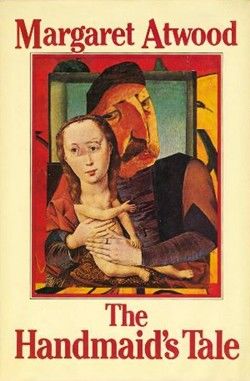
Front Cover of The Handmaid's Tale
The Relevance of Margaret Atwood's The HandMaid's Tale Today

In Margaret Atwood’s The Handmaid’s Tale (1985), the narrator is Offred, the handmaid, who proven fertile, must conceive a child with one of the Commanders of the Republic of Gilead (the totalitarian regime that replaced the United States) and bear it for him and his infertile wife. Atwood paints a detailed yet horrifying picture of a grotesque society in which women lose their basic rights, families and identity and are treated as a functional commodity (Offred means “Of Fred”, belonging to him).
Written in the height of the Reagan and Thatcher eras, The Handmaid’s Tale represents an open critique of their conservative policies: of government authoritarianism, Christian morality and discrimination of minorities.
The novel falls into the category of “feminist dystopian literature”, in which not only is society restricted by rules and terror, but where women’s rights are suppressed by a powerful and repressive religious fanaticism.
The novel itself is an extreme vision of gender repression (also affecting men, to some extent), sexual and cultural repression but it also proves controversial as the tradition of “women helping women” is replaced by a misogynistic pyramidal society with both men and infertile women at the vertices, all united in what appears to be a birth control crusade.
Reading The Handmaid’s Tale today is an act of enlightenment, especially at a time in which the right to decide what to do with their own bodies is still a challenge for many women all over the world.
Written in the height of the Reagan and Thatcher eras, The Handmaid’s Tale represents an open critique of their conservative policies: of government authoritarianism, Christian morality and discrimination of minorities.
The novel falls into the category of “feminist dystopian literature”, in which not only is society restricted by rules and terror, but where women’s rights are suppressed by a powerful and repressive religious fanaticism.
The novel itself is an extreme vision of gender repression (also affecting men, to some extent), sexual and cultural repression but it also proves controversial as the tradition of “women helping women” is replaced by a misogynistic pyramidal society with both men and infertile women at the vertices, all united in what appears to be a birth control crusade.
Reading The Handmaid’s Tale today is an act of enlightenment, especially at a time in which the right to decide what to do with their own bodies is still a challenge for many women all over the world.