
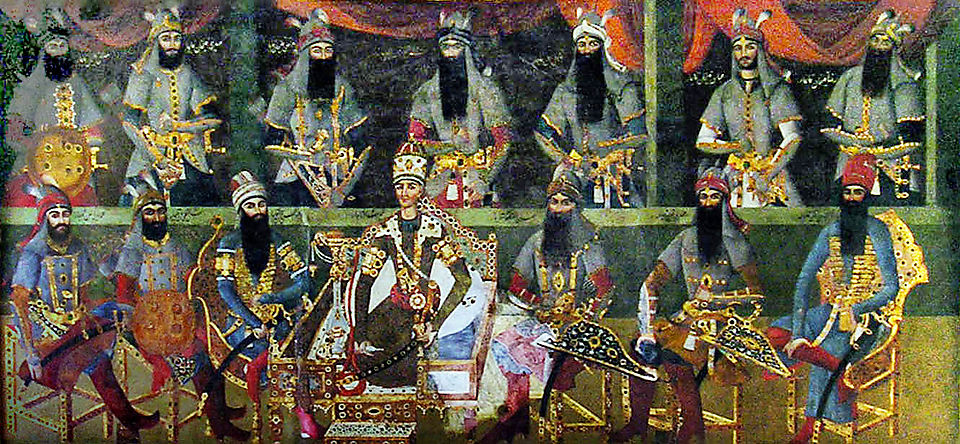
Painting of Agha Mohammad Khan with his men
The Qajar Dynasty (1785-1925)

The Qajar Dynasty was a time in Iranian history that witnessed a transformation in Iranian culture, societal values, ideologies and art.
The Qajars originate from a lineage of Oghuz Turks. The dynasty’s first Shah was Mohammed Khan Qajar, eunuch chief of the Qajar tribe. Mohammed Khan was castrated as a child by the leader of a rival tribe and was therefore succeeded by his nephew Fath Ali Shah Qajar.
Fath Ali Shah’s reign (1797-1834) brought many cultural changes to Persia. He sought to integrate European culture into Persia, as the country began trading and exporting with European nations. This allowed for new technology, clothing and artistic themes to enter Persian society.
While increased trading with Europe allowed for healthy expansion of the Persian economy and infrastructure, European ideologies began to alter Persian cultural values. European gender ideals of masculine supremacy changed the scope of Qajar artistry, as artists began to stray away from the usual portrayals of gender ambiguity. Instead of creating androgynous portraiture, Qajar artists began to masculinise and feminise their work, displaying clear gender norms and societal placements for men and women. European influences even changed the nation’s view on homosexuality from normal to immoral.
The preceding Safavid dynasty had sought to form relations between European nations, but still firmly believed in Persian philosophy, religion, culture, art and morality. The Qajar dynasty furthered this relationship with Europe, all the while deeming themselves as inferior, causing European ideologies to dominate Persian society.
The Qajars originate from a lineage of Oghuz Turks. The dynasty’s first Shah was Mohammed Khan Qajar, eunuch chief of the Qajar tribe. Mohammed Khan was castrated as a child by the leader of a rival tribe and was therefore succeeded by his nephew Fath Ali Shah Qajar.
Fath Ali Shah’s reign (1797-1834) brought many cultural changes to Persia. He sought to integrate European culture into Persia, as the country began trading and exporting with European nations. This allowed for new technology, clothing and artistic themes to enter Persian society.
While increased trading with Europe allowed for healthy expansion of the Persian economy and infrastructure, European ideologies began to alter Persian cultural values. European gender ideals of masculine supremacy changed the scope of Qajar artistry, as artists began to stray away from the usual portrayals of gender ambiguity. Instead of creating androgynous portraiture, Qajar artists began to masculinise and feminise their work, displaying clear gender norms and societal placements for men and women. European influences even changed the nation’s view on homosexuality from normal to immoral.
The preceding Safavid dynasty had sought to form relations between European nations, but still firmly believed in Persian philosophy, religion, culture, art and morality. The Qajar dynasty furthered this relationship with Europe, all the while deeming themselves as inferior, causing European ideologies to dominate Persian society.