
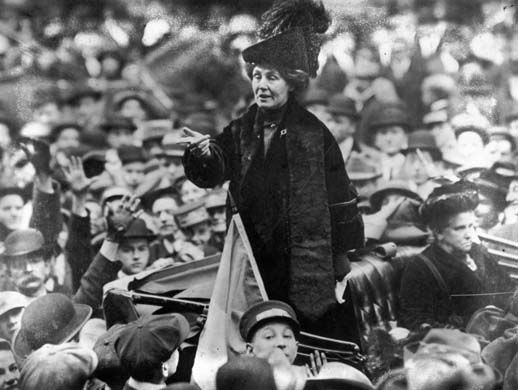
Emmeline Pankhurst addresses a crowd in New York City in 1913
The Problematic Relationship between Suffragism, Colonialism and Universal Equality

On 14 July 1913, in a speech to women’s suffrage campaigners at the London Pavilion, Emmeline Pankhurst declared “I’d rather be a rebel than a slave.”1
This rallying cry for the disenfranchised women of Britain no doubt roused the crowds before her. However, the connotations of the term “slave” highlight the problematic relationship between the suffrage movement and nationalism.
The suffrage movement has its roots in 18th century abolitionism (the ending of slavery), as the idea of universal equality resonated with advocates of women’s rights. In her Vindication of the Rights of Women (1792), the writer Mary Wollstonecraft asks
This ingrained form of racism was woven into the political fabric of the time. Pankhurst herself in her later years joined the Conservative party and openly approved of imperialism, contradicting the values of equality she had previously advocated.
Pankhurst’s powerful phrase illustrates the dynamic between white and non-white British suffragism. For while the latter demographic was also involved in the movement, many of the former considered their own struggle to be superior and non-inclusive.
This rallying cry for the disenfranchised women of Britain no doubt roused the crowds before her. However, the connotations of the term “slave” highlight the problematic relationship between the suffrage movement and nationalism.
The suffrage movement has its roots in 18th century abolitionism (the ending of slavery), as the idea of universal equality resonated with advocates of women’s rights. In her Vindication of the Rights of Women (1792), the writer Mary Wollstonecraft asks
Is one half of the human species, like the poor African slaves, to be subject to prejudices that brutalise them... only to sweeten the cup of man? Is not this indirectly to deny woman reason?”2The prospect of universal equality became more complex as the suffrage movement developed. When the women of New Zealand won the right to vote in 18933, well before British women, there was anger that people of a colony, Maori no less, had succeeded them.
This ingrained form of racism was woven into the political fabric of the time. Pankhurst herself in her later years joined the Conservative party and openly approved of imperialism, contradicting the values of equality she had previously advocated.
Pankhurst’s powerful phrase illustrates the dynamic between white and non-white British suffragism. For while the latter demographic was also involved in the movement, many of the former considered their own struggle to be superior and non-inclusive.
Do you want to learn to write like this?
References
- Purvis, June. Emmeline Pankhurst: A Biography. Psychology Press. 2002. 227
- Crawford, Elizabeth. Women: From Abolition to the Vote. BBC. 2011-06-20
- Adams, Jad. Women and the Vote. Oxford University Press. 2014. 26