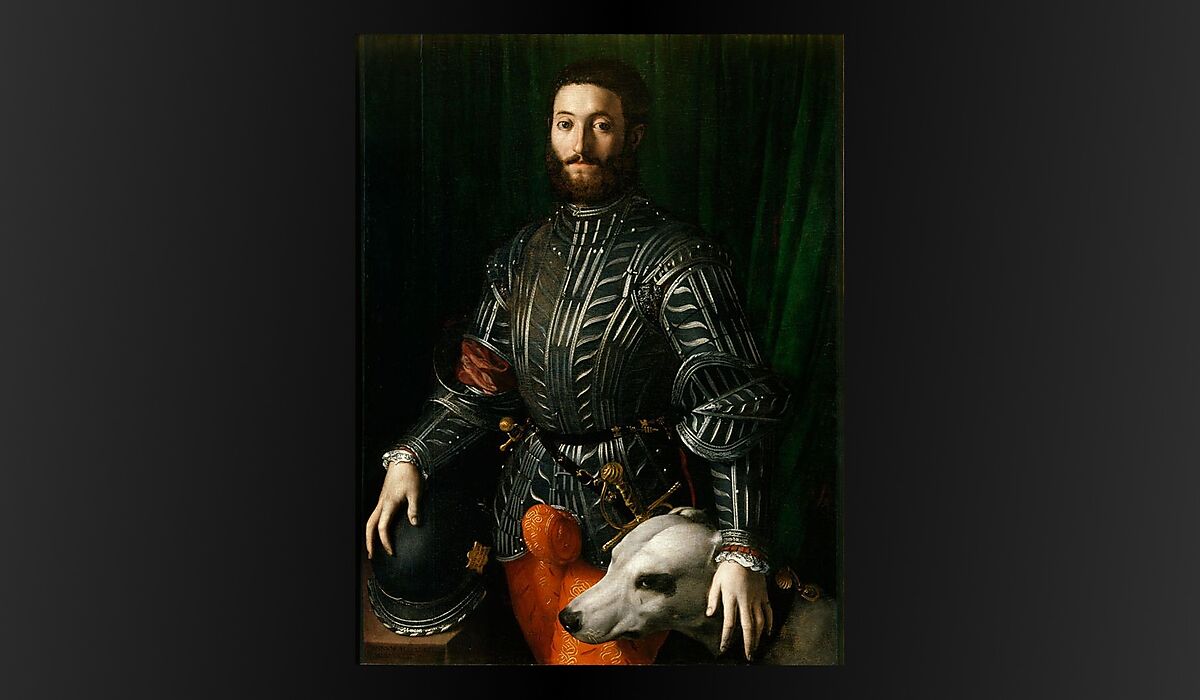
In the early 1530s, Guidobaldo Della Rovere, the son of the Duke of Urbino, commissioned a lavish portrait of himself resplendent in his Milanese armour. At this time, the 18-year-old nobleman was in conflict with his father who wanted him to marry the nine-year-old Giulia Varano for dynastic reasons. However, Guidobaldo had his heart set on another.1
Around this time, an influential work The Book of the Courtier (1528) by courtier and diplomat Baldassare Castiglione had emerged in Urbino. Among other things, the book set out the ideals of masculinity to which all noblemen should aspire.
According to Castiglione, a nobleman’s principal profession ‘must be that of arms’ and he should be a ‘very bold, stern’ individual who is ‘always among the first when the enemy is to be seen’.2 Castiglione also suggests feminine clothing could negatively affect military success.3 With these masculine ideals established in the Urbino court, Guidobaldo’s stern gaze, confident stance and choice of armour is unsurprising.
Aside from Guidobaldo’s armour, the gold-embellished codpiece is an equally striking focal point. A codpiece was a Renaissance ornamentation worn over the crotch to emphasise the male genitalia. It is not only a prominent assertion of Guidobaldo’s sexual maturity but also a statement of his body’s important political function in producing a legitimate heir to a wealthy and influential family.4
In book IV of The Book of the Courtier, the discussion turns to love and it is agreed that ‘rational love’ is superior to ‘sensual love’.5 By 1534, Guidobaldo had duly softened his stance and consented to his arranged marriage6 — further evidence of his desire to truly embody the ideals of the late medieval courtier.
Gerry Milligan. ‘Aesthetics, Dress and Militant Masculinity in Castilglione’s Courtier’, Sex, Gender and Sexuality in Renaissance Italy. Edited by Jacqueline Murray, Nicholas Terpstra. Routledge. 2019
Konrad Eisenbichler. Bronzino's Portrait of Guidobaldo II della Rovere. Renaissance and Reformation / Renaissance Et Réforme, vol. 12, no. 1. 1988. 28
Konrad Eisenbichler. Bronzino's Portrait of Guidobaldo II della Rovere. Renaissance and Reformation / Renaissance Et Réforme, vol. 12, no. 1. 1988. 28
Arielle Jasiewicz-Gill
London, UK
This article comes from my interest in gender history. We often admire paintings in galleries and museums for the aesthetic appeal however paintings are also vessels for history — you just need to look closer!