

Nature, Humanity, and God
The Poetry of Dylan Thomas: Nature, Humanity, and God
Dylan Thomas was born in Swansea, Wales in 1914, and raised by parents each passionately entrenched in a view diametrically opposed to the other.
Christianity dominated his mother’s life, and Thomas accompanied her to church regularly, while his father, a staunch atheist and a teacher of English language at a local grammar school, worshipped instead the works of Shakespeare and the Romantic poets, with which he cultivated Thomas’s love of language.
At the age of nineteen Thomas published 18 Poems (1934), his first poetry collection, and devoted his life to writing. From the moment he stepped onto the London literary scene in his teens until his death, he led a wild life, adhering to no moral code other than that of pleasing himself and his whims. He was a drunk and an adulterer; in 1950 Thomas told his friend John Brinnin ‘that he was in love with ‘Sarah’ and in love with his wife, and didn’t know what to do’1, and he remained impoverished, despite some commercial success.
While his contemporaries such as WH Auden, TS Eliot, and Stephen Spencer used their works to examine social, political, and philosophical issues, Thomas refused to align himself with any literary movements of his day and instead sought exclusively to explore humanity’s place in the universe and its relation to God and nature.
In his attempt to express the inexpressible, his images clash; they are often contradictory with each idea sparking off into another leaving his poems open to many interpretations. He said of his poetry: ‘Each image holds within it the seed of its own destruction’2
In ‘The Force That Through The Green Fuse’ (1934) Thomas explores the idea of a ‘life energy’ which brings life but also eventually death.
The force that through the green fuse drives the flower
Drives my green age: that blasts the roots of trees
Is my destroyer
And I am dumb to tell the crooked rose
My youth is bent by the same wintry fever.3
This force that underlies the natural world surfaces again in ‘How Shall My Animal?’ (1938), a poem that is layered with nature imagery, but yet open to many interpretations.
How shall my animal
Whose wizard shape I trace in the cavernous skull,
[...]
Drunk as a vineyard snail, flailed like an octopus,
Roaring, crawling, quarrel
With the outside weathers,
The natural circle of the discovered skies
[...]
A brute land in the cool top of the country days
To trot with a loud mate the haybeds of a mile,
[...]
The black, burst sea rejoice,
The bowels turn turtle4
He uses nature as symbols for the life stages of man; the sea is a metaphor for birth and death, while the sun and sky represent his growth, from child to adult, from innocence to experience, before death claims him again.
Thomas’s life force is discernible in ‘Light Breaks Where No Sun Shines’ (1934) in which we witness its omnipresent and cyclical nature.
Light breaks where no sun shines:
Where no sea runs, the waters of the heart
[...]
Light breaks on secret lots
On tips of thought where thoughts smell in the rain;
When logics dies,
The secret of the soil grows through the eye,
And blood jumps in the sun;
Above the waste allotments the dawn halts.5
Could the light that breaks in Thomas’s poem be God? Many of Thomas’s poems contain biblical references, for instance there are references to Adam and Eve, Jacob, Gabriel and Christ in ‘Altarwise by Owl-Light’ (1934). In the poem ‘In The Beginning’ (1934) Thomas muses on the very act of creation, but falls well short of calling his life force ‘God’.
In the beginning was the three-pointed star,
One smile of light across the empty face,
One bough of bone across the rooting air,
The substance forked that marrowed the first sun,
And, burning ciphers on the round of space,
Heaven and hell mixed as they spun.6
For any believer of the Christian faith it is deemed sacrilegious to allude to a governing force and not name it as God.
Titus 1. 15–16
To the pure all things are pure, but to those who are defiled and unbelieving nothing is pure; but even their mind and conscience are defiled. They profess to know God, but in works they deny Him, being abominable, disobedient, and disqualified for every good work.
Thomas does not express gratitude to a divine being or lay himself humbly before Him as required of Christian believers nor does he lament the sins of the lowly poet.
A religious poet is duty bound to spread the word of God, which Thomas does not.
Mark 16. 15–16
And he said to them, ‘Go into all the world and proclaim the gospel to the whole creation. Whoever believes and is baptised will be saved, but whoever does not believe will be condemned’.
Thomas’s goal with his poetry was to convey feeling, to express from his soul what it meant to be human with as authentic a voice as he could find. His hedonistic personal life was the embodiment of the excessive artist, giving poignancy to his poetics musings on the brutality of life and death.
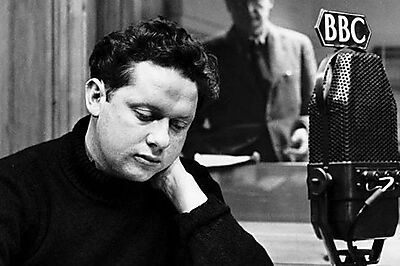
In 1953, his fortunes squandered, pneumonia and emphysema untreated, Thomas’s revelries had thrown him into a dead end. Whilst almost delirious from fever he mustered enough strength for a final bout of drinking at the White Horse Tavern in New York, before collapsing in the nearby Chelsea Hotel, the celebrated spiritual home of bohemian artists. He died aged 39.
A good poem is a contribution to reality. The world is never the same once a good poem has been added to it. A good poem helps to change the shape of the universe, helps to extend everyone's knowledge of himself and the world around him.7 — Dylan Thomas
References
- Paul Ferris. Dylan Thomas: A Biography. New York: Dial Press. 1977. p. 25
- John M. Brinnin. A Casebook on Dylan Thomas. Thomas Y. Crowell Company: New York. 1960. pp. 93-94
- Dylan Thomas. The Dylan Thomas Omnibus: Under Milk Wood, Stories and Broadcasts. London: Phoenix Press. 2000. p. 11
- Dylan Thomas. The Dylan Thomas Omnibus: Under Milk Wood, Stories and Broadcasts. London: Phoenix Press. 2000. p. 66
- Dylan Thomas. The Dylan Thomas Omnibus: Under Milk Wood, Stories and Broadcasts. London: Phoenix Press. 2000. p. 22
- Dylan Thomas. The Dylan Thomas Omnibus: Under Milk Wood, Stories and Broadcasts. London: Phoenix Press. 2000. p. 21
- Ralph Maud (ed.). On the Air with Dylan Thomas: the Broadcasts. New York: New Directions Publishing Corporation. 1992. p.61

My two loves are writing poetry and exploring spirituality. On several holidays in Wales I visited locations that lay claim to some part of the Dylan Thomas legend; the Boat House in Laugharne, his writing shed, and many pubs purported to be his favourite drinking hole. This inspired me to learn more about the man and his poetry. But Dylan Thomas holds a mixed appeal for me. On one hand I appreciate his powerful yearning to untangle what makes us human, but at the same time, from what I have learned about his general character, I think if I had met him in a pub back in the day, I would have been repulsed by him.— Heidi Pyper