
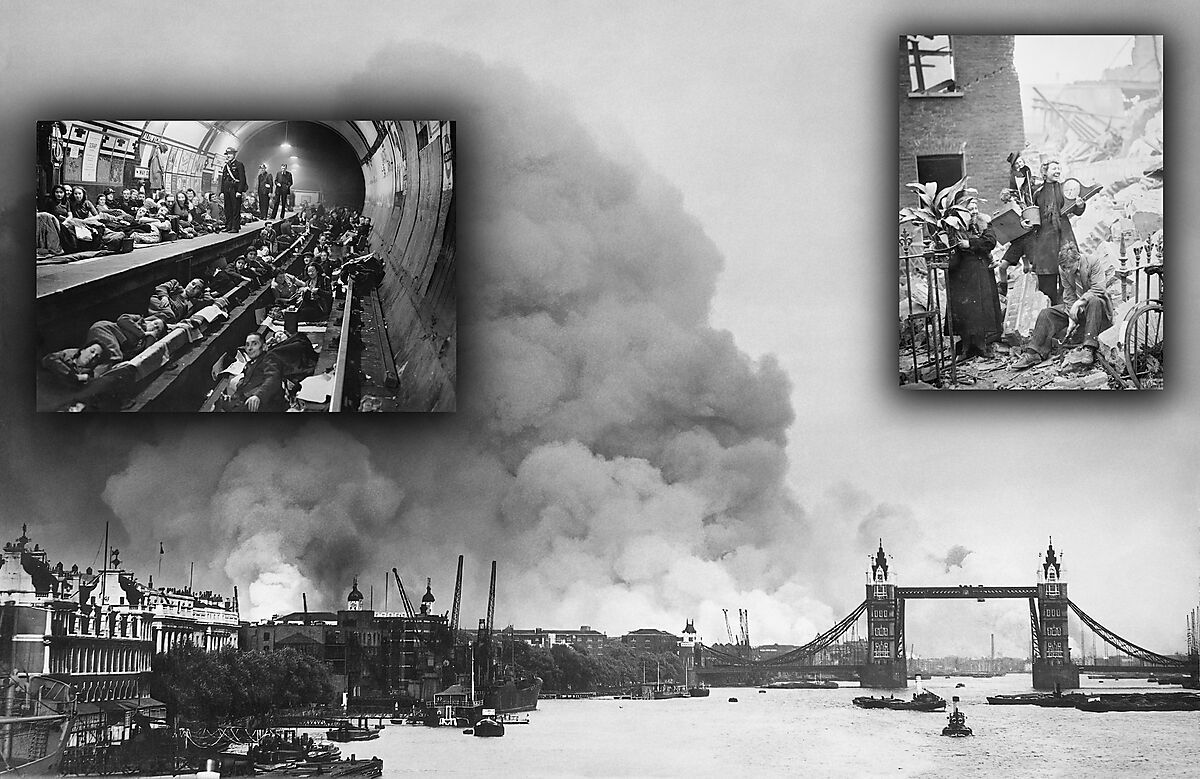
The Blitz
The Mythologisation of the ‘Blitz Spirit’ and its Cultural Legacy
On 3 September 1939, Britain’s Prime Minister Neville Chamberlain addressed the nation, announcing that in response to Adolf Hitler’s invasion of Poland the country was now at war with Germany. His broadcast carried a solemn appeal for national resilience. ‘It is evil things that we shall be fighting against,’ he declared, ‘against them I am certain that right will prevail’.1
Hitler’s war machine swept through Europe with relentless speed, toppling nations from Poland to France in a matter of months. By 1940, Britain stood alone, with the rest of Europe fallen and the United States on the sidelines.
On 10 July 1940, Germany launched a full-scale assault in what would become known as the Battle of Britain (Jul–Oct 1940), a term coined by Britain’s new prime minister Winston Churchill in a speech to parliament on 18 June 1940: ‘What [Allied] General Weygand called the ‘Battle of France’ is over. I expect that the battle of Britain is about to begin. Upon this battle depends the survival of Christian civilisation.’2 The Luftwaffe (which means ‘air weaponry’ — the air force) sought to destroy Britain’s air defences to pave the way for Operation Sea Lion, an invasion of the island. At the height of the battle, in August, the Luftwaffe outnumbered Britain’s Royal Air Force (RAF) by roughly two to one (1,800 aircraft to 750;3 the number of aircraft on each side was a rolling number over the period due to losses and replacements). The British pilots also lacked experience, with the average age being 20 (although roughly a fifth of the RAF was made up of airmen from 13 nations, some of whom had fought the Luftwaffe in Europe).4 Despite these odds, Britain managed to thwart Germany’s ambition to gain aerial superiority through a highly effective strategy of monitoring approaching aircraft through radar, feeding this information to Fighter Command in North London, and scrambling the most efficient combination of fighters to intercept them.5 The RAF’s victory marked the first military defeat of Nazi Germany. It came at enormous cost to both sides, with the RAF losing 1,547 aircraft and the Luftwaffe 1,887.6
On 7 September 1940, the order was given for the Luftwaffe to switch from strategic targets to begin bombing Britain’s major cities.7 This campaign dubbed the ‘Blitz’ (from the German term Blitzkrieg or ‘lightning war’) would run from September 1940 through to May 1941. German bombers targeted British cities, including London, Coventry, Liverpool, and Birmingham, with devastating effect. Homes were reduced to rubble with entire neighbourhoods vanishing under the weight of continuous bombardment; families huddled fearfully in air-raid shelters. In late 1940/early 1941 a renewed wave of attacks began, primarily targeting ports. By mid-1941, hundreds of thousands of civilians were homeless due to bomb damage, and the government was compelled to organise mass evacuations of children and vulnerable adults to the relative safety of the countryside. However, as Britain’s capitulation failed to materialise, Germany was forced to shift its strategic focus to Operation Barbarossa, the invasion of the Soviet Union, on 22 June 1941, bringing the Blitz to an end.
The psychological toll on civilians from the Blitz was immense: entire industries were decimated, 40,000–43,000 British civilians were killed. Across Britain, infrastructure losses included roads and rail lines cut by craters, utility services (water, gas, electricity) disrupted, and many historic buildings and landmarks reduced to rubble. The constant fear of death, destruction of homes, and disruption to everyday life transformed daily existence into a test of endurance.
During these harrowing times, Churchill reinforced resolve through his many speeches: ‘Some who formerly thought of peace, now think only of war. Our people are united and resolved, as they have never been before’8, ‘I do not doubt that we shall break their strength and break their purpose’9, and ‘Little does he know the spirit of the British nation, or the tough fibre of the Londoners.’10
The BBC played a key role in maintaining morale by broadcasting speeches, news bulletins, and entertainment. It’s That Man Again was a popular comedy show featuring Tommy Handley, while the singer Vera Lynn (best known for We’ll Meet Again (1939)) was given her own programme, Sincerely Yours, Vera Lynn, in November 194111.
The government created the War Artists Advisory Committee in 1939 to capture the war through art for propaganda purposes. Henry Carr’s Incendiaries in the Suburb (1941) portrays the aftermath of a bombing in a residential area. The painting captures the devastation of the Blitz but also attempts to engender a sense of resilience amid the destruction. Civilians are shown dousing incendiaries with a collective sense of purpose.
When the war in Europe ended on 8 May 1945, Britain emerged victorious but with a much reduced global stature — victory would come at the cost of Empire.
After the war, motifs centred on the Battle of Britain and the ensuing Blitz began to spread into British Culture. The globally ubiquitous ‘Keep Calm and Carry On’ poster was developed by the Ministry of Information (MOI) between 27 June and 6 July 1939, but printed copies were pulped after the MOI felt that ‘it may even annoy people that we should seem to doubt the steadiness of their nerves’.12 The poster was rediscovered in 2000 in an Alnwick bookstore and the notion that it represented wartime resilience helped in its resurgent appeal.
The motif of the ‘Blitz Spirit’ is also commonly used in the media to describe British stoicism, such as in the wake of the 2005 London bombings, drawing parallels with the resilience they had shown during the Blitz. However, the term most likely entered public discourse after the war, with it only making a first appearance in the Hansard (the parliamentary record) in 1972.1314
Symbolism from the Battle of Britain is pervasive in modern British society, from Spitfire Beer to football chants, including the now banned ‘Ten German Bombers’ sung by England fans when facing Germany. Far-right groups too have played on this memory, with the British National Party running its 2009 ‘Battle for Britain’ campaign, repurposed for its fractious battle against immigration.
In summary, the almost mythical wartime resilience of the British public has become part of collective memory.
On closer examination, however, we see that the government’s attempt to project strength, resilience, and unity played a part in inadvertently creating the narrative we now call the ‘Blitz Spirit’. The reality was more complex: fear, hardship, and dissent existed, but were not foregrounded in the official story. A plausible alternative narrative is that the British public endured out of necessity rather than directly as a result of high morale.
The later emergence of British stoicism as a feature of the war is also due to fundamental socio-political shifts that occurred in the postwar world. With the collapse of empire, nostalgic memory, as embodied in notions such as the ‘Blitz Spirit’, became an anchor, sustaining national pride and unity. This idealised narrative offered comfort amid post-imperial decline and loss of global stature. Such nostalgia can act as a buffer, allowing Britain to avoid confronting the deeper consequences of its diminished status on the world stage; in times of crisis, Britain often looks back to the war.
Each year on 11 November, Armistice Day, the British nation comes together for a day of remembrance, honouring the soldiers who fought in both World Wars. Thousands gathered in London to pay their respects, including prime ministers past and present, members of the Royal Family, and most notably, the veterans.
References
- Neville Chamberlain. "Radio Address by Neville Chamberlain, Prime Minister, September 3, 1939". Avalon.law.yale.edu</em><em>. 2025
- Yale Law School Lillian Goldman Law Library. "Radio Address by Neville Chamberlain, Prime Minister, September 3, 1939". Yale Law School Lillian Goldman Law Library. 2025
- Winston Churchill. "War Situation Volume 362: debated on Tuesday 18 June 1940". UK Parliament. 2025
- John T. Correll. "Their Finest Hour". Air and Space Forces Magazine. 2015
- Royal Air Force. "Battle of Britain". Royal Air Force. 2025
- John T. Correll. "Their Finest Hour". Air and Space Forces Magazine. 2015
- John T. Correll. "Their Finest Hour". Air and Space Forces Magazine. 2015
- Imperial War Museums. "10 Incredible Stories Of Bravery During The Blitz". Imperial War Museums. 2025
- Winston Churchill. "The Few". International Churchill Society. 2025
- Winston Churchill. "The War Situation: House Of Many Mansions". International Churchill Society. 2025
- Winston Churchill. "Every Man to His Post, 1940". National Churchill Museum. 2024
- Richard Pallardy. "Vera Lynn". Britannica. 2025
- Dr Irving Henry. "Keep Calm and Carry On – The Compromise Behind the Slogan". Gov.uk. 2014
- UK Parliament. "Lords Chamber Volume 328: debated on Wednesday 16 February 1972". UK Parliment. 1972

Growing up and being surrounded by a culture still shaped by World War II, I’ve often reflected on how the past continues to influence daily life. This experience of living in Britain and my own interest in history inspired me to write this. This piece is an exploration of the ways in which history remains present in the everyday.— Ashley McPhee