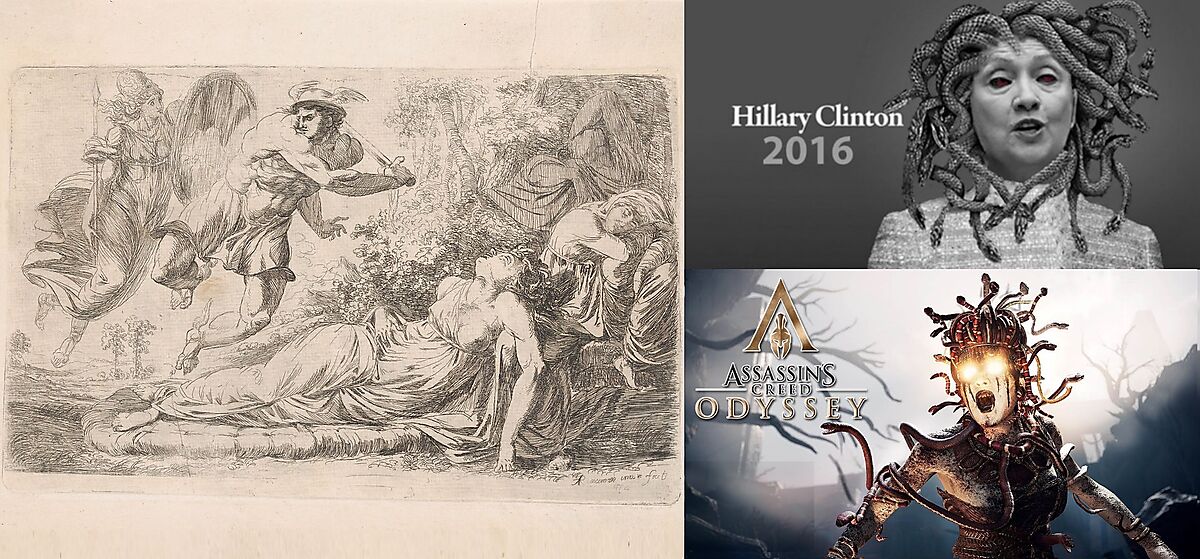
According to Ovid’s epic Metamorphoses (year 8CE), ‘below the mountain mass of icy Atlas’1 lived the gorgon Medusa, with hair of ‘loathsome snakes’.2 Around her dwelling were the figures of men and animals turned to stone by her very gaze. Medusa is slain by the mythical hero Perseus, who avoids her gaze through a polished bronze shield, and then uses the severed head to rescue his mother, Danaë.
Even prior to Ovid’s retelling of the myth, from around 500BCE, Medusa’s head was a common Greek motif, appearing on ornaments, utensils, and medallions. Here, she was considered an apotropaic symbol,3 a symbol that has the power to avert evil or bad luck.
From Renaissance times, Medusa’s power and femininity has made her an enticing subject for Western artists. Her beheading is portrayed as an act of heroism, as in Alexander Runciman’s Perseus and the Sleeping Medusa (1774).
In contemporary popular culture, Medusa appears as a frightening yet feminine monster in the popular video game Assassin’s Creed Odyssey (2018). She has also been the subject of internet memes, where powerful women such as Germany’s Angela Merkel and US senator Hillary Clinton are depicted with serpentine hair, signifying both an anxiety over female leaders and the popularity of Medusa as a symbol of fear and ferocity — one that must be overcome.
However, in Ovid’s retelling, she was once a beautiful maiden who was violated by Poseidon in Athena’s temple.4 For this act of sacrilege, Athena transforms her into a vengeful, snake-haired beast.5
In popular imagination, Medusa’s slaying by a heroic Perseus remains the dominant narrative; her demise as a victim of rape, however, is less well known.
Ovid. Metamorphoses, trans. A.D. Melville. Oxford: Oxford University Press. 2008. 97
Ovid. Metamorphoses, trans. A.D. Melville. Oxford: Oxford University Press. 2008. 98
Albert M Potts. The World’s Eye. Kentucky: The University Press of Kentucky. 1982. 29
Ovid. Metamorphoses, trans. A.D. Melville. Oxford: Oxford University Press. 2008. 98
Ovid. Metamorphoses, trans. A.D. Melville. Oxford: Oxford University Press. 2008. 98
Isabella Barber
Manchester
As a Greek-Cypriot, I grew up being told stories of Greek mythology at bedtime. But as I’ve grown older I have learnt to think critically about these myths, and want to take the opportunity to explore them in greater depth, starting with Medusa’s origin story as an example of the negative portrayal of women in literature throughout history.