
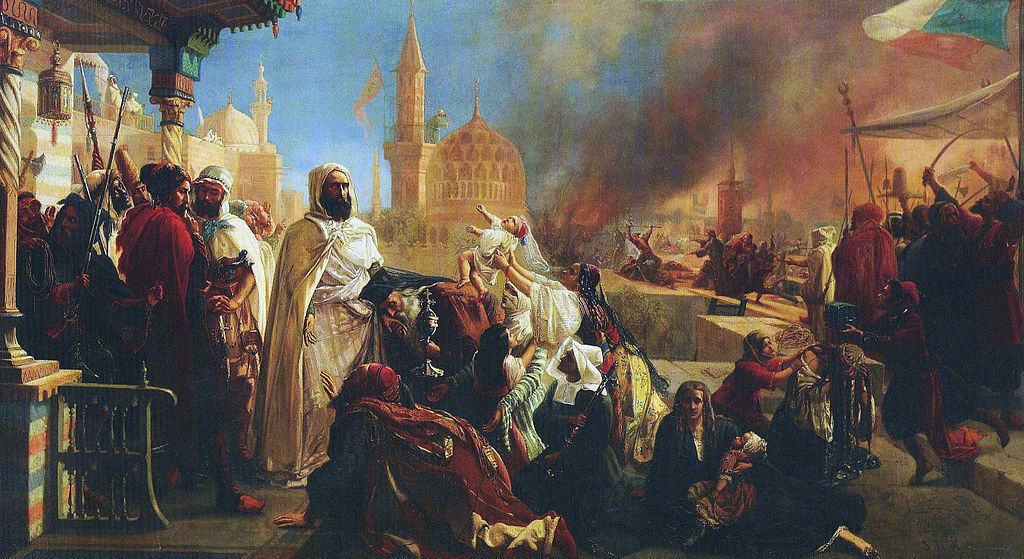
Jan-Baptist Huysmans, Abdelkader Protecting Christians in Damascus, 1861
The Malleability of Historic Memory: The Story of Abdelkader’s Resistance to French Rule
In November 1832, the western tribes of the Mascara region of Algeria gathered under an elm tree to pledge allegiance to 24-year-old Abdelkader, the newly appointed head of a Sufi brotherhood. Sufism is a mystical Islamic practice which promises adherents a personal experience of God, and this was a symbolic reenactment of the Pledge of the Tree, where the Sahabah (companions) had pledged their support to Prophet Muhammad before the conquest of Mecca.1
Two years earlier, on 14 June 1830, invading French forces had landed in Sidi Fredj, a coastal Algerian town. Algeria was a diverse society which included Berbers (the original inhabitants of the region who had converted to Islam), as well as Jews and Christians. Despite the diversity, Arabic remained the common language and Islam the dominant faith. The country was ruled by the Dey, a representative of the Ottoman Empire. However, the regime’s widespread unpopularity among ordinary Algerians rendered it too weak to resist the French.
For the tribes of Western Algeria their discontent materialised into a pledge of allegiance to Abdelkader. In 1832 he declared a mass jihad (or holy war) against the French, urging Algerians to fulfil their sacred duty and defend their ‘world of Islam’ from the Christian invader.2
Abdelkader quickly formed a coalition of Algerian forces to fight the French, accomplishing a series of military successes and forcing treaties. In 1834 General Louis Alexis Desmichels made major concessions to Abdelkader in the Desmichels Treaty, giving him the interior of the Oran and allowing him to establish his own state in Western Algeria. He earned himself the title of Emir al-Mumineen or Commander of the Faithful in the process. Abdelkader continued his conquest over the French as well as other tribes of the region, and at the height of his campaign he held jurisdiction over two-thirds of Algeria, culminated in the Treaty of Tafna negotiated with General Thomas-Robert Bugeaud in 1837.3 He gained a reputation as a pious and fair leader, ruling according to the precepts of Sharia law and implementing features such as equal taxation and education.4
However, his expansion came to an abrupt halt in 1841 after Bugeaud was promoted to Governor General with a remit for the conquest of Algeria. French policy transformed into occupation totale, leading to the crushing of Abdelkader’s state and his eventual surrender in 1847.
A century later, in 1954, a liberation movement rose again in Algeria to overthrow French rule. The National Liberation Front, an Algerian nationalist movement, championed Abdelkader as the father of their independence struggle, but downplayed the role of Islam, focusing instead on his patriotism, and military and diplomatic achievements.5
In parallel to this, the French ran a campaign to position Abdelkader as a French ally. Following his surrender in 1847, Abdelkader was detained in France for four years, but was then released by president Louis-Napoleon and allowed to live in Syria on a handsome pension. Abdelkader distanced himself from Algerian politics to the extent of disowning one of his sons for encouraging the Algerian insurrection of 1871. On 15 October 1949 French authorities had inaugurated a monument in Cacherou, a town near Mascara, to commemorate Abdelkader, heralding him as a French patriot.6
In a third reinterpretation of Abdelkader’s legacy, following the War of Independence (1954–62), Islamic authors have sought to reclaim the Islamic foundations of his resistance movement.7 The writer Jurj al-Rasi has claimed Abdelkader as the father of the modern Islamic state for his role in establishing links between Islam and democracy.8
These reinterpretations of Abdelkader reveal the malleability of historic memory, a phenomenon which allows for historic figures to re-emerge as influential forces, often in contradictory forms. The past is moulded and manipulated to suit new agendas, becoming an indispensable tool in the shaping of the future.
Today both Algerians and tourists visit the Emir Abdelkader Mosque and University in Constantine, Algeria. Opened in 1994 to commemorate Abdelkader, it is the second largest mosque in Algeria, with magnificent Islamic architecture, and stands as a monument to one of Algeria’s most illustrious sons.
References
- Itzchak Weismann. "God and the Perfect Man in the Experience of ‘Abd al-Qâdir al-Jaza’iri". The Muhyiddin Ibn Arabi Society. 2001
- Martin Evans and John Phillips. Algeria: Anger of the Dispossessed. London: Yale University Press. 2007. p.28
- Martin Evans and John Phillips. Algeria: Anger of the Dispossessed. London: Yale University Press. 2007. p.29
- Itzchak Weismann. "God and the Perfect Man in the Experience of ‘Abd al-Qâdir al-Jaza’iri". The Muhyiddin Ibn Arabi Society. 2001
- Michael Kemper. "The Changing Images of Jihad Leaders: Shamil and Abd al-Qadir in Daghestani and Algerian Historical Writing". The Journal of Alternative and Emergent Religions. 11, no. 2. 2007. pp.28–58. 38
- Jan C. Jansen. "Creating National Heroes, Colonial Rule, Anticolonial Politics and Conflicting Memories of Emir 'Abd al-Qadir in Algeria, 1900-1960s". History and Memory. 28, no. 2. 2016. pp.3–46. 30
- Michael Kemper. "The Changing Images of Jihad Leaders: Shamil and Abd al-Qadir in Daghestani and Algerian Historical Writing". The Journal of Alternative and Emergent Religions. 11, no. 2. 2007. pp.28–58. 45
- Michael Kemper. "The Changing Images of Jihad Leaders: Shamil and Abd al-Qadir in Daghestani and Algerian Historical Writing". The Journal of Alternative and Emergent Religions. 11, no. 2. 2007. pp.28–58. 28–58

Algeria has a fascinating colonial history. Sitting only a short distance across the Mediterranean from Europe, it lay at the heart of the French Empire. I wanted to explore Abdelkader’s role in Algerian independence, both in his early resistance movement and his legacy.— Amy Wallwork