
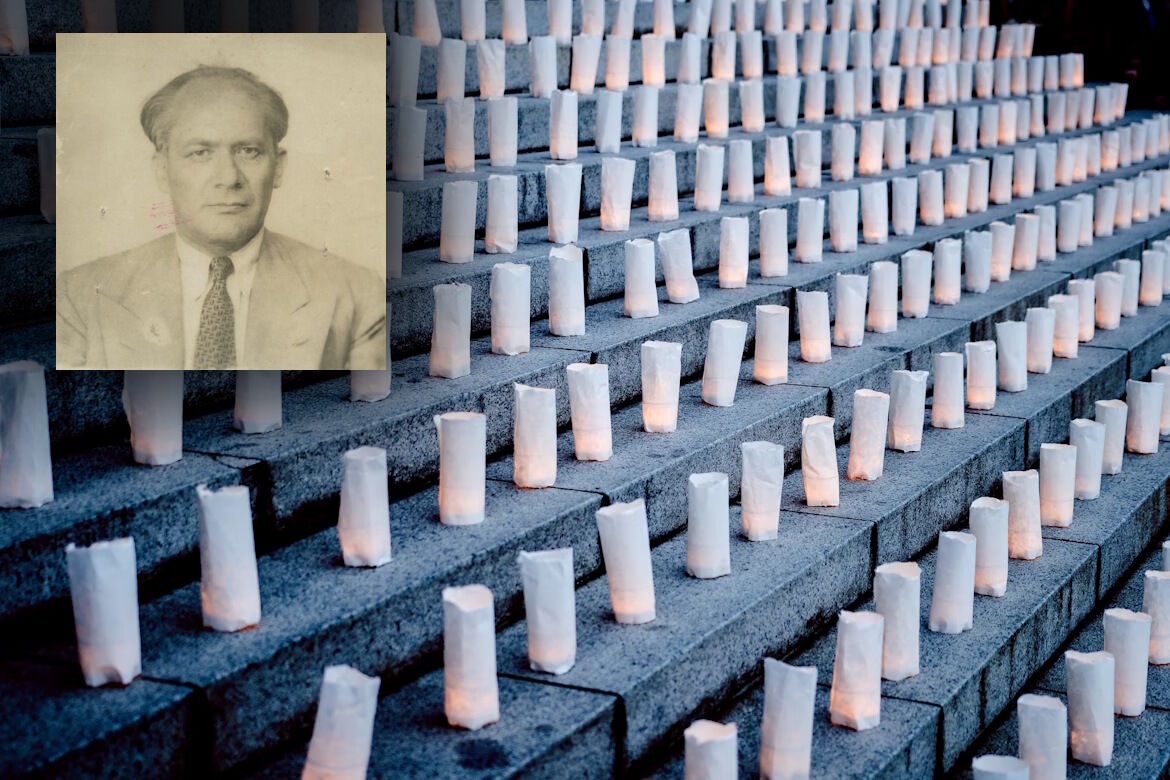
Raphael Lemkin and the 1948 Genocide Convention
The Limits of International Justice: The 1948 Genocide Convention and the Persistent Failure to Prevent Mass Atrocities
In the aftermath of WW2, the Allies prosecuted 22 high-ranking Nazis at the Nuremberg Trials (formally, the International Military Tribunal). Observing from the sidelines was the Polish lawyer Raphael Lemkin, who had lost 49 members of his family in the Holocaust1. Lemkin argued that the Tribunal, while delivering retrospective justice, had not gone far enough, as it failed to anticipate or deter what he described as ‘future Hitlers’.2.
On 9 December 1948, the UN General Assembly unanimously adopted the Genocide Convention3, an international mechanism designed to define and outlaw genocide so that the atrocities of the Holocaust would never be repeated.
Lemkin spearheaded the creation of the convention. He had coined the term ‘genocide’ in 1944 (from Latin geno ‘race’ and cide ‘killing’) to describe the Nazi extermination of Jews. He was inspired to act after learning of the systematic killing of Armenians during WW1 by the Ottoman Empire, a crime that had gone unnamed and unpunished.
The convention defined genocide clearly, setting out criteria for when mass killings could be called ‘genocide’. It defined the crime as acts committed with intent to destroy, in whole or in part, any of four possible groups, identified by their nationality, ethnicity, race, or religion. The term ‘destroy’ was not limited to killing, but included causing serious bodily or mental harm, intentionally imposing destructive conditions of life, measures to prevent births, and the forced transfer of children from one group to another.
At the heart of the convention is the concept of dolus specialis, or ‘special intent’ — a key legal element that separates genocide from other war crimes. To prove genocide, one must demonstrate that the perpetrators acted with the specific intent to destroy a protected group, rather than committing acts of violence as part of a wider conflict.
Two of the most harrowing illustrations of genocide in recent history emerged in Rwanda and Bosnia. On 6 April 1994, Rwandan President Juvénal Habyarimana was assassinated during the country’s civil war, creating a power vacuum that exposed Rwanda’s Tutsi minority (a long-marginalised ethnic group) to brutal persecution. In the months that followed, Hutu militias (armed groups from Rwanda’s majority ethnic group) systematically murdered an estimated 500,000 Tutsis 4. Just over a year later, on 11 July 1995, in the Bosnian town of Srebrenica, Republika Srpska forces (VRS), led by General Ratko Mladić, entered a UN-designated ‘safe zone’ and executed over 8,000 Bosniak Muslims, targeted for their religious and ethnic identity. The massacre unfolded with no resistance from UN peacekeepers, marking the second genocide in just over a year.
On 8 November 1994, the International Criminal Tribunal for Rwanda (ICTR) was established5 and began prosecuting those responsible for the genocide three years later. Despite criticism for its selective focus — especially its limited attention to war crimes committed by the Tutsi-led Rwandan Patriotic Front (RPF) — it successfully secured the first-ever genocide conviction. Jean-Paul Akayesu, former mayor of the Taba commune in the Gitarama Prefecture of Rwanda, was found guilty of facilitating and ordering killings and rapes of Tutsi residents in his commune, demonstrating a clear intent to destroy the Tutsi population and making him a pivotal figure in the genocide.6 The tribunal concluded that the genocide was not merely part of Rwanda’s civil war, but was a systematically executed campaign by political leaders, military personnel, and civilians, aimed primarily at non-combatant victims, including women and children.
In 1993, the International Criminal Tribunal for Yugoslavia (ICTY) was established and later tried members of the Army of Republika Srpska (VRS) for the 1995 Srebrenica massacre.7. At his trial in 2001, it was initially challenging to prove that Radislav Krstić, a senior Bosnian Serb general, acted with the special intent required for genocide, as the defence argued he was engaged in a military campaign targeting Bosniak men of fighting age. The tribunal nonetheless found that Krstić's role amounted to an intent to destroy a substantial part of the Bosniak population, finding him guilty of genocide and sentencing him to 46 years in prison.8 Three years later, Krstić’s sentence was reduced to 35 years on appeal, after the judges found insufficient evidence that he possessed dolus specialis (the specific intent that defines genocide) and instead convicted him of aiding and abetting genocide.9 Yet, a five‑judge panel rejected the defence’s claim that the Srebrenica massacre itself did not qualify as genocide — a pivotal decision affirming the status of genocide in international law.
In the years that followed, the ICTY also prosecuted figures from other conflicts in the region. A series of high-profile acquittals — such as those of Kosovo Liberation Army commander Ramush Haradinaj in 200810 and Croatian Army General Ante Gotovina in 201211 — left many victims’ groups disillusioned, viewing the tribunal’s decisions as selectively enforced and politically influenced. Nevertheless, these trials marked an important evolution in the enforcement of the Genocide Convention, helping to set international precedents.
However, despite its noble aims and carefully articulated legal definitions, the 1948 Genocide Convention has ultimately failed in its core purpose: it has not prevented genocide. This failure lies not in the text of the law, but in wider systemic forces.
Chief among these systemic factors is the political self-interest of powerful states. The convention depends on nations to enforce its provisions, yet enforcement collapses when those same nations have strategic or economic interests in regimes committing atrocities.12 For example, during the Rwandan genocide, France continued military support to the Rwandan government despite the ongoing massacres of civilians, signalling their support for the regime and a disregard for the convention13.
Selective enforcement further undermines the convention’s credibility. The slow, fragmented response of the international community, particularly key UN members such as the United States and France, during both Rwanda and Srebrenica allowed atrocities to unfold openly and with impunity. When legal obligations are enforced inconsistently, they lose their moral authority. Countries come to regard international law not as a binding standard, but as a tool selectively applied when politically convenient.
In 1959, at the age of 59, Raphael Lemkin died of poverty in a New York apartment14. Despite receiving multiple nominations for the Nobel Peace Prize, he died in obscurity in a country that, during his lifetime, did not ratify the Genocide Convention that he dedicated his life to creating.
It was only decades after his death that Lemkin’s legacy would resurface prominently, during the tribunals for Rwanda and former Yugoslavia, where genocide finally began to be recognised as the ‘crime of crimes’, bringing renewed attention to his pioneering work.
References
- Facing History & Ourselves. "Raphael Lemkin and the Genocide Convention". Facing History & Ourselve</em><em>s. 2020
- Donna-Lee Frieze (ed.). Totally Unofficial: The Autobiography of Raphael Lemkin. Connecticut: Yale University Press. 2013. 118
- William A. Schabas. "Convention on the Prevention and Punishment of the Crime of Genocide, Paris, 9 December 1948". Audiovisual Library of International Law. 2023
- Luc Reydams. "‘More than a million': the politics of accounting for the dead of the Rwandan genocide". Review of African Political Economy. 2020
- ICTR. "The ICTR Remembers 20th Anniversary of the Rwandan Genocide". IRMCT.org</em><em>. 2025
- ICTY.org. "International Criminal Tribunal for the former Yugoslavia". icty.org. 2017
- United Nations International Residual Mechanism for Criminal Tribunals. "Historic judgement finds Akayesu guilty of genocide". unictr.irmct.org. 2025
- ICTY.org. "Historic judgement finds Akayesu guilty of genocide". icty.org</em><em>. 1998
- ICTY.org. "PROSECUTOR v.RADISLAV KRSTIC". icty.org</em><em>. 2025
- ICTY.org. "Haradinaj, Balaj, and Brahimaj Acquitted on Retrial". icty.org</em><em>. 2025
- ICTY.org. "Appeals Chamber Acquits and Orders Release of Ante Gotovina and Mladen Markač". icty.org</em><em>. 2025
- Jonathan Beloff. "Rwanda’s Foreign Relations Post-Genocide: Shifting from France to the UK". Kings College London
- Sascha Nanlohy. "Geopolitics and Genocide: Patron Interests, Client Crises, and Realpolitik". Journal of Global Security Studies. 9, no. 1. 2024. 1-20. pp.3
- Douglas Irvin-Erickson. Raphael Lemkin and the Concept of Genocide. United States: University of Pennsylvania Press. 2016. pp. 1-320

In the current social and political landscape we find ourselves in, it can sometimes feel as though we are swimming in circles, making the same mistakes over and over again. I wanted to write this article because I believe it is important to reflect on the past. I think that if we don’t stop to consider the past, we risk making a mockery of the future.— Harry Hudson