
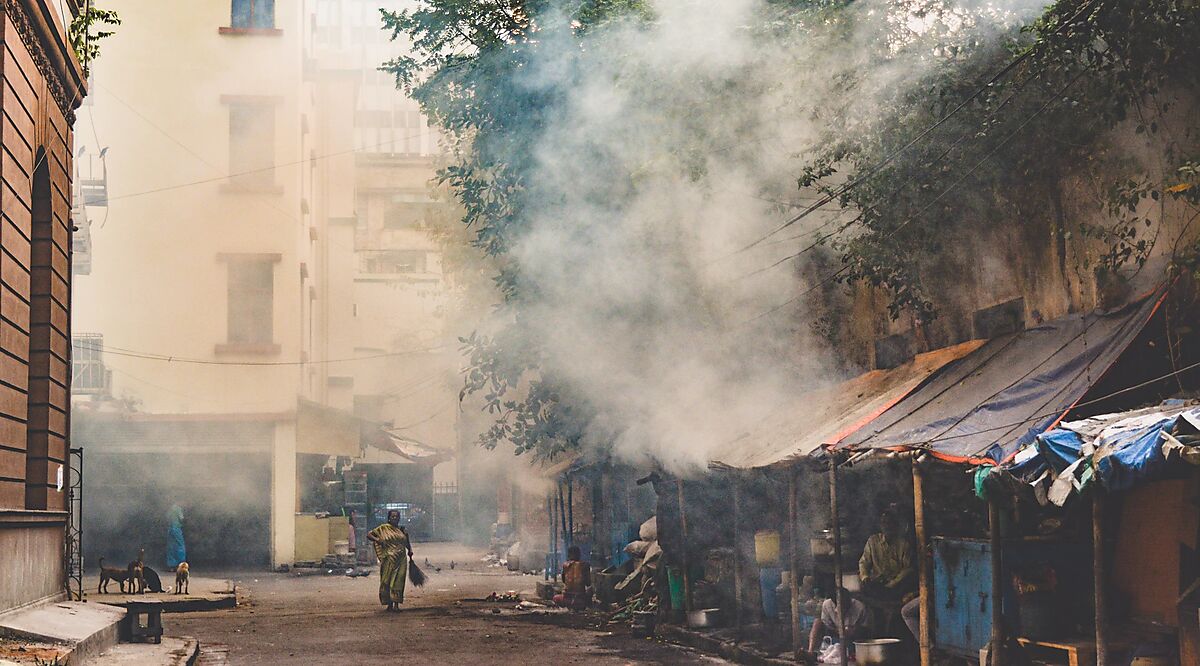
Kolkata, West Bengal, India
The Indian Emergency of 1975 and Rohinton Mistry’s ‘A Fine Balance’
On 25 June 1975, Indian premier Indira Gandhi announced a state of emergency over national radio, amidst mounting pressure to oust her from power. Barely two weeks earlier, she had been found guilty of electoral malpractice during her 1971 campaign. The Emergency gave Gandhi dictatorial powers and would last for 21 months.
In Rohinton Mistry’s A Fine Balance (1995), tailors Ishvar and Omprakash Darji, who are uncle and nephew, live under the Emergency in a slum in a fictional ‘city by the sea’, most likely Mumbai. Their slum is facing impending demolition by authorities seeking to ‘beautify’ the city.
In the real world, Gandhi’s beautification programme sees the destruction of 100,000 slum dwellings in Delhi between 1975 and 1977, displacing 700,000 people.1 In the 1976 tragedy of Turkman Gate, Old Delhi, authorities bulldoze homes, and police shoot dead 12 protestors.2 This compulsory urbanisation creates space for businesses and facilities for the Asian Games of 1982.
In Mistry’s fictional account, the Darjis are threatened with forced vasectomy, mirroring developments in the real world where Gandhi’s government launches a mass sterilisation programme. India is under pressure from international agencies (such as the UN) to bring its population under control, with a billion-dollar aid package in the balance.3 Gandhi’s son Sanjay, a political outsider with no formal qualifications, delivers results through a campaign that coercively sterilises men from poor communities.4 In 1976, sterilisations peak at over 8 million.5 Official records attribute 1,774 deaths to botched surgeries.6
In the election held around the lifting of the Emergency on 21 March 1977, Indira Gandhi’s Congress party was swept out of power. Both Indira and Sanjay lost their seats.
Mistry’s novel, which records popular discontent during this period, was shortlisted for the Booker Prize.
References
- Piyush Tiwari, Ranesh Nair, Pavan Ankinapalli, Manisha Gulati, Pritika Hingorani, Jyoti Rao. India's Reluctant Urbanization: Thinking Beyond. New York: Palgrave Macmillan. 2015. p. 95
- Emma Tarlo. Unsettling Memories: Narratives of the Emergency in Delhi. Los Angeles: University of California Press. 2003. p.38
- Matthew Connelly. "Population Control in India: Prologue to the Emergency Period". Population and Development Review. 32. 2006. 629-667. p. 651
- Mara Hvistendahl. Unnatural Selection: Choosing Boys Over Girls, and the Consequences of a World Full of Men. New York: Public Affairs. 2011. p.136
- Kristin Victoria Magistrelli Plys. Brewing Resistance: Indian Coffee House and the Emergency in Postcolonial India. Cambridge: Cambridge University Press. 2020. p.72
- Rickie Solinger, Mie Nakachi. Reproductive States: Global Perspectives on the Invention and Implementation of Population Policy. New York: Oxford University Press. 2016. p.145

I wanted to write this article to honour the marginalised Indian people who had their lives and experiences written out of history. I highly recommend ‘A Fine Balance’ as an informative and emotional telling of the Emergency from the perspective of those who suffered.— Georgia Britton