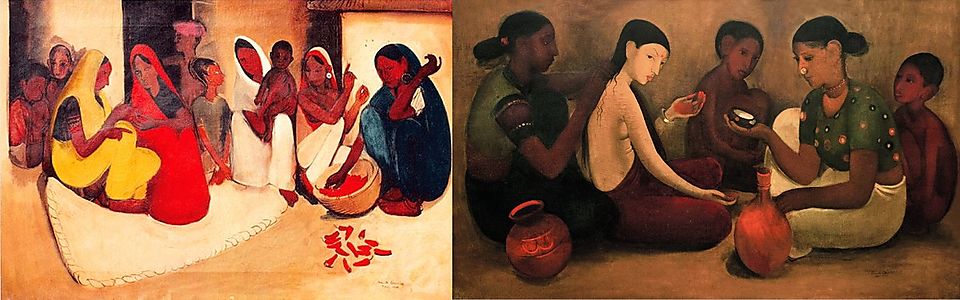
This work, ‘The India that belonged only to Amrita Sher-Gil’, is a derivative of ‘Village Scene’, ‘Bride's Toilet’ used under CC BY. ‘The India that belonged only to Amrita Sher-Gil’ is licensed under CC BY SA 4.0 by The Cultural Me
The India that belonged only to Amrita Sher-Gil: The fusion of Eastern and Western Art
In 1937 after journeying through southern India, Amrita Sher-Gil began to reacquaint herself with the latter half of her Hungarian-Indian identity. While early works, like the Gauguin-esque Self-Portrait (1930), reflected her Parisian studies she remained unfulfilled, believing (as did her mentor Lucien Simon) that her artistic development lay in India1. “Europe,” she said, “belongs to Picasso, Matisse and many others, India belongs only to me”.2
Village Scene (1938) depicts the everyday life of ordinary Indians, reflecting her ambition to “be, through the medium of line, color, and design, an interpreter of the life of the people.”3 Yet, her style embodied Post-Impressionism in its focus on form, line and colour to express the raw emotions of her subjects, a departure from traditional Indian sentimental artistry.
In the Bride’s Toilet (1937), depicting the rituals of pre-marriage preening, the dull background is characteristic of Ajanta cave paintings and the composition: of Indian miniatures. The lengthened figures invoke Modigliani and the colours possess a van Gogh-inspired vibrancy, successfully infusing Indian artistic traditions with Western oil painting techniques.
This was in stark contrast to the pale watercolours and romanticised figures of her contemporaries of the Bengal school who attempted to recapture the quintessential Indian artistry of the pre-colonial era, which Sher Gil felt had a “crippling effect on the creative spirit”4.
Her fusion of Eastern and Western styles reflected the emerging landscape: a cultural India wedded to Western influences, mirroring her dual identity and showing “a living people in a living language”5.
I wanted to highlight how the fusion of Eastern and Western styles in Sher-Gil’s work resulted in a more intimate, authentic and emotive picture of ordinary Indians, than others had achieved before her.