
Above and beyond poster
The Iconic Poster of Dorie Miller

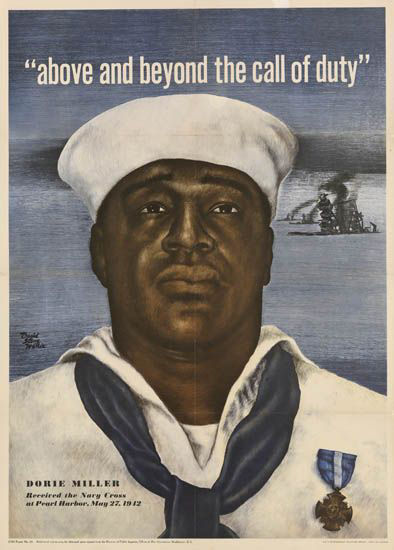
Standing at attention is a black man in naval attire, a medal pinned on his chest. Behind him is an eerie seascape with three ships in a row beginning to sink. The words “above and beyond the call of duty” are printed above his head. We also learn that he is “Dorie Miller” and that he received the Navy Cross, the second-highest decoration awarded by the United States Navy1, on 27 May 1942. This poster was commissioned by the US military as a propaganda tool to encourage black Americans to join the war effort. However, due to racial segregation, Miller and other black servicemen were no more than lowly mess attendants.2
Miller joined the Navy on 16 September 1939 and served aboard the battleship USS West Virgina. On 7 December 1941, during the attack on Pearl Harbour, after first transporting his critically injured Captain and other servicemen to safe quarters, Miller, who was untrained, single-handedly operated a machine gun, firing at Japanese aircraft until he was ordered to evacuate. Miller’s bravery was recognised: he became the first black American to be awarded the Navy Cross.3
David Stone Martin designed and illustrated this poster using a photograph of Miller for inspiration. He imbued the poster with sentimental value with the intention of attracting black Americans into the military.
Miller himself was killed in action on 24 November 1943. Five years later, on 26 July 1948, President Truman signed an executive order committing to the desegregation of the armed forces.4
Miller joined the Navy on 16 September 1939 and served aboard the battleship USS West Virgina. On 7 December 1941, during the attack on Pearl Harbour, after first transporting his critically injured Captain and other servicemen to safe quarters, Miller, who was untrained, single-handedly operated a machine gun, firing at Japanese aircraft until he was ordered to evacuate. Miller’s bravery was recognised: he became the first black American to be awarded the Navy Cross.3
David Stone Martin designed and illustrated this poster using a photograph of Miller for inspiration. He imbued the poster with sentimental value with the intention of attracting black Americans into the military.
Miller himself was killed in action on 24 November 1943. Five years later, on 26 July 1948, President Truman signed an executive order committing to the desegregation of the armed forces.4