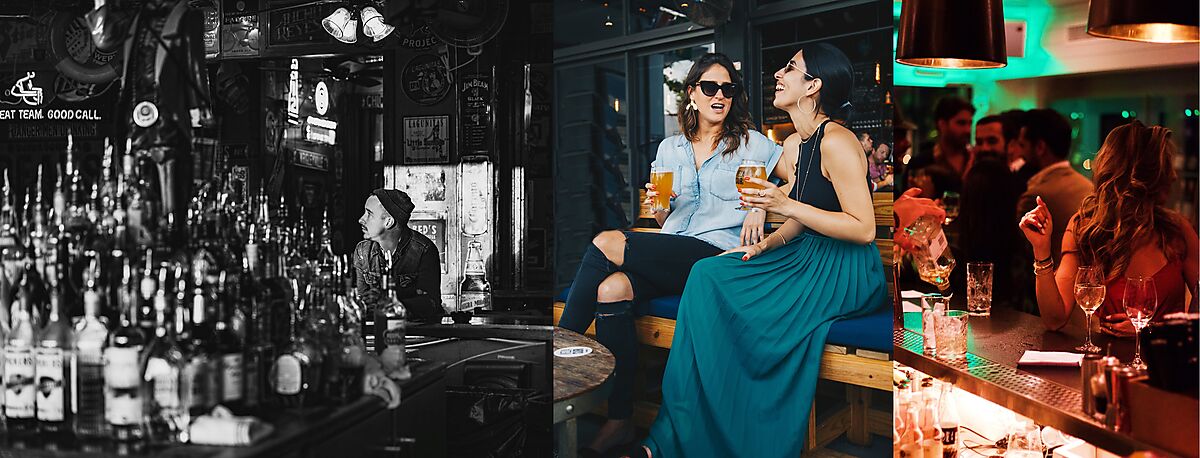
By the end of WW1, British pubs had begun their transformation from seedy drinking dens; partitions and snugs were stripped away, changing stuffy rooms into bright and beautiful spaces.1 Landlords began to pay more attention to the décor, food and entertainment on their premises — a reaction to the changing demographic of their clientele.
The absence of men during the war saw an extraordinary number of women entering the workforce. Extra money, loneliness and grief contributed to their spending leisure time in the pub.2 While previously the domain of a few, largely working-class, women, the number of middle and upper-class pub-goers rose from 1916.3 Women who had once shamefully entered through the back-alley now marched through the front doors with their heads held high.4
Behind these changes was the Central Control Board (CCB), a liquor traffic body created in 1915 by a government seeking a peaceful home front5. The CCB advocated that ‘women are as equally entitled to drink as men.’6, but also encouraged better facilities for women as a means for responsible pub management.
However, a Birmingham Christian temperance group obtained over 37,000 female signatories to a petition demanding that women under 21 be banned from the pub until the end of the war.7 Chief Constables from Newcastle also met with the CCB to ask that women should only be allowed to drink whilst eating a meal as a solution to the ‘growing evil’8 of increased female drinking.
The Brewers’ Journal, a London-based monthly trade journal, however, ‘strongly opposed any conspiracy to exclude women from the licensed house’9, as they were vital to its enrichment — a WW1-induced turning point that is reflected to this day.
David W. Gutzke. Gender, Class, and Public Drinking in Britain During the First World War. Social History, 27 (54). 1994. 378
David W. Gutzke. Gender, Class, and Public Drinking in Britain During the First World War. Social History, 27 (54). 1994. 369
Robert Duncan. Pubs and Patriots: The Drink Crisis in Britain during World War One. Liverpool University Press. 2013. 151
David W. Gutzke. Gender, Class, and Public Drinking in Britain During the First World War. Social History, 27 (54). 1994. 374
David W. Gutzke. Gender, Class, and Public Drinking in Britain During the First World War. Social History, 27 (54). 1994. 372
David W. Gutzke. Gender, Class, and Public Drinking in Britain During the First World War. Social History, 27 (54). 1994. 378
John Greenaway. Drink and British Politics since 1830: A Study in Policy-Making. London: Palgrave MacMillan. 2013. 101
David W. Gutzke. Gender, Class, and Public Drinking in Britain During the First World War. Social History, 27 (54). 1994. 383
David W. Gutzke. Gender, Class, and Public Drinking in Britain During the First World War. Social History, 27 (54). 1994. 384
Helena Geddes
Montrose
Having grown up in modern Britain, it is easy to forget that there was a time it was socially unacceptable for a woman to nip to the pub for a beer with her friends! This is now such a normal part of life for many British women and I would like the reader to understand where this shift in attitudes originated.