
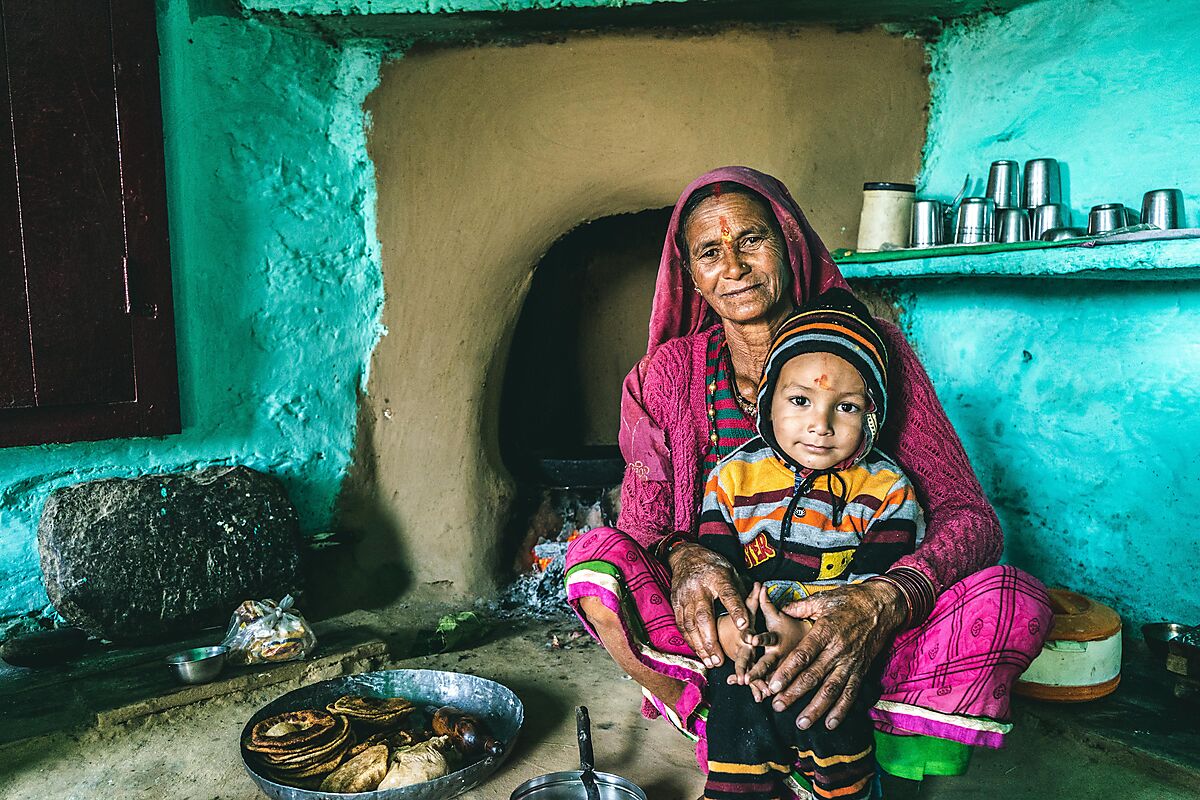
Woman and Child, India
The Epidemiological Transition and Health Inequality in India
There are no hospitals in the rural village of Rajokri, India. Those who live there must travel several kilometres for even the simplest ailment. Sensing an opportunity, the Cancer Awareness, Prevention and Early Detection Trust (CAPED) set up a temporary cervical cancer screening camp there in 2019, with the goal of detecting early signs of cancer in women.1
Despite offering the screening for free, the volunteers at CAPED soon realised the village women were embarrassed to come forward due to the stigma surrounding women’s health. Even those who did attend expressed reluctance in following up because transportation to the nearest hospital was often unreliable, and the prospect of having to miss work was unfeasible for many.2
CAPED’s drive for early diagnosis was motivated by a sharp increase in cancer cases in India, which has risen from around 1 million in 2010 to over 13 million by 2020.3 Cancer and other non-communicable diseases (NCDs) are now the cause of about 65% of all mortalities.4 This change in disease patterns, from a prevalence of infectious diseases (such as HIV and malaria) to NCDs (such as cancer, heart conditions, and diabetes), is known as an Epidemiological (or Health) Transition.5 Many countries have already experienced this transition at various points in history. However, the transition is progressing at a much faster rate in developing countries like India. For example, England’s transition, driven by industrialisation and economic growth, slowly unfolded over two centuries, from 1790 to 1970.67 In India on the other hand, large investments in public health and rapid advances in medical technology have resulted in the transition spanning a mere two decades8.
The rapidity of the transition has fed into preexisting health inequalities in India. One dimension of this inequality is the dichotomy between urban and rural, with an estimated 10% of the population having access to 38% of radiotherapy devices, all of which are only available in urban areas.9 Proximity to a health facility is particularly crucial for NCDs, the treatment of which is generally more complex than for infectious diseases, requiring multiple visits spanning several months or years. The treatment for NCDs is also typically more expensive causing an increase in out-of-pocket expenses for the patient.10
The costs associated with NCDs represent a significant challenge for those living below the poverty line (the minimum level of income deemed adequate to meet basic needs such as food, shelter, and clothing). In India the poverty line is $2.15 per day. Approximately 180 million people earn less than that,11 and for this demographic the financial impact of NCDs (travel costs, out-of-pocket expenses, lost income due to absence from work…) are particularly pronounced.
To combat this problem, the Indian government established the Health Ministry’s Cancer Patient Fund (HMCPF) in 2009. The purpose of the fund is to provide financial assistance to cancer patients living below the poverty line, supporting them along the entire treatment journey, from diagnosis to chemotherapy to surgery.
Patients are able to access the fund through 27 Regional Cancer Centres located across the country. They are required to provide proof of income, usually through a ration card (which proves entitlement to subsidies or free food) or an income certificate, along with an application signed by the treating doctor.
However, despite the surge in cancer diagnoses, the number of successful applications to the HMCPF has decreased steeply in the past decade.12 The HMCPF seems to set minimal requirements for applicants. Therefore, the primary reason cancer patients are not accessing the fund is likely because many do not meet the requirement of earning an income below the poverty line.
Is the poverty line an adequate measure of health inequality? It is estimated that 16.4% of India’s population is affected by social determinants of health, even if living above the poverty line.13 Social determinants include one’s social demographic, level of education, and living environment as well as working conditions. These factors play a significant role in determining an individual’s quality of life and can have both a short-term and long-term impact on health. For instance, low educational attainment is often associated with unemployment, low income, or hazardous jobs. Living in environments susceptible to air pollution or poor water quality can increase the risk of illness and diseases. Additionally, residing in remote areas may result in limited transportation options and difficult access to health facilities.
The HMCPF is an unfortunate example of how India’s health system is not yet ready to face the challenges brought upon by the epidemiological transition. India’s attempts at fighting the transition have been too focused on monetary determinants of poverty. All governmental plans to support cancer patients are purely financial; there is little to no support for people experiencing any other dimension of inequality.
India’s prime minister Narendra Modi has shown genuine commitment to the cause. ‘True progress is people-centric. No matter how many advances are made in medical science, access must be assured to the last person at the last mile,’ he said at the One Earth One Health convention in 2023.14 The PM goes on to speak of his commitment to achieve accessible and affordable healthcare.
If he is to achieve that, then there needs to be a substantial shift in how India looks at health and inequality. The government must realise the importance of education, public transportation, and sanitation for health equality and commit additional investment for their development. By doing so, India will be better prepared to fight the looming health challenges brought on by the epidemiological transition.
References
- American Cancer Society. "India Lakshmi's Story: Accessing Cervical Cancer and Treat Services". Youtube. 2020
- CAPED INDIA. "Who We Are". CAPED INDIA. 2023
- Ramnath Takiar, Deenu Nadayil, A. Nandakumar. "Projections of number of cancer cases in India (2010-2020) by cancer groups". Asian Pac J Cancer Prev. 11, no. 4. 2010. 1045-9. 1045-9
- The World Bank. "World Development Indicators". Data Bank. 2024
- Johan P. Mackenbach. "The Epidemiologic Transition Theory". Journal of Epidemiology and Community Health. 48, no. 4. 1994. 329-331. 329-331
- John R. Evans, Karen Lashman Hall, Jeremy Warford. "Shattuck Lecture--Health Care in the Developing World: Problems of Scarcity and Choice". N Engl J Med. 305, no. 19. 1981. 1117-27. 1117-27
- Abdel R. Omran. "The Epidemiologic Transition: a Theory of the Epidemiology of Population Change". The Milbank quarterly. 83, no. 4. 2005. 731-57. 731-57
- Suryakant Yadav and Perianayagam Arokiasamy. "Understanding epidemiological transition in India". Epidemiological Transitions- Beyond Omran’s Theory. 7, no. 1. 2014. 1-14. 1-14
- Elizabeth Soumya. "India Needs Cancer Care Outside Its Big Cities". Think Global Health. 2024
- Yarlini Balarajan, S. Selvaraj, S.V. Subramanian. "Health Care and Equity in India". Lancet. 377, no. 9764. 2011. 505–515. 505-515
- The World Bank. "Country Profile". The Poverty and Inequality Platform. 2024
- Ministry of Health and Family Welfare. "RAN (Health Ministers Cancer Patient Fund)". Ministry of Health and Family Welfare. 2018
- The World Bank. "Country Profile". The Poverty and Inequality Platform. 2024
- PMINDIA. "PM inaugurates 6th Edition of One Earth One Health – Advantage Healthcare India 2023". PMINDIA. 2023

During my degree in International Development, I came to learn how crucial health policy planning is for society, and how it can be a useful tool in the fight against inequality. I wanted to explore this in the context of health policy in India.— Roberta Guarini