
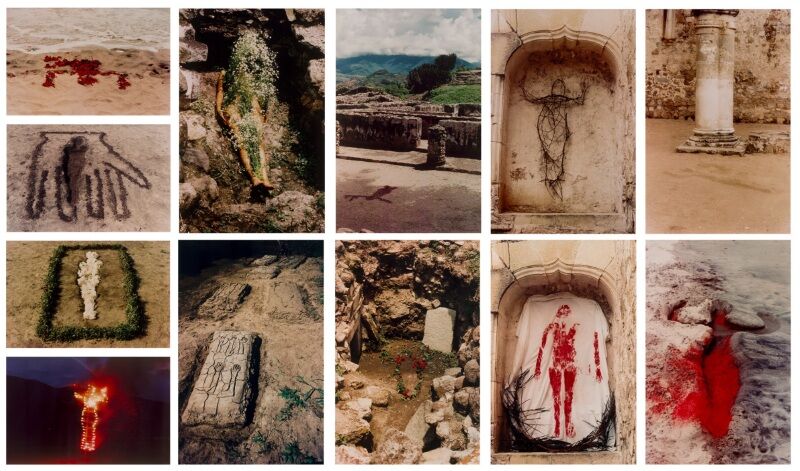
Ana Mendieta, Silueta Series, 1973–1980
The Ephemeral Body: Ritual, Identity and the Elemental in Ana Mendieta’s ‘Siluetas’ (1973–1980)
When the revolutionary Fidel Castro rose to power in Cuba, there was anxiety from both outside and within the Spanish-speaking Caribbean island. Anticipating the communist regime, a wave of approximately 200,000 Cubans — including political opponents and the wealthy — fled the country for Florida. The United States government contributed to this exodus through ‘Operation Pedro Pan’, a programme that sent 14,000 unaccompanied children to the US between 1960 and 62, where they were handled by local aid programmes. Among them were Ana Mendieta and her sister Raquel, great-nieces of interim president Carlos Mendieta; the sisters found themselves stranded in a refugee camp in the Iowan city of Dubuque in 1961.
Ana Mendieta spent her early years in Iowa moving between various temporary residencies. Despite the challenges of this period, she developed an interest in art. In 1966, at the age of 17, she was reunited with her mother and brother, and by 1969, she had completed a bachelor’s degree in art at the University of Iowa. Her graduate studies in the Master of Fine Arts intermedia programme, under the guidance of the artist Hans Breder, introduced her to an emerging discipline that would shape her artistic direction, namely, performance art.
This artform gained prominence in the early 1970s, reflecting a shift among some artists towards using their bodies and immediate environments as mediums of expression. For Mendieta, this presented an opportunity to subvert artistic conventions while embracing her own cultural and spiritual interests. In her 1972 university performance Untitled (Death of a Chicken) Mendieta carried out the ritual slaughter of a chicken, referencing a practice in Santería, a syncretic Afro-Caribbean religion. Santería was developed by enslaved West Africans in Cuba, and allowed followers of the Yoruba religion (a traditional pantheistic faith) to practice their spirituality under the guise of Catholicism. In Mendieta's childhood home in Cuba, the religion was practiced by the servants and thus would have held nostalgic resonance for her; as an adult, it may have also helped her process her displacement.
As an MFA student, Mendieta also encountered land art, a movement that engages with landscapes and natural materials that are subject to environmental changes. This challenges the commodification of classical forms of art: an earthwork can neither be entirely owned, contained or finished. The ephemeral and elemental would become central to Mendieta’s most defining body of work.
The Silueta Series (1973–1980) consists of over 200 photographs taken across locations in Iowa and Mexico among others. For Mendieta, these represent ‘an ongoing dialogue between me and nature’1 and ‘a return to the maternal source’2. Despite the static nature of photography, each entry into the series captures a live event centred on Mendieta’s body — or its imprint.
The original ‘Silueta’, Image from Yagul (1973), was created spontaneously when Mendieta visited an ancient Mesoamerican site in Mexico: she lay in an unmarked tomb, her bare body covered in white flowers. The image suggests Catholic burial rites, while evoking the Earth Mother goddesses of pre-Columbian cultures and the universal energy central to Santería. For the later piece Burial Pyramid (1974) Mendieta returned to the same site, this time embedding her body into the surface of an Aztec tomb. Here her face is visible, and her body is presented more literally, as if buried alive.
Mendieta continued to explore the material of her body, but later emphasised its integration with nature. Her Tree of Life (1976) photographs show a mud-covered Mendieta blending into the trunk of a large tree, an artwork she describes as ‘body as extension of nature and nature as extension of the body’3. Unlike many earthworks, which are large in scale, Mendieta is practically camouflaged in her surroundings.
For an artist whose work mainly centred around her own body, Mendieta later found striking possibilities in stepping outside of that frame. One set of photographs taken in La Ventosa, Mexico in 1976 depict a sandy recess in the shape of her outline, filled with red tempera. As the tide comes in, the vibrant pigment and her outline are gradually washed away, leaving only traces in the sand. In an interview published in 1988, Mendieta recalled ‘learning about her body’ from crawling around the sandy beaches of Cuba at less than a year old, stating that her use of imprints were a way to ‘place myself and my body in the world’4.
Using photography to capture ‘silhouettes’ of her body in locations with personal significance to her, Mendieta produces a tangible document of liminal material and ritual processes — blurring the boundaries between physical and metaphysical, body and environment. Although what we see is only an afterimage, the works find a link between contemporary and ancient conceptions of Latin American and Afro-Cuban identity, while underscoring an affinity with the natural world. Mendieta’s own comments illuminate this synergy:
‘My works are the irrigation veins of [a] universal fluid. Through them ascend the ancestral sap, the original beliefs, the primordial accumulations, the unconscious thoughts that animate the world.’5
The Silueta Series also explores her body’s materiality — less a strictly feminine subject than an integral part of the environment that endures weathering and transformation. In this sense, Mendieta bridges land art and performance art. She would later abandon these mediums in favour of sculpture, something that is inherently suggested in the progression of the series.
On 8 September 1985 Mendieta died, allegedly by falling from her New York apartment window. Some have viewed her death as a final transgressive performance, but supporters of Mendieta have argued that this perspective reflects the same assumptions about her that acquitted her husband, Carl Andre, of her murder. Decades later, Mendieta’s oeuvre continues to captivate new audiences — even if the artist herself remains intangible.
References
- Ana Mendieta. "A Selection of Statements and Notes". Sulfur. 1, no. 22. 1988. 70-74. p.70
- Ana Mendieta. "A Selection of Statements and Notes". Sulfur. 1, no. 22. 1988. 70-74. p.70
- Ana Mendieta. "A Selection of Statements and Notes". Sulfur. 1, no. 22. 1988. 70-74. p.71
- Linda Montano. "AN INTERVIEW WITH ANA MENDIETA,". Sulfur. 1, no. 22. 1988. 65–69. p.65
- Ana Mendieta. "A Selection of Statements and Notes". Sulfur. 1, no. 22. 1988. 70-74. p.72

While performance art may appear daft to some, I think it can offer a close examination of human psychology. Ana Mendieta stands out to me, however, for her exploration of natural environments and historical practices: the stills from her Silueta Series are like enchanted relics uncovered in an archaeological dig. At a time when many of her contemporaries were concerned with ‘modern’ representations of the body, she coated herself in mud, blood and feathers. Despite this shapeshifting, the images together produce a compelling character portrait — or landscape — of an artist who is rooted in the past, yet startlingly present.— Cameron Kirby