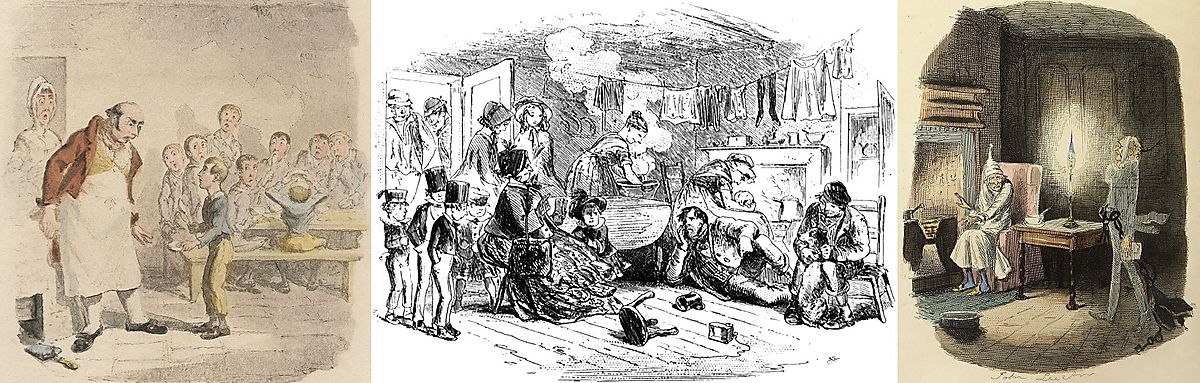
The illustration “Oliver Asking for More” in Charles Dickens’s Oliver Twist (1837) shows the rake-thin protagonist, having drawn the short straw, approaching the cruel Master of the workhouse to beg for more food. This and other notable illustrations, of harried servants, crowded kitchens and the innumerable sooty children that populate Dickens’s novels, provide an immediately recognisable glimpse into Victorian life. Less evident is the strained relationships between Dickens and his many illustrators, as they fought over creative sovereignty.
In Dickens’s time, illustrators were free to choose a set of scenes from the text and depict them as they wished. Initially, Dickens was honoured to collaborate with two well-known illustrators of the 1830s: Robert Seymour (The Pickwick Papers (1837)) and George Cruikshank (Oliver Twist).1 However, as Dickens’s fame grew, so did conflict over the illustrative process, with Dickens dictating “the number of characters as well as their positions, gestures, expressions, dress, and settings”2. Dickens’s insistence on complete authorial control culminated in Cruickshank’s name being removed from later editions of Dickens’s work, after numerous bitter disputes.
Dickens finally found his principle illustrator in Hablot Knight Browne, who went on to illustrate 15 of Dickens’s 20 novels. In an act emblematic of their long relationship, Browne changed his pen-name to “Phiz” (illustrator of physiognomies) to compliment Dickens’s pen-name “Boz”. Browne was young and subservient to Dickens’s dictations. His illustrations are just that: illuminating Nicholas Nickleby (1839), Bleak House (1853) and Little Dorrit (1857); lighting up Dickens’s words without overshadowing them.
Cohen, J. Rabb, J.. Charles Dickens and His Original Illustrators. Ohio State University Press. 1980. 15
Cohen, J. Rabb, J.. Charles Dickens and His Original Illustrators. Ohio State University Press. 1980. 5
Anna Middleton
London
I like to look at the interdisciplinary nature of book production (an author never writes in a vacuum), and Dickens’s relationships with publishers and illustrators provide a fresh insight into the production of his novels. Through his disagreements, I want the reader to understand that Dickens was meticulous in controlling every aspect of his work, and also learn about the professional illustrators of the Victorian era involved in Dickens’s work.