
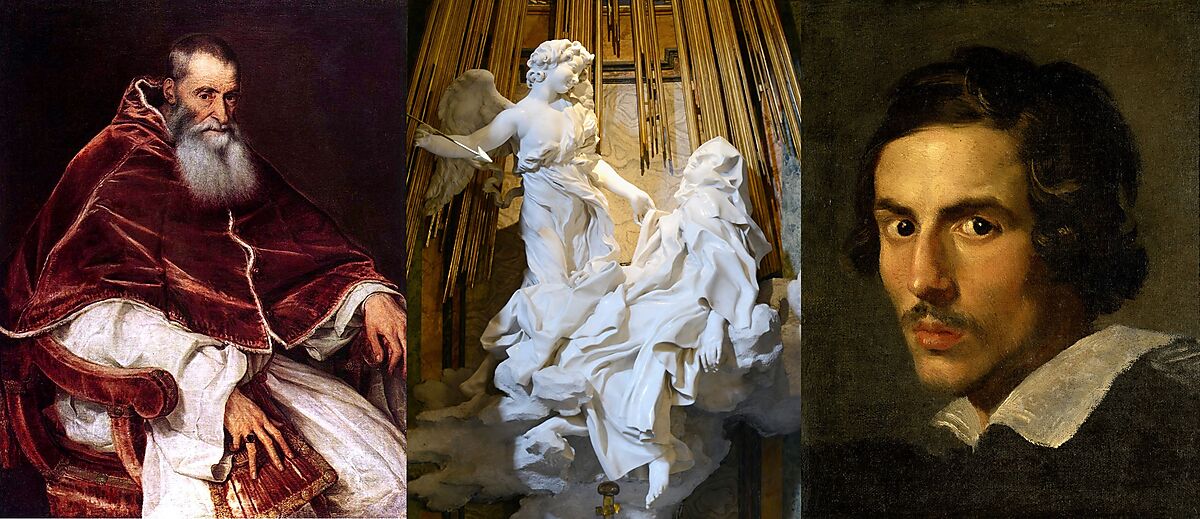
Pope Paul III, The Ecstasy of St Teresa, Gian Lorenzo Bernini
The Catholic Counter-Reformation and Italian Baroque Art
The Ecstasy of Saint Teresa (1647–52) is a sculpture by Neapolitan artist Gian Lorenzo Bernini. It portrays the singular moment of Saint Teresa’s religious ecstasy, as her heart is pierced by God’s love. Bernini was active in what became known as the Italian Baroque, an art movement closely tied to the religious upheavals of the time.
A century earlier, Pope Paul III had convened the Council of Trent (1545–1563) in a bid to counter the Protestant Reformation, which had swept across Europe, undermining Catholicism. To re-establish authority, the popes of the Counter-Reformation presented themselves as heirs of the Roman emperors, on a mission to restore the grandeur of ancient Rome.1
In the decades following the Council of Trent, and under its influence, Catholic scholars also established stricter guidelines to which Catholic art, such as Bernini’s sculpture, should aspire. Artists were encouraged to focus on fundamental aspects of Catholic dogma, especially those threatened by the Protestant Reformation, such as the cult of the Virgin Mary.2
The Church also wanted art to be relatable to ordinary people, to inspire piety and faith in them3. Humanist influences such as Cicero’s thoughts on successful oratory — to delight, teach and persuade the audience — inspired the new Catholic message.4 Emotion too should be depicted in its extreme form, using the immediacy of the moment of action or transformation to establish a ‘closer psychological relation to the audience’5. As a result, a certain theatricality emerged in art.
Accordingly, Bernini’s sculpture is presented to the audience in an eruption of visceral emotion, surrounded by gold and marble architecture — elements that made Baroque art clear in message yet beautiful to behold.
Although the Church set out to only reform religious art, their influence was such that all Baroque art became ‘almost synonymous’ with Counter-Reformation art.6
References
- Bazin, G. Baroque And Rococo. New York: Frederick A. Praeger. 1964. p. 11
- Collins, N. "Catholic Counter-Reformation Art". Visual-Arts-Cork.Com
- Collins, N. "Catholic Counter-Reformation Art". Visual-Arts-Cork.Com
- Viladesau, R. "Counter-Reformation Theology And Art: The Example Of Rubens's Paintings Of The Passion". Toronto Journal Of Theology. 28. 2012. 29-42. p. 0
- Todorović, J. Hidden Legacies Of Baroque Thought In Contemporary Literature: The Realms Of Eternal Present. Cambridge: Cambridge Scholars Publishing. 2017. p. 53
- Collins, N. "Baroque Art: Definition, Styles, History". Visual-Arts-Cork.Com

The works of art I find myself stopping to stare at are the mid-millennium masterpieces by the likes of Michelangelo, Caravaggio or Bernini, often sharing a religious narrative. I have an interest in ecclesiastical (Christian) art due to the volume of interesting stories in the Bible and how they are visually interpreted and used as a tool to teach and influence the masses.— Laetitia Inett