
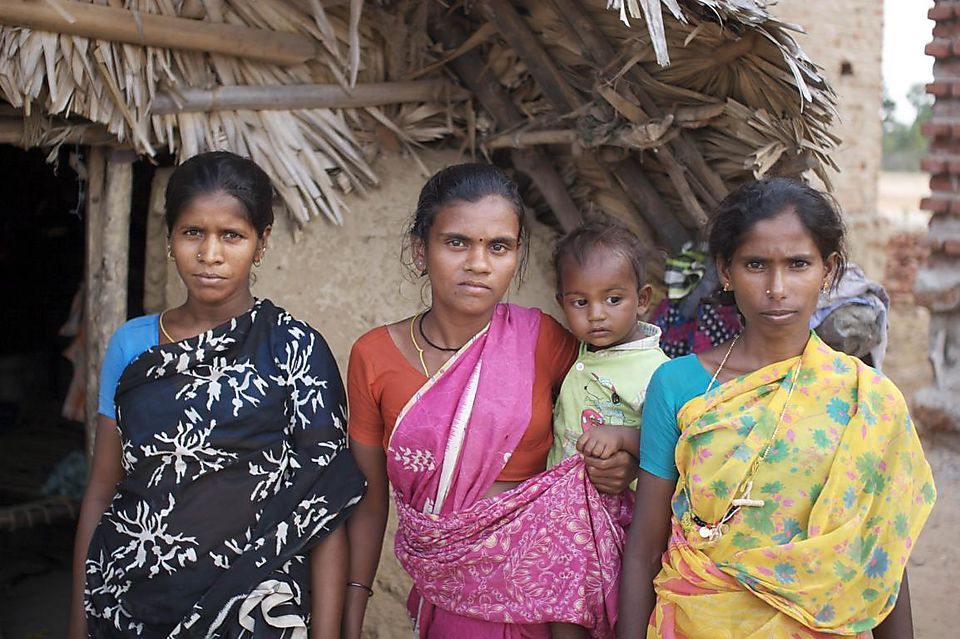
Indian Village Women
The Caste System in India

The caste system has ordered Hindu Indian society for thousands of years. Amongst the world’s most ancient forms of social stratification, it is built on values of ritual purity and impurity, dividing society into four tiers. The Rigveda (c. 1500 BC) describes the caste system as follows: ‘From his mouth God created the Brahmin (priest), from his arms the Kshatriya (warrior), from his thighs the Vaishya (trader), and from his feet the Shudra (labourer).’ The ‘Untouchables’, otherwise known as the Dalits, are considered ritually impure, falling outside of the four-tier structure, forming the lowest rungs of society.
Historically, this meant that upper castes led a more privileged lifestyle, and inter-caste marriage was forbidden. In rural communities, different caste members generally lived separately and had to use different village wells. Even in present-day India, it is common to identify oneself by the caste to which they belong, and caste continues to play a crucial role in determining who someone marries.
Despite this, the caste system has undergone rapid transformation in contemporary India. Modern education, industrialisation, and economic growth have increased opportunities for members of lower castes, threatening the very structures that underpin the system. Western democratic values have caused people to question the system’s fairness, resulting in the government introducing measures to eradicate caste-based discrimination.
Nevertheless, caste remains a deeply rooted cultural phenomenon due to its religious and societal ties. As India transforms, caste loses its power. But it is not yet a thing of the past.
Historically, this meant that upper castes led a more privileged lifestyle, and inter-caste marriage was forbidden. In rural communities, different caste members generally lived separately and had to use different village wells. Even in present-day India, it is common to identify oneself by the caste to which they belong, and caste continues to play a crucial role in determining who someone marries.
Despite this, the caste system has undergone rapid transformation in contemporary India. Modern education, industrialisation, and economic growth have increased opportunities for members of lower castes, threatening the very structures that underpin the system. Western democratic values have caused people to question the system’s fairness, resulting in the government introducing measures to eradicate caste-based discrimination.
Nevertheless, caste remains a deeply rooted cultural phenomenon due to its religious and societal ties. As India transforms, caste loses its power. But it is not yet a thing of the past.