
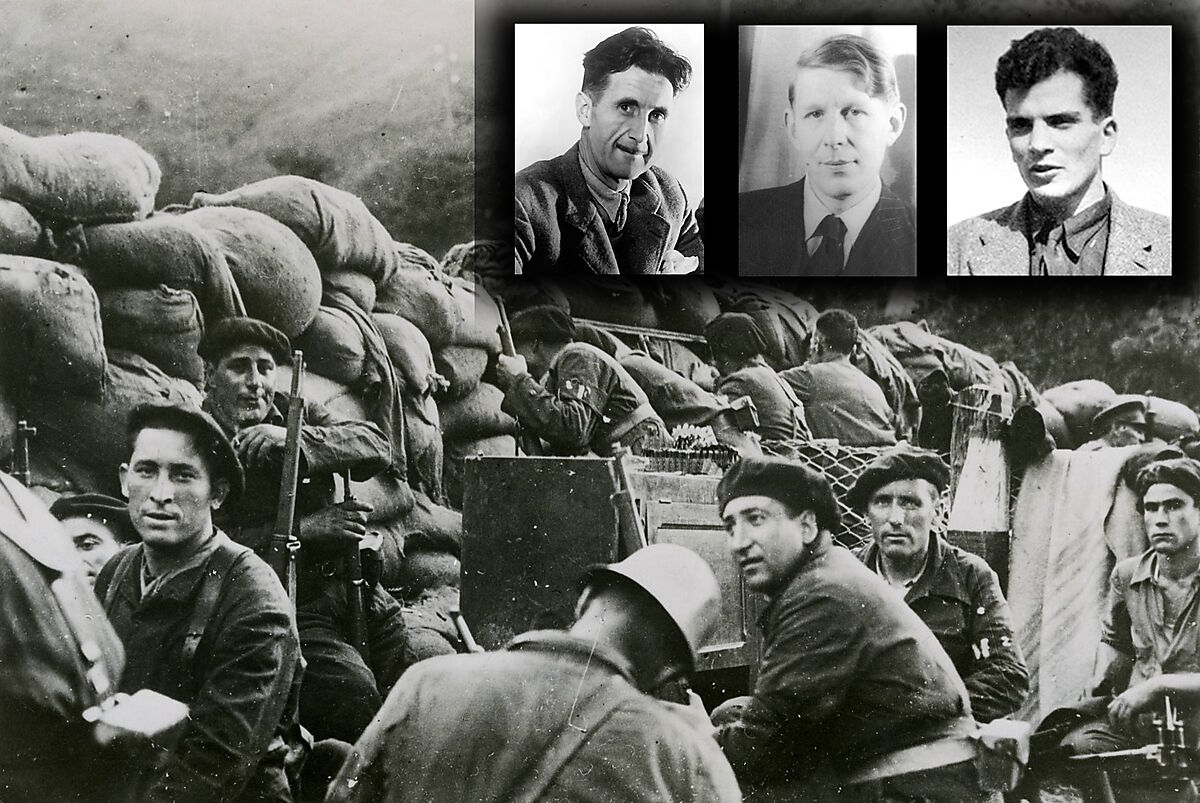
Republican forces during the Battle of Irún 1936; George Orwell, WH Auden, and John Cornford (Inset)
The Bitter Dawn: British Writers and Artists, Idealism, and the Spanish Civil War
Dawn was a particularly dangerous time in the trenches of the Spanish Civil War. Each morning on the Aragon Front, the sun rose behind the Republican position, creating perfect silhouettes for enemy snipers. And so it was that on his way to change guard at dawn on 20 May 1937, Eric Blair, a 33-year-old lanky Englishman, inadvertently let his head peek above the parapet. He suddenly felt a sensation akin to being ‘at the centre of an explosion.’1 A sniper’s bullet had struck his neck, and as blood trickled from his mouth, he was certain that death was imminent.
This wounded volunteer was neither Spanish nor a soldier by training — he was an Englishman fighting in a foreign war. Back home, he was better known by his pen name: George Orwell.
A year earlier on 17 July 1936, following a period of political turbulence and sectarian tension, General Francisco Franco, a pro-monarchy conservative military leader, launched a carefully coordinated coup against the Republican government. The insurgents, soon known as the Nationalists, quickly secured control of a third of the country. However, key naval ports remained in Republican hands, and the coup met spontaneous and determined resistance, particularly in major cities. As neither side achieved a swift victory, positions hardened, and Spain descended into a civil war that would rage until 1939.
The conflict reflected broader trends in Europe, where authoritarian regimes had come to power. Franco, like his counterparts in Nazi Germany and Fascist Italy, found support among those who sought to overturn liberal democracy. Hitler and Mussolini provided critical military assistance, transforming Franco’s Nationalist campaign into a formidable force.
Over in Britain, the Spanish Civil War ‘became a microcosm of all the ideological divisions of the time’2, according to Jason Gurney, a 26-year-old British artist who volunteered to fight on the Republican side. He recounts in his memoir Crusade in Spain (1975) ‘Either you were opposed to the growth of Fascism and went out to fight against it, or you acquiesced in its crimes and were guilty of permitting its growth.’3
John Cornford, an English poet aged only 20 when he left for Spain in 1936, drew on Shakespeare’s Hamlet (1603) to echo these convictions in the third of his untitled Three Poems (1937):
Not by any introspection
Can we regain the name of action,
Whatever dreams may mean to you, they mean sleep.
Black over Europe fall the night,
[…]
We cannot hide from life with thought,
And freedom must be won, not bought.4
WH Auden, aged 29 and a pre-eminent poet of his generation, volunteered to write dispatches from Spain. He too called for an activist stance in his poem ‘Spain’ (1937):
Today the deliberate increase in the chances of death,
The conscious acceptance of guilt in the necessary murder5
Julian Bell, a 29-year-old English poet and nephew of the novelist Virginia Woolf, surmised rather bluntly in a letter to his mother: ‘there’ll never be peace until Fascism is destroyed…There’s only one thing to be done with Fascists, and that’s kill them.’6
But war does not care for noble causes, nor does it spare the intellectual. Jason Gurney, who joined the International Brigades in December 1936, was shot in the trenches while reading a book. He was declared militarily unfit and was already back in England by the summer of 1937.7 John Cornford travelled to Barcelona as a journalist immediately after the war’s outbreak in August 1936, later enlisting as a frontline fighter. On 28 December 1936, Cornford was killed in action; he had turned 21 a few hours earlier. Julian Bell reached a compromise with his family to volunteer as an ambulance driver instead of fighting in the trenches. On 18 July 1937, Bell’s vehicle was hit by a bomb and he died in hospital later that day.8
When the dust settled, the crucible that was the Spanish Civil War would shatter the political certainties of those left-wing intellectuals who fought in the war, forcing them to question not only their enemies but also their own political beliefs. What seemed from the distant shores of England as a heroic crusade for universal democratic ideals — a straightforward war of right and wrong — proved to be a gross oversimplification of a conflict embedded in decades of tangled Spanish history. It materialised into a war ‘more complex, more squalid, and infinitely less heroic when seen at close quarters’.9 As Jason Gurney observed, both sides ‘committed every possible form of cruelty and beastliness. And nobody, from either side, came out of it with clean hands.’10
In the years that followed, this disillusionment went some way in shaping the intellectual climate of the twentieth century. The Spanish experience made the next generation of artists and writers increasingly sceptical of engaging in grand political narratives, especially as the Cold War ushered in an increasingly fraught and paranoid environment.11 Many of these left-wing intellectuals had a deep reckoning with their pre-war communist beliefs. Orwell’s time in Spain crystallised his belief that Soviet communism was no better than the fascism it claimed to oppose, a conviction that inspired his novels Animal Farm (1945) and 1984 (1949). WH Auden and Stephen Spender, once aligned with radical left-wing politics, later distanced themselves from their forgotten idealism.12
By 1939, General Franco’s Nationalists had won the civil war. Years later, Stephen Spender, a poet and author who was at the forefront of the organised intellectual campaign against fascism, reflected on his generation of writers and artists who clambered down from their ivory towers to fight for their ideals. He mused, ‘We were divided between our literary vocation and an urge to save the world from Fascism. We were the Divided Generation of Hamlets who found the world out of joint and failed to set it right.’13
Despite being misguided and ultimately backing the losing cause, for Jason Gurney, the choice had been clear for him and everyone else. Either continue to let fascism, fear, and hate engulf European society, or make a personal stand for freedom. ‘Even at the moments of the greatest gloom and depression I have never regretted that I took part in it.’14
References
- Franklin, James L. "George Orwell and the Spanish Civil War: A Brush With Death". A Journal of Medical Humanities. 2020
- Gurney, Jason. Crusade in Spain. Newton Abbot: Readers Union. 1976. p. 18
- Gurney, Jason. Crusade in Spain. Newton Abbot: Readers Union. 1976. p. 36
- John Cornford. "Three Poems". in John Lehmann, IV (ed.). New Writing. London: Lawrence and Wishart. 1937. pp. 36-39. p. 37
- Spender, Stephen, Lehmann, John. Poems for Spain. London: The Hogarth Press. 1939. p. 58
- Peter Stansky, and William Abrahams. Journey to the frontier: Julian Bell & John Cornford: their lives in the 1930s. London: Constable. 1966. p. 294
- Gurney, Jason. Crusade in Spain. Newton Abbot: Readers Union. 1976. p. 167
- Palfreeman, Linda. Salud! : British Volunteers in the Republican Medical Service during the Spanish Civil War, 1936-1939. Brighton; Portland Or: Sussex Academic Press. 2012. p. 270-1
- Tom Buchanan. Britain and the Spanish Civil War. Cambridge: Cambridge University Press. 1997. p. 163
- Gurney, Jason. Crusade in Spain. Newton Abbot: Readers Union. 1976. p. 188
- Tom Buchanan. Britain and the Spanish Civil War. Cambridge: Cambridge University Press. 1997. p. 168
- Hopkins, James. K. Into the Heart of the Fire: The British in the Spanish Civil War. Stanford: California: Stanford University Press. 1998. p. 350
- Spender, Stephen. World within world: the autobiography of Stephen Spender. London: Readers Union. 1953. p. 202
- Gurney, Jason. Crusade in Spain. Newton Abbot: Readers Union. 1976. p. 188
My interest in the Spanish Civil War was born at university, where I wrote my dissertation on the conflict and its coverage in the press. For such a consequential war, it occupies a relatively small space in our collective historical imagination; a war forgotten by many, not least because of the devastation that immediately followed its conclusion in 1939. This piece is a unique exploration of how art, war, and politics interact with each other, and an attempt to draw attention to the Spanish Civil War — a period that upon inspection quickly begins to rhyme with current events worldwide.— Marc Ainge