
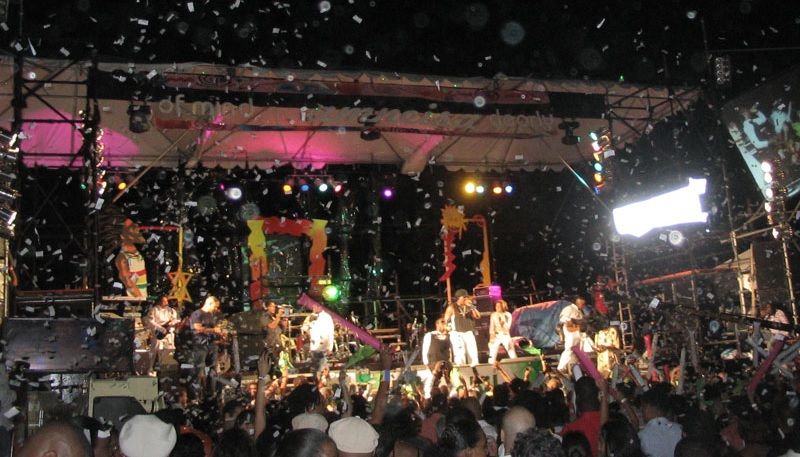
Trinidad Carnival Fete 2006
The Birth of Soca in Trinidad and Tobago

Soca has been the sound of Trinidad and Tobago for over 40 years. Its rhythmic energy and high-tempo beats capture the spirit of the island perfectly: a country of mixed cultures and carnivals.
Soca is a reflection of the two largest ethnic groups that make up the island’s population, with Africans and Indians being the equally predominant ethnic groups.
It first emerged in the 1970s as a response to fears that traditional Calypso music, an important part of Trinidad and Tobago’s heritage, was fading into the background of Reggae, a more commercial and multinational musical genre. Garfield Blackman, a Trinidadian musician, attempted to reinvent Calypso music, to generate fresh interest in the genre and to preserve African and Indian influences in popular music.
Blackman blended sounds from classical Indian instruments, such as the dhaka and chantal, with Calypso beats to create a unique sound that resonated with Trinidad and Tobago’s Indian and African populations.
As contemporary life in the Caribbean comes increasingly under the influence of other cultures, particularly that of its neighbour, the United States, so does its music. Yet, Soca is a living example of how Caribbean music has responded to these challenges and evolved in ways that succeed in preserving the island’s cultural roots.
Soca is a reflection of the two largest ethnic groups that make up the island’s population, with Africans and Indians being the equally predominant ethnic groups.
It first emerged in the 1970s as a response to fears that traditional Calypso music, an important part of Trinidad and Tobago’s heritage, was fading into the background of Reggae, a more commercial and multinational musical genre. Garfield Blackman, a Trinidadian musician, attempted to reinvent Calypso music, to generate fresh interest in the genre and to preserve African and Indian influences in popular music.
Blackman blended sounds from classical Indian instruments, such as the dhaka and chantal, with Calypso beats to create a unique sound that resonated with Trinidad and Tobago’s Indian and African populations.
As contemporary life in the Caribbean comes increasingly under the influence of other cultures, particularly that of its neighbour, the United States, so does its music. Yet, Soca is a living example of how Caribbean music has responded to these challenges and evolved in ways that succeed in preserving the island’s cultural roots.