
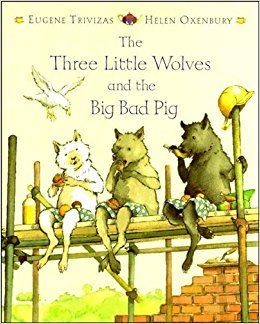
Front cover of Three Little Wolves and the Big Bad Pig
The Big... Not So Bad Wolf

McCallum and Stephens, researchers at Macquarie University, argue that “No book is innocent of ideological implications”1. Can this even be true of one of the most well-known children’s stories: The Big Bad Wolf?
In the last thirty years, there has been a wave of radical narratives that show the villainous wolf in a different light. The villain now is “good”, “vegetarian”, or even sometimes a victim of his own prey. In Trivizas’s children’s book “The Three Little Wolves”, in a twist of the classic tale, three little wolves run from the Big Bad Pig. However, in the end, instead of the pig being punished, we see a friendship developing between them.
Trivizas, like the others who reformulated the wolf’s character, aims to raise awareness of stereotypes in society, with the view of abolishing them. One can see, for example, the wolf as an embodiment of a different ideology, a different religion, etc. The writers attempt to instil a liberal culture in the children, thereby shaping the form of future society.
The ideologies inherent in these narratives serve to promote role models deemed ideal by modern society. The wolf’s character and role evolves from its traditional portrayal and thus serves this purpose.
In the last thirty years, there has been a wave of radical narratives that show the villainous wolf in a different light. The villain now is “good”, “vegetarian”, or even sometimes a victim of his own prey. In Trivizas’s children’s book “The Three Little Wolves”, in a twist of the classic tale, three little wolves run from the Big Bad Pig. However, in the end, instead of the pig being punished, we see a friendship developing between them.
Trivizas, like the others who reformulated the wolf’s character, aims to raise awareness of stereotypes in society, with the view of abolishing them. One can see, for example, the wolf as an embodiment of a different ideology, a different religion, etc. The writers attempt to instil a liberal culture in the children, thereby shaping the form of future society.
The ideologies inherent in these narratives serve to promote role models deemed ideal by modern society. The wolf’s character and role evolves from its traditional portrayal and thus serves this purpose.
Do you want to learn to write like this?