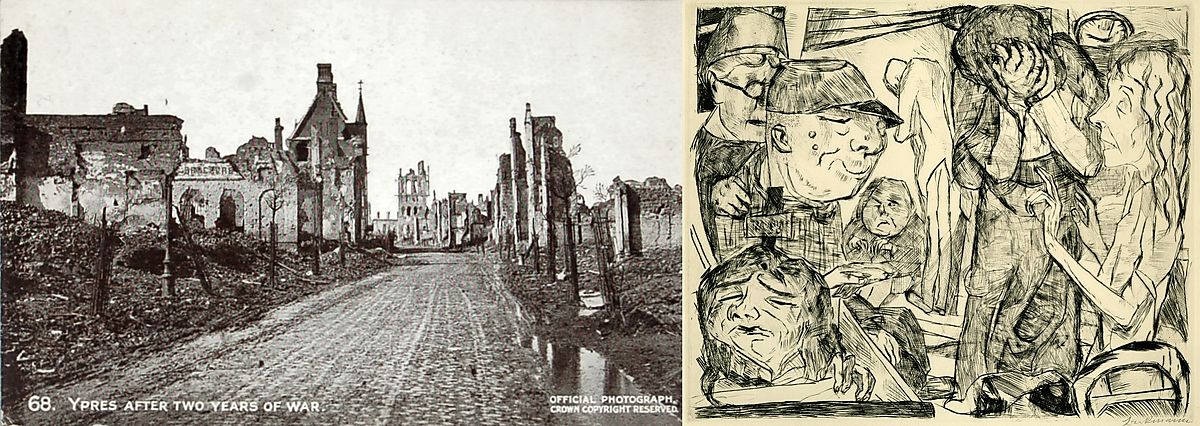
The mass-produced weaponry of WW1 not only caused the deaths of many, but also annihilated the land and the psyche of the survivors. Amongst the industrial-scale slaughter, a German artist serving as a medic bore witness to the utter chaos and desolation through his printmaking; however, the war took its toll on the artist’s own psyche, causing him to suffer a mental breakdown.1
Max Beckmann, previously a traditionalist, developed a raw and expressive style during the war. He was driven to express truth through his art, inspired by his interest in objectivity and existentialism.2 Although Beckmann typically painted, it was his prints that truly captured the German wartime mindset through their crude and erratic style.
Beckmann favoured the drypoint technique, in which the image is drawn onto a plate using a hard-point “needle”; this technique allowed Beckmann to work quickly to capture his volatile environment. With printing, each incision produces a sense of directness and immediacy. Beckmann’s lines became aggressive, erratic, and dense to demonstrate a state of chaos and mental unrest.
Irrenhaus (Madhouse) (1918) is typical of the claustrophobic compositions favoured by Beckmann at the time. Silent figures are crammed into a small space, their faces twisted into grotesque mask-like expressions of torment. The caricatured figures and rough lines convey emotion with brutal honesty, reflecting Beckmann’s own internal trauma.
Beckmann's madhouse is a compelling metaphor for the descent into madness of the world around him. The mechanised destruction of the environment and its effects on society combines with his personal torment to produce a form of realism that reveals the “mystery of our existence”.3
Weitman, W.. A Disturbing Reality: The Prints of Max Beckmann. MoMA, No. 19, Spring. 1995. 18
Fisher, J. L. (ed.). Max Beckmann Prints from the Museum of Modern Art. MoMA. 1992. 22
Beckmann, M.. On My Painting. New York: Bucholz Gallery, Curt Valentin. 1941. 4
Harriet Bews
London
This article provides an insight into the psychological effects WW1 had on people. I was interested in writing this piece to learn more about the mental effects of war, as art often reveals a more raw and emotional account of events than history.