
The Wilderness as an Idealised but Lost Space
The American Wilderness as an Idealised but Lost Space in Jack Kerouac’s ‘Big Sur’ (1962) and ‘Desolation Angels’ (1965)

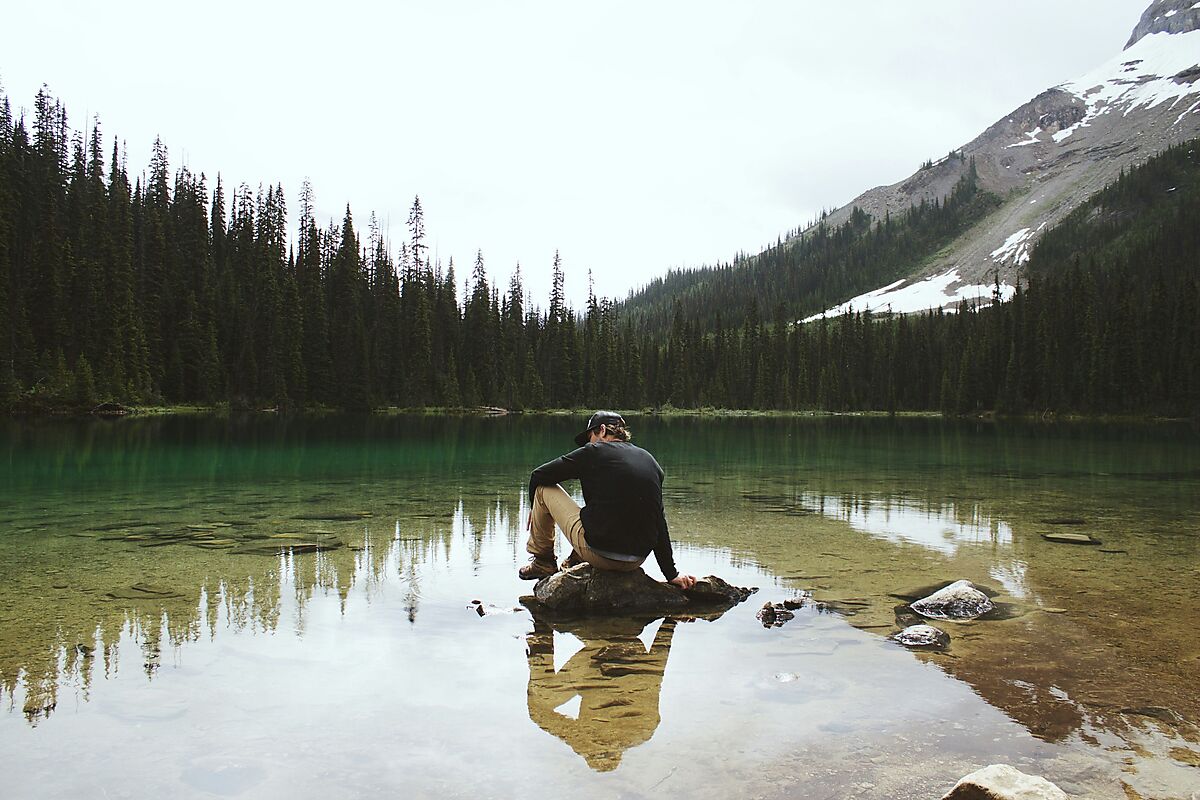
In the summer of 1957, Jack Kerouac stood at the top of Desolation Peak in Washington State, USA, staring into the never-ending wilderness. As a fire lookout in this remote spot, he spent 63 days in total isolation, attempting meditation with the hope of transcendence over conventional America.
Jack Kerouac (1922–1969) was in his thirties in the 1950s when America witnessed the onset of its ‘consumer revolution’, a time when technological advances during WW2 were harnessed for peacetime production of consumer goods creating a boom in consumer choice. It was the time ‘the modern supermarket and shopping mall were coming into being’.1 Through persuasive advertising, which portrayed certain products as essential for both lifestyle and status, American habits and mindsets were increasingly controllable by corporations. This led to the emergence of a culture of ‘one-dimensional thought’ where, according to philosopher Robert Holton, people were unable to imagine an alternative to the lifestyle being aggressively marketed to them.2
Kerouac was a prominent author and one of the figureheads of a counterculture movement known as the Beat Generation, which emerged as a reaction against consumerism. The Beat Generation was a loose group of friends and writers who in the 1940s and 50s embraced unconventional and eccentric lifestyles, characterised by hedonism and liberated sexual expression. Much of this is documented in Kerouac’s semi-autobiographical novel On the Road (1957), perhaps the quintessential text of the Beat Generation, in which the characters, drawn from Kerouac’s real friends and fellow beat figures, reject the stagnation and domestic confines of conventional American society for a life ‘on the road’ driving and hitchhiking around America, preferring exhilarating experiences (or ‘kicks’3) over domestic stability.
Kerouac’s novels have a strong thread of social critique running through them. He often associates consumerism and materialism with social degradation, paralleling products with people’s negative characteristics, for example, cars to ‘sneering workers’. In Big Sur (1962), while waiting to hitchhike, he sees ‘sleek long station-wagon after wagon’, ‘all colors of the rainbow and pastel at that, pink, blue, white’. He caricatures the modern American family, the husband at the wheel wearing a ‘ridiculous vacationist hat’ while his wife forces him to ‘take down a fresh pair of slacks’ when they get ‘the slightest bit creased.’4 Kerouac further delves into how Americans in this environment become perpetually ‘angry’, likening urban America to ‘hell’.5
In several of Kerouac’s novels, the protagonists, all semi-autobiographical imaginings of himself, attempt an alternative, counterculture existence through the deliberate evasion of the culture of commoditisation imposed on them. Sometimes this involves withdrawing from urban life into the wilderness. In Desolation Angels (1965), the character of Duluoz, mirroring Kerouac’s own experiences, spends the summer as a fire lookout, alone on Desolation Peak in Washington State.6 In Big Sur, he seeks solace at an isolated cabin in California’s Big Sur National Park.7
In the wilderness, on the one hand, we may assume Kerouac’s protagonists seek to achieve some kind of spiritual transcendence through meditation. The fact that Kerouac saw himself as ‘the modern day American Bhikku’8 (a Buddhist monk who lives a monastic life), adds weight to this idea. On the other hand, Kerouac saw modernity as a threat to masculinity, with men (such as the man in the vacationist hat) ‘tamed and domesticated’.9 Since the early 19th century, the American Wilderness has been ‘imagined as an exclusively masculine space […] where men could prove their manliness.’10 Viewed in this light, this form of escapism could be seen as their attempt to seek the masculine ideal in the wilderness and its ‘virgin lands’11 that are there to be conquered.
In the wilderness, the connections to the urban are not easy to shake off. In Desolation Angels, despite Duluoz’s physical isolation, he is required to converse nightly with other lookouts via the radio.12 The solitude needed for meditation is denied as technology has rendered it impossible to avoid social obligation. In one episode, Duluoz encounters tins of ‘frozen, hardened can-milk’13 mauled by a bear, reflecting urban encroachment.
The very concept of ‘the wilderness’ itself was susceptible to commercial manipulation, marketed as an idealised masculine domain by brands such as Levi’s Jeans and the iconic ‘Marlboro Man’ cigarette brand. In Big Sur National Park, the Pfeiffer Campsite holiday company promoted adventure holidays, commodifying and selling the wilderness experience.14
Thus, when Kerouac stood on Desolation Peak, he came ‘face to face with [him]self’15 and realised that self to be thoroughly dependent on societal constructs. His novels expose the notion of a ‘true alternative’ to society in the wilderness to be an idealised fantasy; the pervasive influence of American commercial culture rendered it impossible. Eventually, Kerouac’s protagonists yearn for material products and the urban environment on which they have become dependent using the language of ‘return’,16 as if they truly belonged in the city. This yearning obstructs their meditative focus, and they are unable to shift their modern, societal identities simply by physically distancing themselves from the urban. Through the failed attempts of his semi-autobiographical characters’ to find an alternative to society in the wilderness, Kerouac reveals the model of escape to be imagined and non-viable. That alternative space itself had been constructed by society. Kerouac thus exposes the complete domination of modern homogeneity that even he, a figure hailed as a proponent of counterculture, cannot evade.
Disillusioned, Kerouac returned to live in various cities, embracing the beat lifestyle, fuelled by excessive alcohol, drifting away from his Buddhist beliefs. In 1968, he wrote his final autobiographical book, Vanity of Duluoz, before dying, broke, of an alcohol-related abdominal haemorrhage a year later.
References
- Robert Holton. "‘’The Sordid Hipsters of America’’: Beat Culture and the Folds of Heterogeneity". in Jennie Skerl (ed.). Reconstructing the Beats. New York: Palgrave Macmillan. 2004. pp. 11-26. p.12
- Robert Holton. "‘’The Sordid Hipsters of America’’: Beat Culture and the Folds of Heterogeneity". in Jennie Skerl (ed.). Reconstructing the Beats. New York: Palgrave Macmillan. 2004. pp. 11-26. p.15
- Jack Kerouac. On the Road. London: Andre Deutsch, 1958; repr. London: Penguin Books Ltd.. 2000. p.29
- Jack Kerouac. Big Sur. London: Penguin Books Ltd.. 2012. p.35
- Jack Kerouac. Desolation Angels. London: Penguin Books Ltd.. 2020. p.103
- Jack Kerouac. Desolation Angels. London: Penguin Books Ltd.. 2020. pp.1-384
- Jack Kerouac. Big Sur. London: Penguin Books Ltd.. 2012. pp.1-192
- John Suiter. Poets on the Peaks: Gary Snyder, Philip Whalen and Jack Kerouac in the North Cascades. Washington D.C: Counterpoint Press. 2002. p.164
- Pierre-Antione Pellerin. "Jack Kerouac’s Eco poetics in The Dharma Bums and Desolation Angels: Domesticity, Wilderness and Masculine Fantasies of Animality". Animals and the American Imagination. 2. 2011. 1-23. p.4
- Pierre-Antione Pellerin. "Jack Kerouac’s Eco poetics in The Dharma Bums and Desolation Angels: Domesticity, Wilderness and Masculine Fantasies of Animality". Animals and the American Imagination. 2. 2011. 1-23. p.2
- Pierre-Antione Pellerin. "Jack Kerouac’s Eco poetics in The Dharma Bums and Desolation Angels: Domesticity, Wilderness and Masculine Fantasies of Animality". Animals and the American Imagination. 1, no. 2. 2011. 1-23. p.1
- Jack Kerouac. Desolation Angels. London: Penguin Books Ltd.. 2020. p.10
- Jack Kerouac. Desolation Angels. London: Penguin Books Ltd.. 2020. p.57
- Shelley Alden Brooks. Big Sur: The Making of a Prized California Landscape. Oakland: University of California Press. 2017. p.60
- Jack Kerouac. Desolation Angels. London: Penguin Books Ltd.. 2020. pp.1-384
- Jack Kerouac. Desolation Angels. London: Penguin Books Ltd.. 2020. p.63