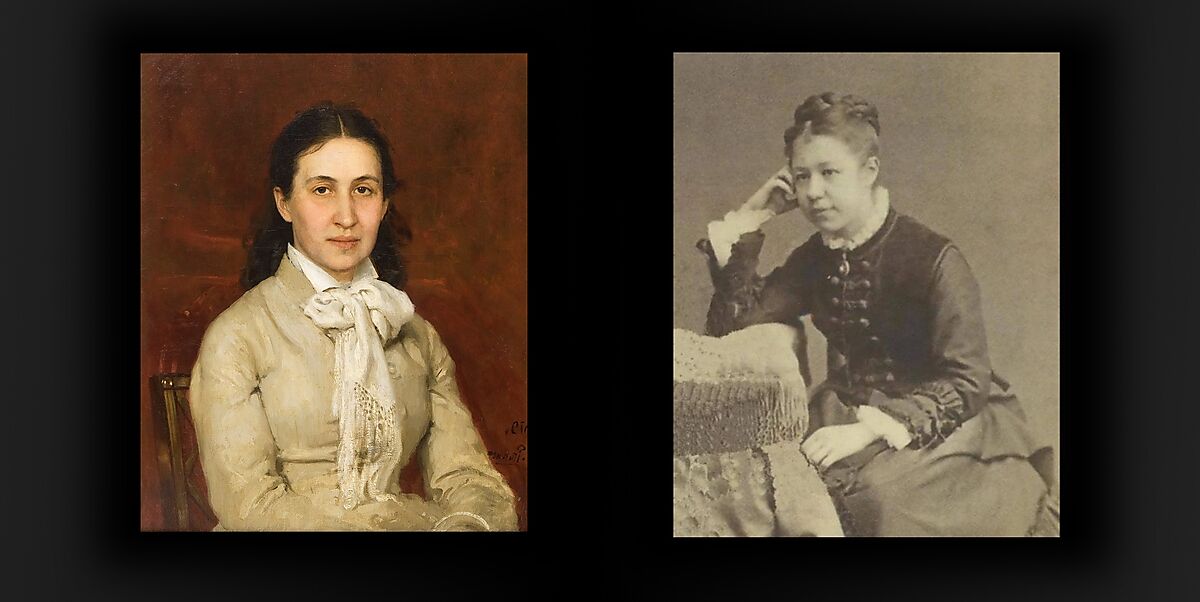
In 1876, on the Abramtsevo estate 60km outside of Moscow, Elizaveta Mamontova, a philanthropist from the landed gentry, founded a joinery workshop for young people from the local villages.1 Later, villagers were invited onto the estate and taught traditional techniques, in an effort to keep this knowledge alive in the peasantry. The output from the workshops were sold in local markets, providing the peasants with income.
Following the abolition of serfdom in 1861 and amidst rising industrialisation, the traditional agrarian lifestyle of the Russian peasantry had begun to change, as villagers moved to cities to work in factories, or to cut peat (an energy source).2 Traditional skills such as woodcarving, lacemaking, and embroidery were at risk of being lost.
Motivated by a desire to preserve these traditions, the Russian intelligentsia grew increasingly interested in the narod (the people).3 The Abramtsevo estate became a colony for artists interested in peasant art and workmanship, who then incorporated these techniques into their own work.
Elena Polenova, a painter, created over 100 designs for furniture using the Russian folk style, which borrowed motifs from peasant art and items. She designed carved wooden cabinets and chairs, and also drew illustrations of Russian folk tales for children’s books. Many of Polenova’s designs were realised in Mamontova’s workshops.
This was the beginning of Russia’s Arts and Crafts movement. The movement had originated in Britain in the 1850s as a reaction against the inferior designs of mass-produced factory goods, and favoured a return to traditional craftsmanship.
In Russia this preoccupation continued into the 1900s with the development of neoprimitivism, a movement pioneered by Natalia Goncharova and Mikhail Larionov, which embraced Russian folk traditions.
Laura Engelstein. ‘Between Old and New: Russia’s Modern Women’ in (eds.) Amazons of the avant-garde : Alexandra Exter, Natalia Goncharova, Liubov Popova, Olga Rozanova, Varvara Stepanova, and Nadezhda Udaltsova, ed. by Bowlt, J. E. and Drutt, M. London: Royal Academy of Arts; New York: Solomon R. Guggenheim Foundation. 1999. 69
Wendy Salmond. A matter of give and take: Peasant crafts and their revival in late imperial Russia. Design Issues, 13. 1997. 7
Peter Stupples. Abramtsevo: Resisting and Accepting Cultural Translation. New Zealand Slavonic Journal 45, no. 1. 2011. 80
Eleanor Firth
Sheffield
I first became interested in Russian Avant-Garde art when studying Russian at university. During my year abroad, I studied in Moscow and visited art galleries in my free time, seeing artwork by many of the Avant-Garde artists. I went on to write my dissertation on Russian art, focusing on the period 1870–1920.