
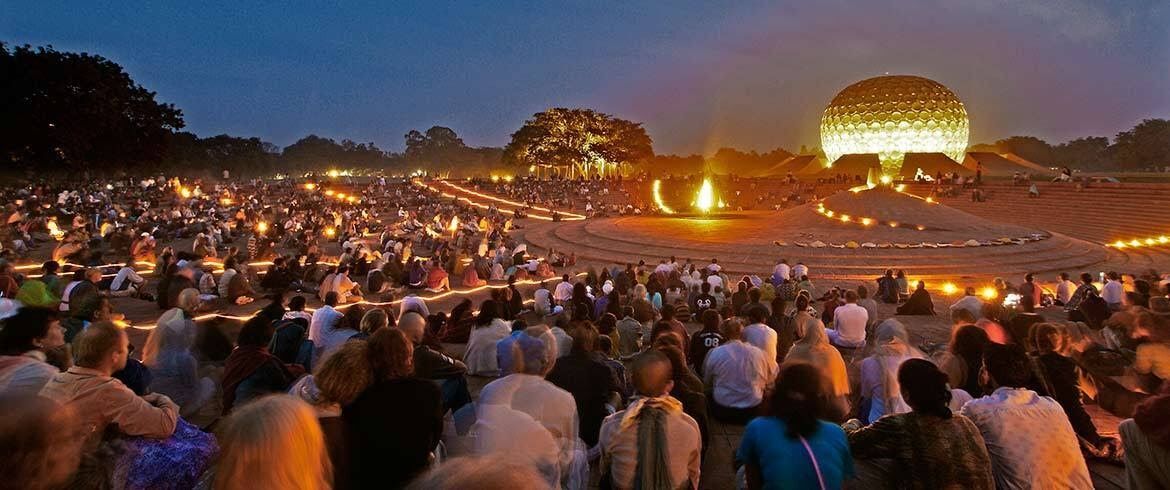
Auroville Meditation Centre
Tamil Nadu’s Auroville, Mirra Alfassa, and the Philosophy of Sri Aurobindo
On 28 February 1968, the representatives of 124 nations, which included the states of India, placed a handful of soil brought from their homeland in a lotus-shaped urn to lay the foundation for Auroville, an experimental universal township in the state of Tamil Nadu, India.1
Auroville was to be an intentional community, a group of people who have chosen to live together as a community with a shared set of often utopian values. (The word ‘utopia’ derives from a novel of the same name by the English humanist Thomas More (1478–1535) in which Utopia refers to a perfect society.) Intentional communities had existed in India since the early Vedic times (1500–1000 BCE) in the form of spiritual residential communities called Ashrams. In the 20th century, following WWII and peaking in the late 1960s, intentional communities with utopian aspirations gained followings across the world driven by the prevalent hippie culture and anti-capitalist sentiment; many were established in the United States, New Zealand, Europe, and Israel. These communities provided a refuge for people seeking change and exploring alternative ways of living, away from postwar social upheavals. Currently active intentional communities founded at that time, apart from Auroville, include Findhorn (1962, Scotland), Twin Oaks (1967, Virginia, USA), and Damanhur (1972, Italy).2
Auroville was the brainchild of Mirra Alfassa (1878–1973), a Parisian, influenced by her mentor Sri Aurobindo (1872–1950). Aurobindo was an Indian nationalist, educated in England, who would later develop his own philosophy. Aurobindo was held on a charge for sedition in 1908 and after his release in May 1909 he moved to Pondicherry (a French colony in India) in 1910. Alfassa had travelled to India in March 1914 accompanying her then husband Paul Richard who wanted to gain the Pondicherry seat at the French Senate. She arranged a meeting with Aurobindo as she had heard of him and is said to have been spiritually moved by the encounter. After her return to Pondicherry the second time, Alfassa helped establish the Sri Aurobindo Ashram around 1924, which formed organically around Aurobindo’s followers at that time. She become known as ’The Mother’ — a term bestowed upon her by Aurobindo.3
In 1964, a decade and a half after Aurobindo’s death, Alfassa proposed the idea of Auroville (with the French aurore for dawn and ville for city rendering ‘City of Dawn’), an intentional community in pursuit of Aurobindo’s vision.
Structurally, Auroville comprises three distinct zones: the Peace, City, and Greenbelt areas. The Peace area forms the central circle including the Matrimandir, lake, gardens, Urn, amphitheatre and banyan tree. The Matrimandir is a round, golden structure with inner chambers dedicated for meditation. Surrounding the Matrimandir are twelve lotus-shaped petals with the first eight (Sincerity, Humility, Gratitude, Perseverance, Aspiration, Receptivity, Progress, Courage) representing attitudes towards the Divine and the last four (Goodness, Generosity, Equality, Peace) towards humanity. The City area is split into four: residential, industrial, international and cultural; while the Greenbelt consists of eco-friendly farms and forest areas.4 Alfassa drafted a series of three documents that serve as guiding principles and practices for living in Auroville. In her first text, A Dream (1958), Alfassa sets out a vision for an ideal society where humans live in harmony. This was followed a decade later by The Auroville Charter (1968) which further expanded on the original vision. Subsequently, Alfassa wrote To be a True Aurovilian (1970), explaining the everyday practices necessary to achieve the fruits of Aurobindo’s philosophy.5
Aurobindo argued that human evolution is not limited to physical changes but also involves the evolution of consciousness. Consciousness is central to terrestrial (earthly) existence and as such inseparable from physical existence. A highly evolved form of consciousness would approach a state known as the Divine. We can contrast this idea with that of the Buddhist notion of Nirvana. In Aurobindo’s philosophy the Divine is realised on earth through the transformation of human consciousness, whereas Nirvana seeks liberation from the cycle of suffering through rebirth.67
Aurobindo defines the Divine using the term Sachchidananda or unity. Sachchidananda consists of three Sanskrit words: Sat (existence or being), Chit (consciousness or awareness), and Ananda (bliss or delight). Aurobindo saw these three aspects together making up the Divine, representing the ultimate reality (or Absolute). The unity of Sachchidananda refers to the interconnected nature of the universe, encompassing the physical, conscious, and spiritual realms. Through spiritual practice and inner transformation, individuals seek to transcend their superficial differences, ego, and ignorance and recognise their oneness with all of creation.89
This transcendental stage is achieved through the ascent of the lower consciousness and the descent of the higher consciousness. When achieved, the realisation brings about a profound shift in consciousness, leading to harmony with the universe. The lower consciousness represents everyday awareness of the physical world — bodily desires, ego, and physical attachments, oblivious of our deeper spiritual nature. The higher consciousness, on the other hand, represents an awakened state. In this state, an individual becomes aware of their inner self, the unity of all existence, and the divine essence common to them and all things. According to Aurobindo, the purpose of human life is to evolve from a limited egocentric existence of lower consciousness to the higher (Divine) consciousness.1011
In practice, the Divine is sought through a form of yoga developed by Aurobindo called Integral Yoga. Integral Yoga comprises Jnana Yoga (self-analysis, observation, and knowledge), Bhakti Yoga (love, and spiritual devotion), and Karma Yoga (action and work ethics).12 The purpose of integral yoga is to awaken the higher consciousness, harmonising it with the everyday lower consciousness, leading to a state of unity — in other words, Sachchidananda.1314
In Aurobindo’s vision, the Divine represents the highest truth of existence, the ultimate goal of human life, and the guiding force behind the evolutionary process of consciousness. The Auroville project, by basing itself on this vision, can be seen as an attempt towards achieving a future society state in present-day India — one that is spiritually equivalent to a future form of the human species.
Today, Auroville is home to over 3,288 residents from 60 different nationalities.15 While there have been challenges in its implementation (with socioeconomic disparities and problems in engaging with the local community16), it continues to be a unique experiment for an intentional community of the 21st century.
References
- Auroville. "Auroville in Brief". Auroville The City of Dawn. 2020
- Suryamayi Aswini Clarence-Smith. "Towards a spiritualised society: Auroville, an experiment in prefigurative utopianism". University of Sussex. 2019
- Editors of Encyclopaedia Britannica. "Sri Aurobindo Indian philosopher and yogi". Britannica. 2023
- Auroville. "Auroville in Brief". Auroville The City of Dawn. 2020
- Auroville. "Auroville in Brief". Auroville The City of Dawn. 2020
- Sri Aurobindo. "The Life Divine Volume 21 and 22". The Mother and Sri Aurobindo. 2005
- Sri Aurobindo. "Letters on Yoga—I Volume 28". The Mother and Sri Aurobindo. 2012
- Sri Aurobindo. "The Life Divine Volume 21 and 22". The Mother and Sri Aurobindo. 2005
- Sri Aurobindo. "Letters on Yoga—I Volume 28". The Mother and Sri Aurobindo. 2012
- Sri Aurobindo. "The Life Divine Volume 21 and 22". The Mother and Sri Aurobindo. 2005
- Sri Aurobindo. "Letters on Yoga—I Volume 28". The Mother and Sri Aurobindo. 2012
- Sri Aurobindo. "Letters on Yoga—II Volume 29". The Mother and Sri Aurobindo. 2013
- K. Pratap Kumar. "Sri Aurobindo’s Theory of Spiritual Evolution". International Journal for Research in Engineering Application & Management. 2018
- Samta P Pandya. "Auroville as an intentional spiritual community and the practice of Integral yoga". Cogent Arts & Humanities. 5, no. 1. 2018. 1–20. 1–20
- Auroville Resident Service. "Census April 2023—Auroville population". Auroville The City of Dawn. 2023
- Jessica Namakkal. "European Dreams, Tamil Land: Auroville and the Paradox of a Postcolonial Utopia". Journal for the Study of Radicalism. 6, no. 1. 2012. 59–88. 59–88
I love to travel and explore diverse cultures. In December 2021, my visit to Auroville in India was quite insightful. I was fascinated by the serenity of the place, its philosophy and practice. I wanted to write about Auroville because it combines my research interest in culture, human development, and health and well-being. With this article, I would like to offer the readers a more nuanced understanding of Auroville’s essence to humanity.— Deepa Srivastava PhD