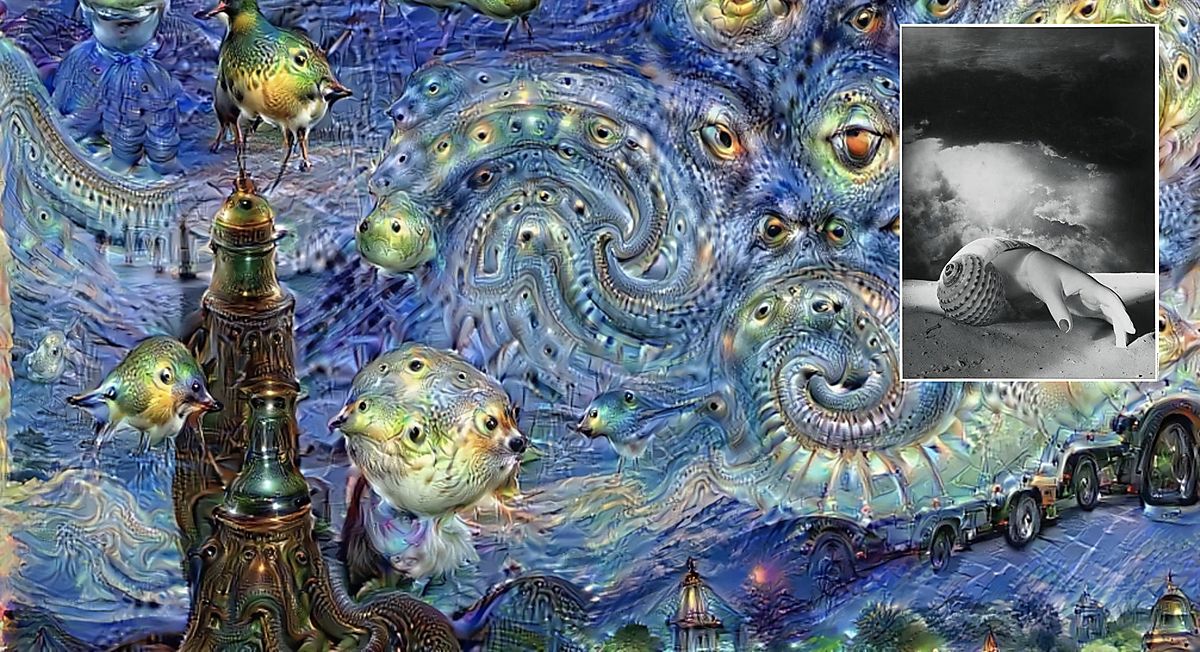
In 2015, computers began to dream. Software engineer Alexander Mordvintsev, from technology firm Google, developed a program called DeepDream that simulates the behaviour of the human brain during sleep, a period when subconscious thoughts and images combine to produce bizarre connections.
Mordvintsev developed an artificial neural network (a type of self-learning algorithm) to perform pareidolia (pattern recognition). The computer scans a user-uploaded image for traces of physical features (such as an eye), which it had trained itself to recognise. It then exaggerates those features, mirroring the behaviour of human dreams. The resulting images, with their surreal qualities, have earned DeepDream the title of ‘digital Salvador Dali’1.
The Surrealists, such as Dali, incorporated dreams into their work, seeking to harness their inherent irrationality and randomness to achieve imaginative freedom. This was an opportunity for them to overcome the trappings of modern society: narrow-mindedness, conventions and taboos.2 The idea is best exemplified by André Breton in the Surrealist Manifesto of 1924 when he asks, ‘When will we have sleeping logicians?’
As art drew together dreams and reality, a new aesthetic ‘surreality’ arose. Here the artistic goal was not to replicate dreams, but to imitate the form of dreams by tapping into techniques of automatism, such as free association.3 The techniques, influenced by Sigmund Freud’s theories of psychoanalysis, enabled the artist to access the unconscious mind for inspiration.4 The resulting artworks surface bizarre juxtapositions and dreamlike landscapes, exemplified by Dora Maar’s Untitled (Shell Hand) (1934).
Almost a century later, a mechanical computer program accesses images from its memory to produce bizarre artworks — a development that would perhaps have pained the free-minded surrealists.
During my studies in Digital Archaeology at Leiden, while reading about image recognition software and computer vision, I came across DeepDream. I recently attended a talk about AI and creativity by Marcus du Sautoy in Oxford, where it struck me that a comparison could be made between DeepDream and Surrealist automatism. The irony of course is that Surrealism emerged as a counter-movement to the mechanical and rational.