
Noh Performance
Supernatural Stories and Simplicity in Japan’s Traditional Noh Theatre

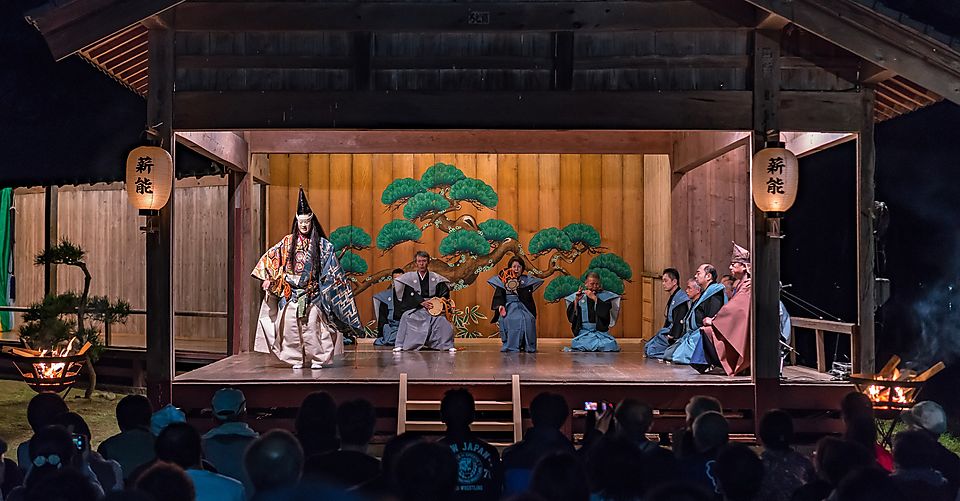
Simplicity and elegance permeate the stage during a noh performance. Stories are portrayed on a plain, square stage lacking in props and large set pieces — a minimalistic setting to fully engage the audience.
Noh is the oldest of the three main types of Japanese theatre, with kabuki and bunraku being the other two forms. It distinguishes itself from its modern counterpart kabuki through its traditional acting style. Originating in the 14th century, noh owes much of its heritage to Zeami: the Shakespeare of Japanese theatre, who was responsible for developing and popularising the form during the Muromachi Period (1336–1573). Noh is performed by specialised troupes, five of which have existed since the Tokugawa Period (1603–1868) and remain active today.1
These troupes incorporate music, dance and poetic narratives to depict tales of legend and history, with an emphasis on the supernatural. The principal actor, or shite, usually plays a supernatural character such as a spirit or demon. The shite is the only actor to wear a mask — a crucial feature in noh theatre — to convey to the audience the identity of the character he represents. These masks are skilfully crafted from cypress wood so that the actor can display a variety of expressions by altering the angle of the mask.2
The uniqueness of the entertainment coupled with skilful performances has helped this centuries-old art form to survive in the competitive modern landscape.
Noh is the oldest of the three main types of Japanese theatre, with kabuki and bunraku being the other two forms. It distinguishes itself from its modern counterpart kabuki through its traditional acting style. Originating in the 14th century, noh owes much of its heritage to Zeami: the Shakespeare of Japanese theatre, who was responsible for developing and popularising the form during the Muromachi Period (1336–1573). Noh is performed by specialised troupes, five of which have existed since the Tokugawa Period (1603–1868) and remain active today.1
These troupes incorporate music, dance and poetic narratives to depict tales of legend and history, with an emphasis on the supernatural. The principal actor, or shite, usually plays a supernatural character such as a spirit or demon. The shite is the only actor to wear a mask — a crucial feature in noh theatre — to convey to the audience the identity of the character he represents. These masks are skilfully crafted from cypress wood so that the actor can display a variety of expressions by altering the angle of the mask.2
The uniqueness of the entertainment coupled with skilful performances has helped this centuries-old art form to survive in the competitive modern landscape.